
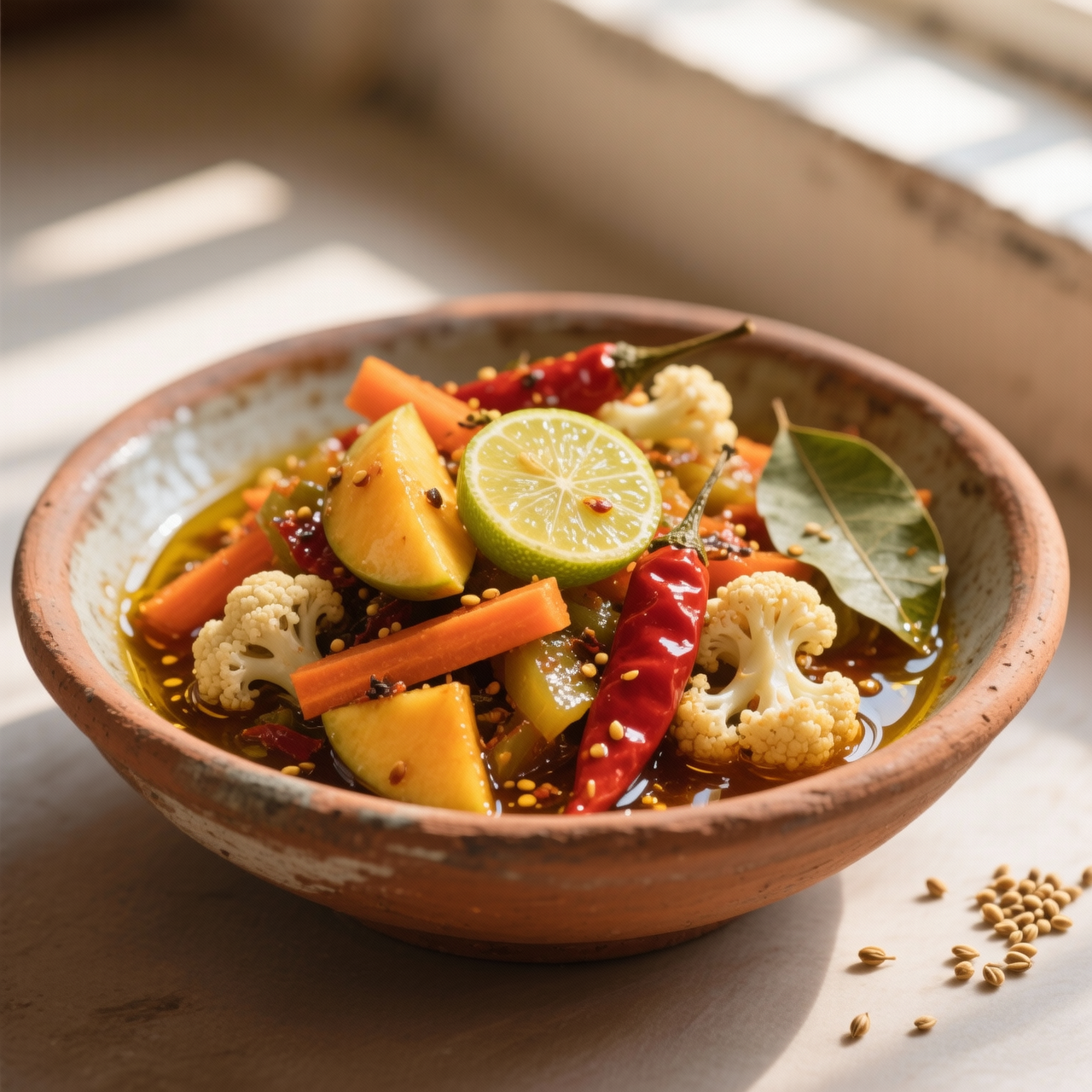
Achar (Mixed Pickle)
When I first learned to make achar in my grandmother’s sunlit courtyard in Lahore, I didn’t realize I was participating in a centuries-old act of preservation and patience. Pakistani mixed pickle isn’t just a condiment; it is a living archive of harvest seasons, traded spices, and family memory. The base typically begins with raw mustard oil, which we fiercely heat to remove its pungent bite before letting it cool just enough to coax the whole spices awake. Turmeric, fennel, fenugreek, and crushed red chilies form the aromatic backbone, while seasonal vegetables like carrots, cauliflower, green mango, and radish provide crunch and earthy sweetness. What makes this recipe matter to me is its absolute refusal to rush. True achar demands weeks of quiet maturation, resting in tightly sealed glass jars where the oil slowly penetrates the vegetables and the sharp spices mellow into a harmonious, tangy heat. I have watched countless home cooks stumble at the very first hurdle: moisture. Even a single drop of water on a stirring spoon or a damp cutting board invites mold to bloom overnight, instantly ruining months of careful work. Another frequent mistake is underestimating the oil ratio or skipping the initial tempering, which leaves the final product tasting harsh and grassy rather than rich and deeply layered. Some try to shortcut the curing process by adding commercial vinegar, but that strips away the traditional slow-oxidation character that defines a proper Pakistani pickle. When you finally crack a mature jar open, the oil will have deepened to a brilliant coppery red, the vegetables will yield slightly under a gentle press, and the aroma should instantly transport you to a bustling kitchen. That profound sensory shift is the true reward of patience.
Nutrition
| Per serving | Calories | Protein | Carbs | Fat | Sat fat | Fibre | Sugar | Sodium |
|---|---|---|---|---|---|---|---|---|
| beginner | 85kcal | 1g | 2g | 9g | 1g | 2g | 1g | 280mg |
| intermediate | 65kcal | 1g | 4g | 5g | 1g | 2g | 2g | 950mg |
| expert | 145kcal | 2g | 8g | 12g | 2g | 3g | 4g | 850mg |
Per serving · Ava-estimated — a guide, not a clinical figure.
- 500 gunripe mango— washed, thoroughly dried, and cut into pieces
- 200 gcarrot— peeled and cut into batons
- 150 gturnip— peeled and cut into wedges
- 150 gcauliflower— separated into small florets and dried
- 100 ggreen chili— slit lengthwise
- 50 ggarlic clove— peeled and left whole
- 750 mlmustard oil— heated until smoking then cooled completely
- 30 gmustard seed— whole
- 20 gfennel seed— whole
- 15 gfenugreek seed— whole
- 10 gnigella seed— whole
- 15 gturmeric powder
- 25 gred chili powder
- 40 gsalt— non-iodized
- 2 gasafoetida— powdered
This beginner-friendly version of traditional Pakistani achar removes the intimidation factor by swapping labor-intensive spice grinding for high-quality jarred paste and pre-mixed spice blends. Instead of toasting and milling whole seeds, you will rely on a ready-made achaar masala to guarantee authentic flavor without the guesswork. The focus here is strictly on moisture control and safe oil tempering, which are the most critical steps for a shelf-stable pickle that matures properly over several weeks. Watch closely when heating the mustard oil; it must reach a gentle shimmer and completely lose its raw, pungent aroma before the spices are added, otherwise the final product will taste unpleasantly bitter. Keep the heat strictly at medium-low when incorporating your chopped vegetables to prevent scorching the paste, and never rush the cooling process before jarring. Thoroughly sterilizing your storage containers is absolutely non-negotiable, as even a single drop of residual water can introduce harmful bacteria. By following this streamlined approach, you will confidently craft a vibrant, tangy condiment with zero prior fermentation experience, ready to brighten any meal after just a brief resting period.
Equipment
- 16-oz glass jar— must be thoroughly dried and sterilized
- Wooden spoon— prevents scratching and chemical reactions with metal
- Small saucepan— for gently warming the oil
Method
- 1
Sterilize your glass jars and lids by boiling them in water for ten minutes, then place them upside down on a clean towel to air-dry completely.
Any trapped moisture will ruin the fermentation.
sterilizing~ 10 minTricky bit - 2
Pour the mustard oil into a small saucepan and heat over medium-low until it reaches a gentle shimmer and loses its raw, pungent aroma.
Do not let the oil smoke.
tempering~ 3 minTricky bit - 3
Stir in the jarred pickle paste and cook for ninety seconds until fragrant.
Keep the heat low to prevent scorching.
blooming~ 2 min - 4
Remove the pan from the heat and gently fold in your pre-cut mixed vegetables until every piece is evenly coated in the spiced oil.
Allow the mixture to cool to room temperature before jarring.
macerating~ 5 minTricky bit - 5
Pack the cooled mixture tightly into your sterilized jars, wipe the rims clean, and seal with the lids.
Store in a cool, dark pantry to mature.
packing~ 2 min
Storage times are a guide — always use your judgement and store food safely.