
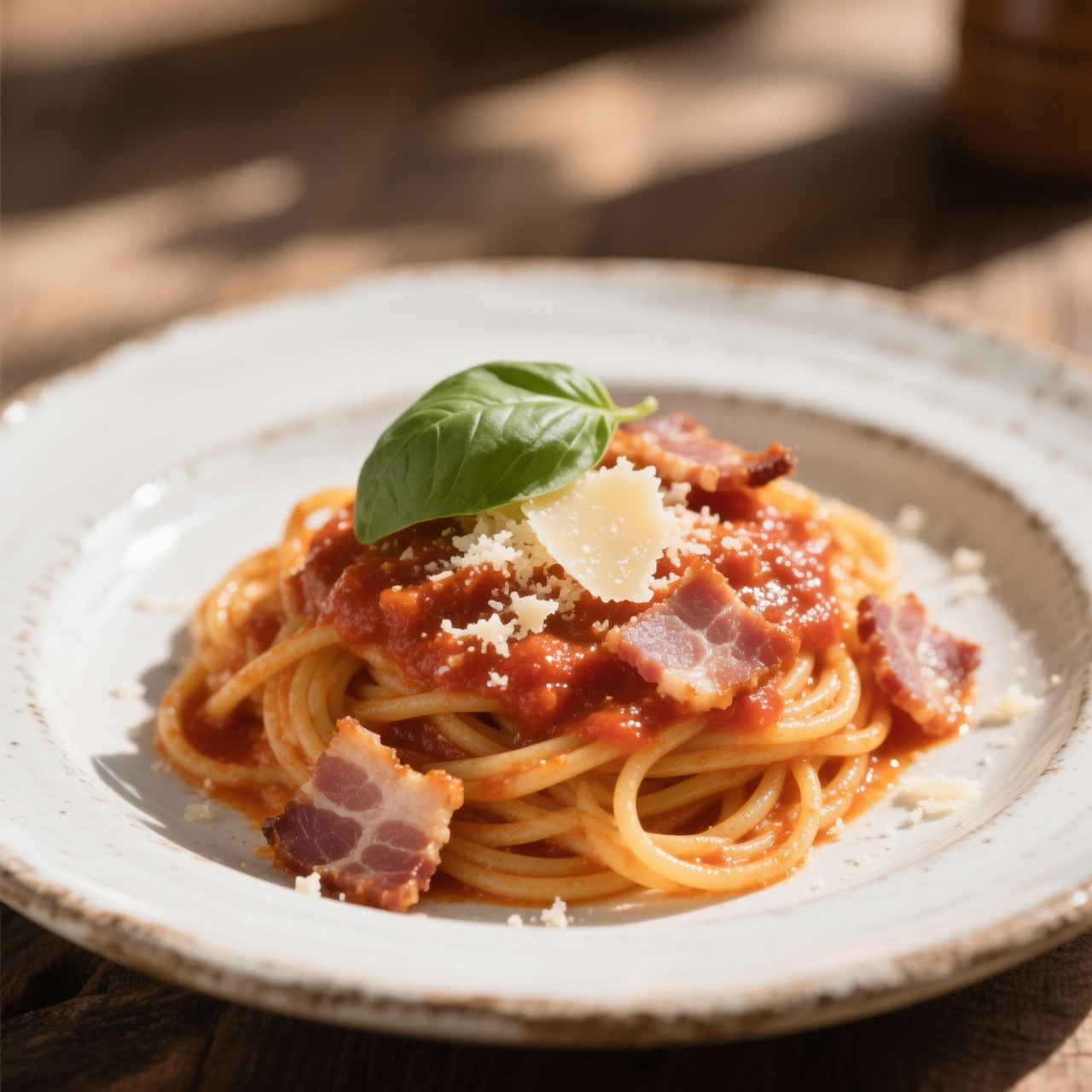
Amatriciana sauce
When I first encountered amatriciana in a sun-drenched trattoria near the Apennines, I understood immediately why it’s considered a cornerstone of Roman cooking. Born in the mountain town of Amatrice in Lazio, this sauce began as a practical meal for shepherds who carried aged pecorino, dried pasta, and preserved pork through long grazing seasons. Over time, it migrated to Rome, where tomatoes were introduced and the recipe crystallized into the triumvirate we know today. What makes amatriciana matter isn’t its complexity, but its ruthless precision. There’s nowhere to hide when you’re working with only four core ingredients. The guanciale must render slowly until its fat turns translucent and its edges crisp, providing a deep, savory foundation that pancetta simply cannot replicate. The tomatoes should be bright and lightly simmered, just enough to marry with the pork fat without turning into a jam. And the pecorino Romano? It’s the final anchor, folded in off the heat to avoid breaking. The most common pitfalls I see in home kitchens are entirely born of impatience or overcomplication. People rush the guanciale until it turns brittle, add garlic or onions because they assume every Italian sauce needs an aromatic base, or drown the tomatoes in heavy wine. Others stir in cheese over direct heat, watching it curdle into a grainy mess. True amatriciana is an exercise in restraint. Respect the ingredients, control the temperature, and let the sauce speak for itself. When you get it right, you taste centuries of pastoral tradition in a single bowl.
Nutrition
| Per serving | Calories | Protein | Carbs | Fat | Sat fat | Fibre | Sugar | Sodium |
|---|---|---|---|---|---|---|---|---|
| beginner | 365kcal | 15g | 10g | 31g | 12g | 3g | 8g | 710mg |
| intermediate | 245kcal | 11g | 9g | 19g | 8g | 3g | 6g | 650mg |
| expert | 420kcal | 17g | 9g | 34g | 13g | 2g | 5g | 920mg |
Per serving · Ava-estimated — a guide, not a clinical figure.
- 200 gguanciale— Cut into 1 cm thick strips or cubes
- 400 gcanned peeled tomato— Preferably San Marzano, crushed by hand
- 60 gpecorino romano cheese— Freshly grated, reserve half for garnish
- 2 gdried chili pepper— Crushed or whole flakes, adjust to heat preference
This beginner-friendly Amatriciana sauce prioritizes confidence over strict tradition, using accessible shortcuts to deliver bold flavor without the intimidation factor. While traditional recipes call for slicing and rendering slab guanciale, beginners should simply purchase pre-cubed, vacuum-sealed guanciale and a jar of high-quality crushed tomatoes to streamline prep. The key is patient, low-and-slow cooking: gently warm the cured pork in a heavy pan until it releases its fat, then add your tomatoes and let everything simmer until the oil separates on the surface. Watch for a deep, rust-colored hue and a thickened consistency that coats a spoon. If the sauce looks too dry, splash in a little reserved pasta water to loosen it up. Don't stress about perfect balance on your first attempt; simply season with freshly cracked black pepper, stir in grated Pecorino Romano off the heat to prevent clumping, and taste before adjusting salt. This approach removes the guesswork, ensuring a rich, comforting sauce that still honors the original Roman flavors while giving you a reliable technique foundation to build upon later.
Equipment
- Heavy-bottomed skillet— Stainless steel or cast iron works best for even heat distribution
- Wooden spoon— For gentle stirring to avoid breaking down the tomatoes too quickly
- Fine grater(optional)— For fresh Pecorino Romano
Method
- 1
Place the pre-cubed guanciale in a cold heavy-bottomed skillet and turn the heat to medium-low.
Starting cold helps render the fat slowly without scorching the edges.
cold rendering~ 7 min - 2
Add the jarred crushed tomatoes directly to the pan once the pork looks translucent and glossy.
The residual fat will instantly sizzle, carrying the meat flavor into the tomatoes.
simmering~ 1 min - 3
Reduce heat to low and let the sauce bubble gently until it thickens and oil pools on the surface.
Stir occasionally; if it splatters, cover loosely with a lid for a few minutes.
reduction~ 15 min - 4
Remove the pan from heat and fold in the grated cheese and freshly cracked pepper.
Adding cheese off-heat prevents it from seizing into rubbery clumps.
finishing~ 1 minTricky bit
Cooking from frozen
Thaw overnight in the fridge and reheat gently on the stove with a splash of water to restore consistency.
Storage times are a guide — always use your judgement and store food safely.