
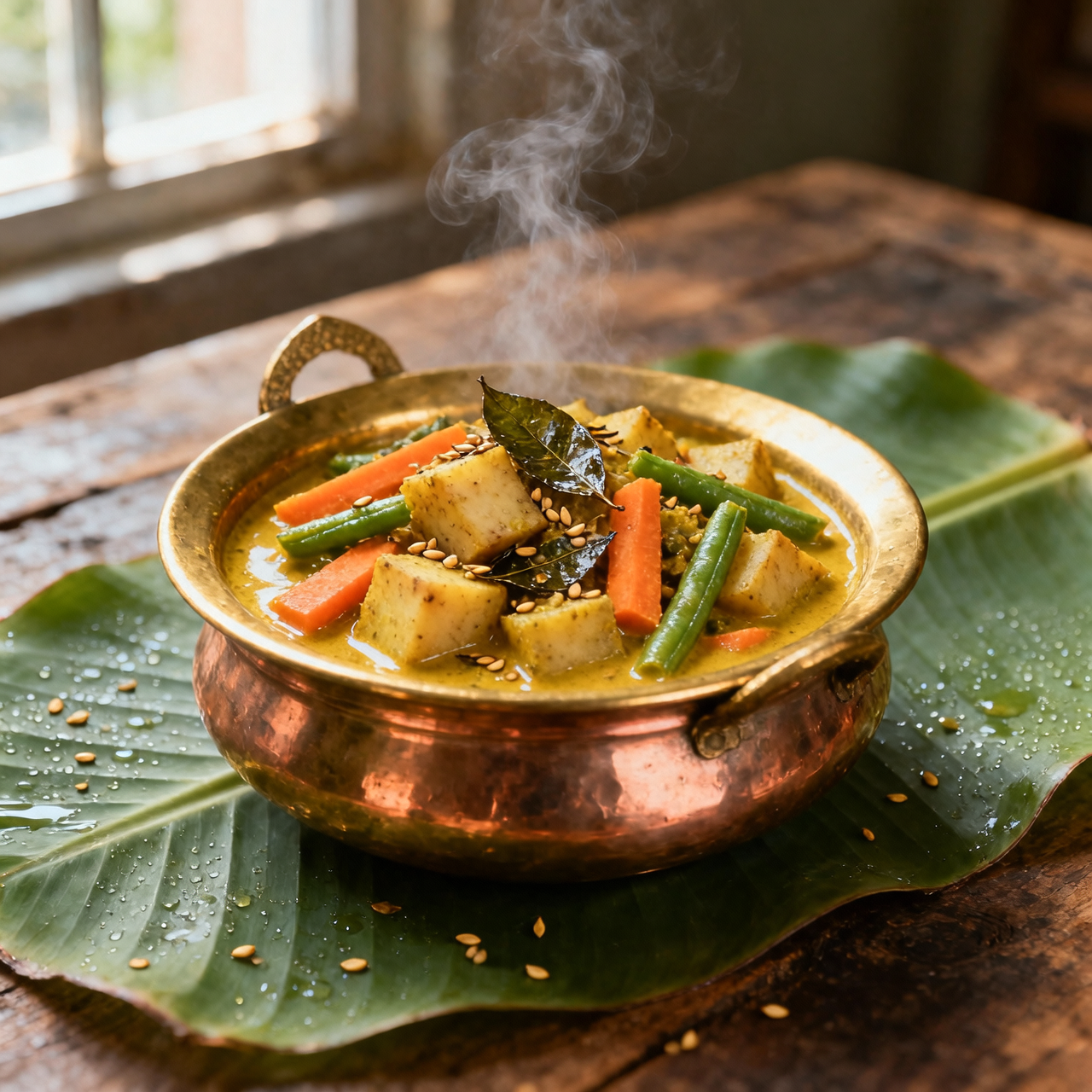
Avial
When I first learned to make Avial in my grandmother’s kitchen in Kerala, I quickly realized it was less a recipe and more a philosophy of balance. Born from the ancient culinary traditions of the Malabar coast, this dish was historically designed to transform whatever seasonal vegetables were available into a harmonious, nourishing centerpiece, traditionally served during the Onam feast. For me, it matters deeply because it embodies the quiet elegance of South Indian vegetarian cooking, where nothing is wasted and every ingredient is allowed to shine without dominating. The magic lies in the marriage of tender root vegetables, drumsticks, and raw banana with a freshly ground coconut paste, all gently simmered until they surrender their individual textures into a cohesive whole. Yet, so many stumble along the way. The most frequent mistake I see is rushing the simmer, which leaves the vegetables stubbornly firm or turns the gravy into a mush. Others drown the dish in heavy spices, forgetting that Avial thrives on subtlety. Turmeric should only tint, not shout, and green chilies must whisper rather than burn. Perhaps the greatest pitfall, especially when adapting it to a strictly vegan kitchen, is neglecting the coconut emulsion. If the paste is not blended to a silky, thick consistency or if the pan is too hot when you stir it in, the sauce will split and turn grainy. I always remind myself to treat it patiently, folding in the final tempering of mustard seeds and curry leaves only when the pot is pulled from the flame. Done right, it tastes like monsoon rain and home.
Nutrition
| Per serving | Calories | Protein | Carbs | Fat | Sat fat | Fibre | Sugar | Sodium |
|---|---|---|---|---|---|---|---|---|
| beginner | 446kcal | 8g | 48g | 25g | 16g | 12g | 13g | 1020mg |
| intermediate | 446kcal | 8g | 48g | 25g | 16g | 12g | 13g | 1020mg |
| expert | 446kcal | 8g | 48g | 25g | 16g | 12g | 13g | 1020mg |
Per serving · Ava-estimated — a guide, not a clinical figure.
- 200 gyam— elephant foot variety, peeled and cubed uniformly
- 150 gplantain— raw, firm, peeled and cubed
- 150 gbean— French type, trimmed and halved
- 100 gcarrot— peeled and cut into batons
- 100 gmango— raw green, peeled and diced
- 200 gcoconut— mature, freshly grated or shredded
- 3 pieceschili— green, slit lengthwise
- 4 gcumin— whole seeds
- 5 gturmeric— ground powder
- 10 gsalt— fine sea salt
- 30 mloil— coconut oil, unrefined preferred
- 4 gmustard— black seeds
- 10 gleaf— curry leaves, fresh, rinsed and dried
- 100 mlmilk— coconut, unsweetened and full-fat
This version prioritizes accessibility without sacrificing the dish’s core identity. You will use a high-quality jarred coconut-chili paste instead of grinding spices from scratch, and pre-cut vegetables can be substituted if needed. The key is gentle heat management. Because commercial pastes often contain stabilizers, they can scorch quickly if the pot runs dry. Keep a small bowl of warm water nearby to adjust consistency, and stir only when necessary to prevent breaking the vegetables. Watch for the moment the oil begins to pool at the surface during the final simmer; this signals the paste has properly emulsified. Do not rush the vegetable staging. Add harder roots first, letting them soften before introducing delicate greens. The goal is a cohesive, spoon-coating texture where each vegetable remains distinct but fully infused with the coconut base. Trust the low simmer, and let the raw mango provide the necessary brightness without needing additional acids. This pathway guarantees a confident first attempt while honoring the dish’s comforting essence.
Equipment
- Heavy-bottomed pan— non-stick coating is fine here
- Measuring cups— for liquid adjustment
Method
- 1
Bring a large pot of salted water to a rolling boil.
Water should taste lightly of the sea.
boiling~ 5 min - 2
Add yam and plantain to the pot and reduce to a gentle simmer.
Cover partially to retain moisture.
simmering~ 8 min - 3
Stir in bean, carrot, and mango once the roots begin to soften.
Vegetables should still hold firm edges.
staging~ 3 minTricky bit - 4
Drain the vegetables, reserving half a cup of the cooking liquid.
Do not discard the starchy water.
straining~ 1 min - 5
Return vegetables to the pan over medium heat and fold in coconut, chili, cumin, turmeric, salt, and milk.
Use jarred paste if substituting fresh grind.
folding~ 2 min - 6
Simmer until the sauce thickens and coats the back of a spoon.
Oil will visibly separate at the edges when ready.
reducing~ 5 minTricky bit - 7
Heat oil in a small skillet until shimmering.
Test with a single mustard seed to gauge heat.
heating~ 1 min - 8
Add mustard and leaf to the hot oil until they crackle and release aroma.
Remove from heat immediately after popping.
tempering~ 1 minTricky bit - 9
Pour the tempered mixture over the vegetables and remove from heat.
Let it rest covered for two minutes.
resting~ 2 min