
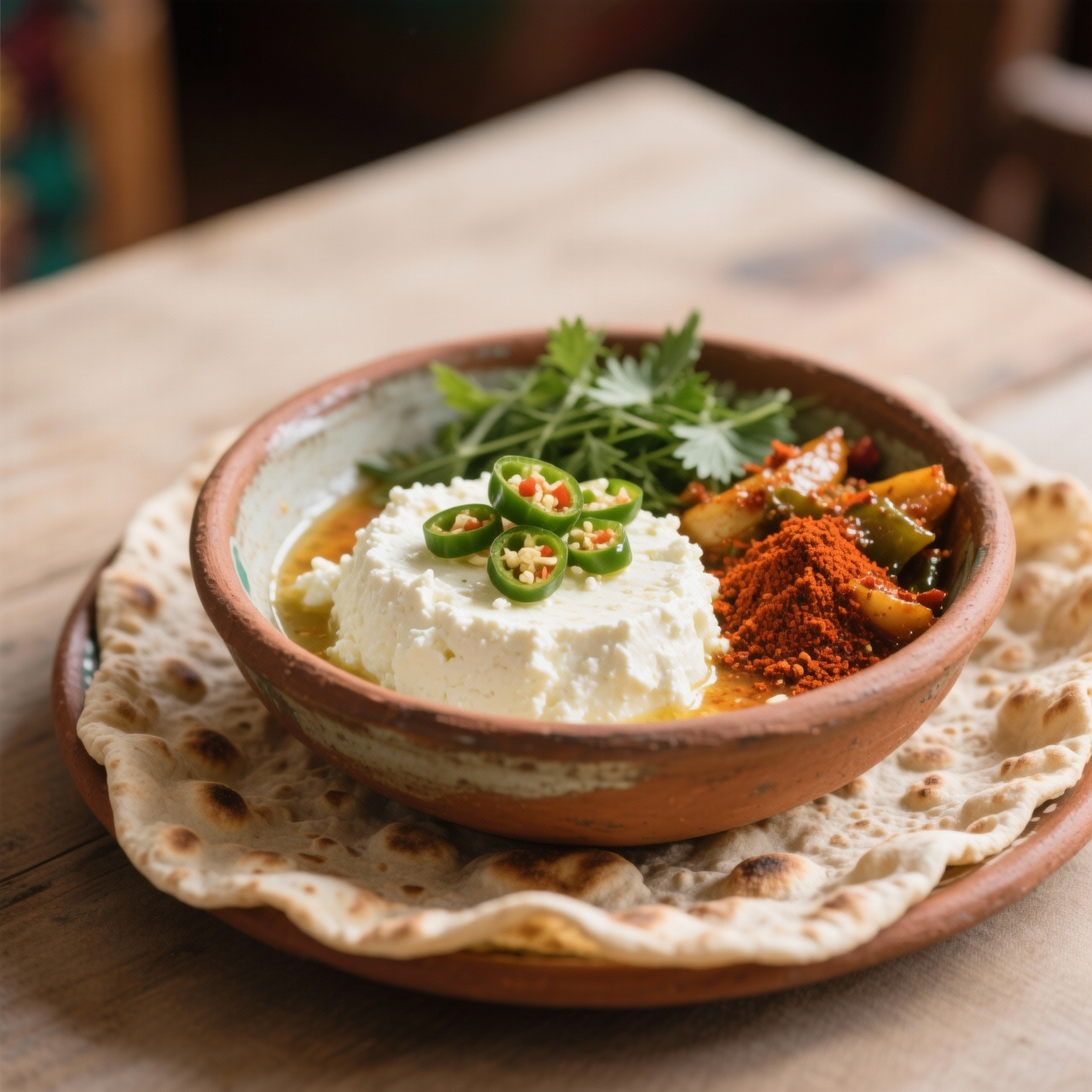
Ayib (Ethiopian cottage cheese)
I’ve always believed that the quietest components on a plate often carry the most weight, and nowhere is that truer than with ayib. Born in the highlands of Ethiopia, this fresh, unripened cheese has long served as the essential cooling counterpoint to fiercely spiced wats and richly simmered stews. It’s a preparation that demands patience over complexity, relying entirely on the gentle alchemy of steady heat, whole milk, and a measured splash of citrus. What makes it matter so deeply to me is how it strips dairy down to its honest, unadorned essence, yielding a bright, crumbly texture that melts on the tongue while instantly tempering the aggressive burn of berbere and niter kibbeh. Yet, so many home cooks stumble at the very first step. The most frequent pitfalls are rushing the temperature, which yields rubbery, squeaky curds, and using too much acid, which leaves a harsh metallic tang instead of a clean lactic sweetness. You must also resist the urge to vigorously stir once the whey separates; the curds need quiet, undisturbed time to set before you gently ladle them into a cheesecloth to drain. I’ll admit, grabbing a plastic tub of commercial cottage cheese from the supermarket aisle might seem faster. Those usually run about four dollars, but they are heavily processed with gums, unevenly salted, and completely stripped of the delicate, grassy milk character that makes authentic ayib sing. When you heat fresh milk to just shy of boiling, coax it to split with careful precision, and let gravity do its slow work, you are left with a pure, pantry-staple triumph. It costs mere pennies, requires under an hour of hands-on attention, and rewards you with a cheese that truly belongs on a proper Ethiopian table.
Nutrition
| Per serving | Calories | Protein | Carbs | Fat | Sat fat | Fibre | Sugar | Sodium |
|---|---|---|---|---|---|---|---|---|
| beginner | 110kcal | 11g | 4g | 6g | 4g | 0g | 3g | 160mg |
| intermediate | 125kcal | 8g | 5g | 8g | 5g | 0g | 4g | 85mg |
| expert | 145kcal | 11g | 4g | 9g | 6g | 0g | 3g | 110mg |
Per serving · Ava-estimated — a guide, not a clinical figure.
- 1000 mlWhole milk— Full-fat milk yields the best texture and curd yield
- 45 mlLemon juice— Can substitute with white vinegar or traditional ergo
- 5 gSalt— Fine sea salt
This beginner-friendly approach to Ayib strips away the traditional waiting-for-natural-sourness step and uses a reliable, controlled acid-set method that guarantees success on your first try. Instead of relying on spontaneous fermentation, we gently warm whole milk to a precise temperature before introducing fresh lemon juice, ensuring consistent, tender curds every time. The process is streamlined into fewer steps with more forgiving timing, making it ideal for home cooks who want authentic texture without the guesswork. Watch closely during the heating phase—scalding the milk will make the cheese rubbery, so keep the heat low and steady. When the lemon juice hits, you will see the whey separate almost immediately; resist the urge to stir vigorously, as gentle folding preserves the delicate, crumbly structure that cools fiery wats perfectly. While shop-bought cottage cheese or ricotta runs about $4–$6 per container and often contains added stabilizers, gums, and excess sodium, this 30-minute from-scratch version yields a cleaner, milky flavor and a lighter mouthfeel for a fraction of the cost. The result is a fresh, uncomplicated cheese that delivers the authentic Ethiopian cooling element with minimal fuss.
Equipment
- Heavy-bottomed pot— Stainless steel or enamel prevents scorching
- Instant-read thermometer(optional)— Highly recommended for precise temperature control
- Fine-mesh colander— Must securely hold the cheesecloth
- Cheesecloth— Pre-dampen to prevent curd adhesion
Method
- 1
Pour whole milk into a heavy-bottomed pot and warm over medium-low heat.
Stir occasionally to prevent a skin from forming on the surface.
scalding~ 5 min - 2
Heat until the milk reaches 180°F or small bubbles form around the edges, then immediately remove from heat.
Do not let it boil, or the curds will become rubbery.
temperature_monitoring~ 1 minTricky bit - 3
Stir in fresh lemon juice and salt, then let the pot sit completely undisturbed.
The whey will turn translucent as the acid sets the milk proteins.
curdling~ 8 min - 4
Line a fine-mesh colander with damp cheesecloth and gently scoop the solid curds into it.
Pour slowly to avoid splashing and breaking up the delicate clumps.
draining~ 2 min - 5
Gather the cloth corners, twist gently to expel excess liquid, and let drain for 15 minutes.
Stop squeezing once the cheese holds its shape but remains moist and crumbly.
pressing~ 4 minTricky bit
Storage times are a guide — always use your judgement and store food safely.