
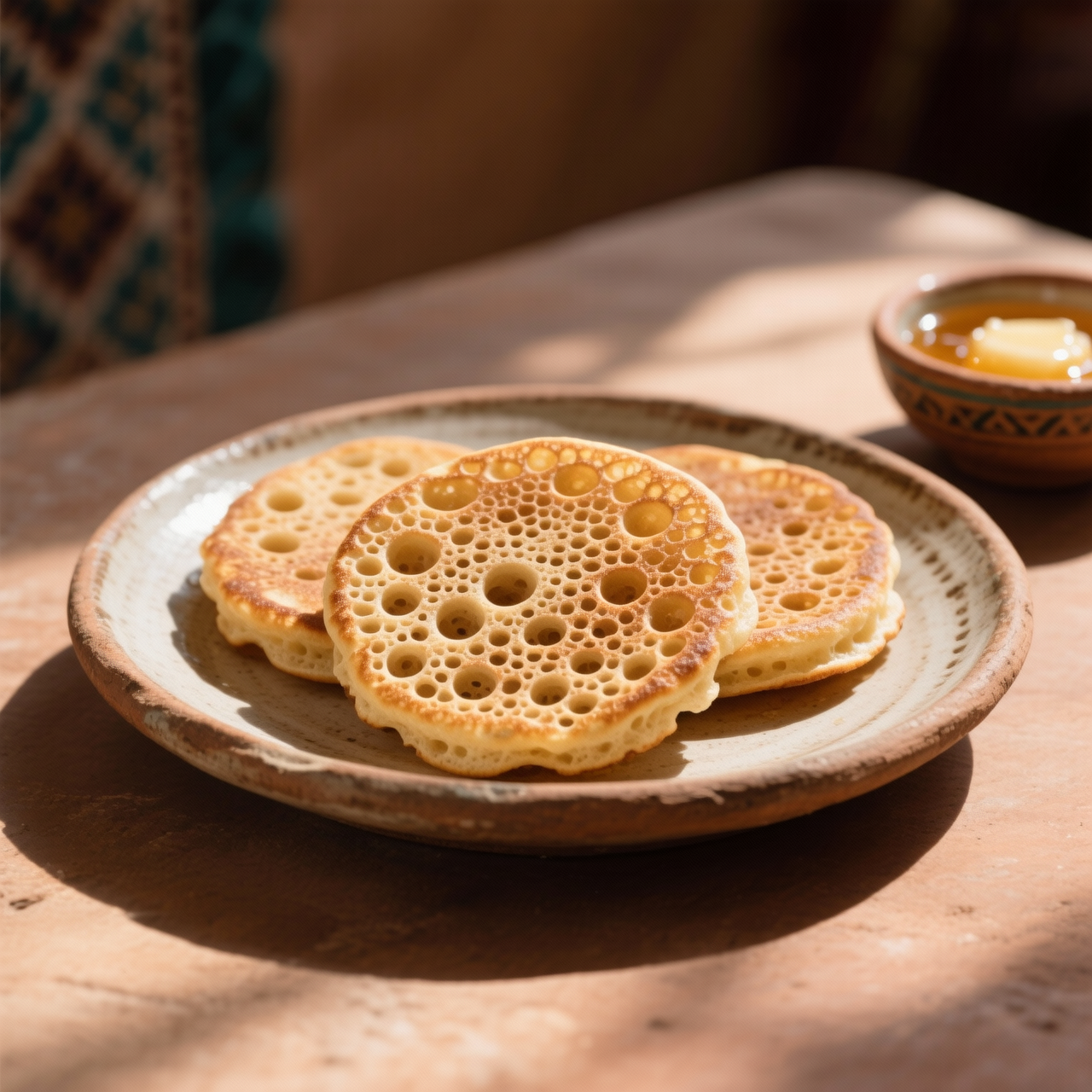
Baghrir (thousand-hole pancakes)
I first discovered baghrir in a sunlit Marrakech courtyard, where a steady stream of spongy, honey-drizzled pancakes landed on the breakfast table. These thousand-hole pancakes are the soul of Moroccan mornings, built entirely from fine semolina, yeast, and water, relying on a slow fermentation to create their signature porous crumb. They matter because they turn the simplest pantry staples into something profoundly alive, a perfect vegan vehicle for melted butter or warm syrup that commercial alternatives simply cannot replicate. You can easily buy a plastic-wrapped pack of supermarket crumpets for about two dollars, but they are fundamentally different: dense, uniformly flat, and leavened with chemical raising agents that leave a metallic tang. Worse, they lack the delicate, nutty depth of properly fermented semolina and rely on preservatives to maintain shelf stability. Making baghrir from scratch isn’t just about ditching the processed aisle; it’s about reclaiming a living dough. The most common pitfall is rushing the fermentation or overmixing the batter once the yeast wakes up. If you stir too vigorously after the first rise, you’ll knock out the gas pockets and lose those signature holes. Another mistake is cooking on a pan that’s too hot or too greased; baghrir must only cook on one side in a dry or lightly oiled surface, left untouched until the top dries and the bubbles burst open. Give the batter time, keep the heat gentle, and you’ll achieve that ethereal, lace-like texture that makes packaged crumpets feel entirely obsolete.
Nutrition
| Per serving | Calories | Protein | Carbs | Fat | Sat fat | Fibre | Sugar | Sodium |
|---|---|---|---|---|---|---|---|---|
| beginner | 210kcal | 6g | 36g | 4g | 1g | 3g | 1g | 180mg |
| intermediate | 245kcal | 7g | 47g | 2g | 0g | 4g | 3g | 350mg |
| expert | 205kcal | 6g | 35g | 5g | 0g | 2g | 1g | 295mg |
Per serving · Ava-estimated — a guide, not a clinical figure.
- 300 gsemolina— Extra-fine grain yields the best texture
- 100 gall-purpose flour— Sifted before mixing
- 7 gactive dry yeast— Approximately 2 1/4 teaspoons
- 10 gbaking powder— Essential for the porous honeycomb texture
- 5 gsalt— Fine sea salt
- 15 gsugar— Helps activate the yeast
- 750 mlwater— Lukewarm, approximately 35C
Store-bought crumpets cost roughly $0.75 each and rely on chemical leaveners, added sugars, and preservatives to mimic that signature spongy texture and holey surface. This beginner-friendly Baghrir replaces them with a simple, entirely from-scratch semolina batter that relies on natural yeast fermentation. The process skips complex kneading or precise temperature control; instead, you simply whisk fine semolina, water, yeast, salt, and baking soda until smooth, then let it rest. The key to success here is patience during the resting phase, which allows the yeast to activate and the semolina to fully hydrate, creating the batter’s signature frothy consistency. Watch the batter closely before cooking: it should resemble thick, bubbly pancake batter and smell faintly yeasty. If it looks too dense, whisk in a tablespoon of warm water. Cook only on one side in a lightly oiled non-stick pan over medium-low heat. You will see hundreds of tiny holes open as it cooks, which is exactly what you want. Flip is never required. The result is a tender, slightly tangy pancake that soaks up honey or butter beautifully, proving that authentic Moroccan breakfasts are just as achievable as supermarket staples.
Equipment
- Large non-reactive mixing bowl— glass or stainless steel works best
- Whisk or hand blender(optional)— hand blender guarantees a perfectly smooth batter
- Non-stick skillet— heavy-bottomed or cast iron, lightly seasoned
Method
- 1
Dissolve the active dry yeast in warm water and let it sit until frothy.
Water should be comfortably warm to the touch, not hot.
blooming~ 5 min - 2
Whisk the fine semolina and salt into the yeast mixture until the batter is completely smooth.
A few small bubbles at this stage indicate early fermentation.
whisking~ 2 min - 3
Cover the bowl and let the batter rest at room temperature until it doubles in volume and looks highly aerated.
Do not skip this step, as hydration creates the pancake structure.
proofing~ 60 min - 4
Stir the baking soda into the rested batter just before you heat your pan.
This final addition triggers the rapid gas release that forms the signature holes.
activating~ 1 min - 5
Heat your lightly oiled non-stick skillet over medium-low heat until a test drop of batter sizzles immediately.
Too much heat will seal the surface before the holes can open.
preheating~ 3 min - 6
Pour a quarter cup of batter into the pan and cook undisturbed until the top looks matte and dry.
Never flip baghrir; they are designed to cook on one side only.
pan-frying~ 3 minTricky bit - 7
Slide the cooked pancake onto a wire rack and cover the stack loosely with a clean towel while you finish the batch.
Stacking keeps the pancakes pliable and prevents them from drying out.
resting~ 1 min
Cooking from frozen
Toast straight from frozen or microwave briefly, then finish under a hot grill to restore the signature porous surface.
Storage times are a guide — always use your judgement and store food safely.