
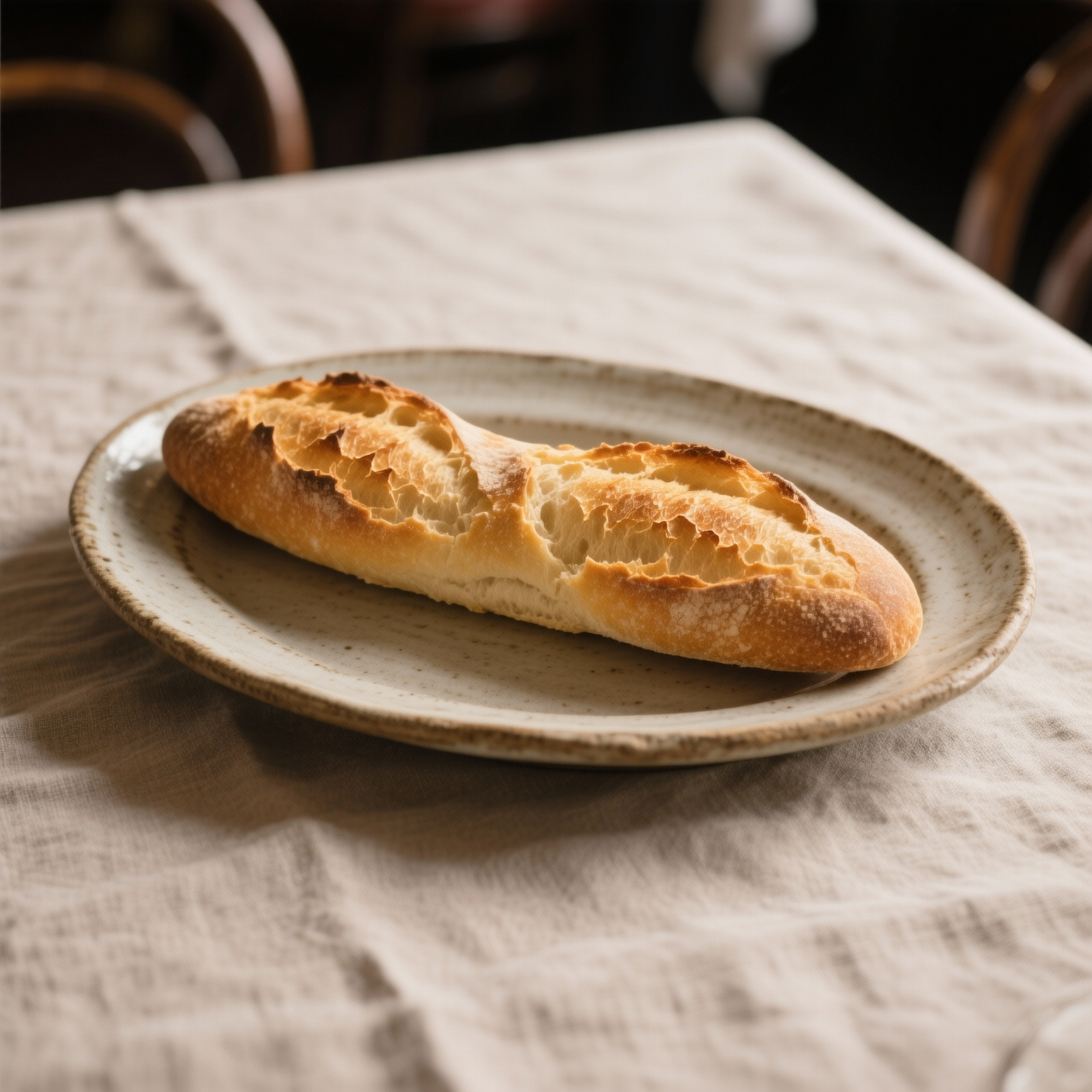
Baguette
There is a quiet magic in pulling a properly baked baguette from the oven, and I have spent years chasing it. Born on the streets of France in the early twentieth century, the traditional loaf was never meant to be a factory product. It was designed to be eaten fresh, its crust shattering at the slightest pressure while the interior breathes with an open, irregular crumb. Today, most supermarket loaves cost around two dollars or pounds, yet they arrive wrapped in plastic, padded with preservatives, and stripped of the fermentation that gives real bread its character. They stale within hours, leaving behind a dense, gummy texture that barely justifies the price. Making your own requires nothing but flour, water, salt, and yeast, but it demands a shift in mindset. You are not assembling ingredients; you are coaxing life into a living dough. The most common pitfall I see is rushing the process. Bakers try to force the rise, skip the gentle folds, or slash the dough with a timid hand, resulting in tight, dense loaves with pale, unyielding crusts. A true baguette needs time to develop flavour and structure, along with steam in the oven to achieve that signature glossy, crackling exterior. When you bake from scratch, you trade convenience for a deeply satisfying ritual. The result is entirely plant-based, completely transparent in its ingredients, and infinitely superior to anything you will ever find on a grocery shelf. It is best enjoyed the day it is baked, while the crust still sings and the centre remains tender, a simple loaf that reminds you why bread was invented in the first place.
Nutrition
| Per serving | Calories | Protein | Carbs | Fat | Sat fat | Fibre | Sugar | Sodium |
|---|---|---|---|---|---|---|---|---|
| beginner | 325kcal | 13g | 66g | 2g | 0g | 3g | 1g | 520mg |
| intermediate | 335kcal | 10g | 71g | 1g | 0g | 3g | 0g | 780mg |
| expert | 340kcal | 12g | 68g | 2g | 0g | 3g | 1g | 450mg |
Per serving · Ava-estimated — a guide, not a clinical figure.
- 500 gBread flour— High-protein flour yields the best chew and crust
- 350 mlWater— Lukewarm to activate yeast
- 5 gInstant yeast— Can be substituted with fresh yeast
- 10 gFine sea salt— Do not let yeast directly contact undissolved salt
This beginner-friendly approach strips away the intimidating poolish pre-ferments and complex hydration calculations of traditional French baking, delivering a reliable straight-dough method that fits into a standard evening schedule. Instead of wrestling with wet, sticky dough, you will use a slightly lower hydration ratio that stays manageable on your countertop, allowing for straightforward folding and a forgiving proof. Watch for the dough to spring back slowly when poked—this tactile cue replaces precise timers and guarantees you bake at the perfect moment. A quick oven-steam trick using a simple roasting pan replaces professional deck ovens, ensuring you still get that signature crackling crust. Shop-bought baguettes typically cost around three dollars but rely on dough conditioners, artificial preservatives, and rapid commercial yeasting that sacrifices depth of flavour and creates a gummy, cottony crumb. By making this from scratch with just four basic pantry ingredients, you bypass the additives entirely, control the exact salt level, and enjoy a genuinely crisp crust and open, chewy interior that truly elevates simple meals. The technique is designed to build muscle memory, so your second loaf will already outshine any bakery shelf option.
Equipment
- Large mixing bowl— ceramic or stainless steel preferred
- Baking sheet— heavy gauge prevents warping under high heat
- Razor blade or sharp paring knife— essential for clean crust scoring
- Small metal roasting pan— placed on bottom rack to generate steam
Method
- 1
Dissolve the instant yeast in lukewarm water in a large mixing bowl until fully dispersed.
Water should feel like bathwater, not hot to the touch.
hydrating~ 1 min - 2
Stir in the bread flour and salt until a shaggy mass forms, then rest the uncovered bowl for twenty minutes.
This resting phase hydrates the gluten network before any kneading.
autolyse_rest~ 20 min - 3
Turn the dough onto a lightly floured surface and knead firmly for eight minutes until it becomes smooth and slightly tacky.
Push with the heel of your hand and fold the dough back over itself repeatedly.
kneading~ 8 min - 4
Place the dough back into a lightly oiled bowl, cover with a damp cloth, and leave in a warm spot until doubled in volume.
A draft-free corner or turned-off oven with the light on works perfectly.
bulk_fermentation~ 60 min - 5
Gently deflate the dough, divide it into two equal pieces, and roll each piece tightly into a long cylinder before pinching the final seam closed.
Tension on the surface is key to achieving an elongated loaf rather than a round one.
shaping~ 5 minTricky bit - 6
Let the shaped loaves rest for thirty minutes on a prepared baking sheet, then slash the tops diagonally with a sharp knife.
Hold the blade at a shallow forty-five degree angle for maximum oven spring.
scoring~ 3 min - 7
Slide a pan of hot water onto the bottom rack of your preheated oven, place the baking sheet on the middle rack, and bake until deeply golden.
Remove the water pan for the final five minutes to crisp the crust completely.
steam_baking~ 25 min
Cooking from frozen
Thaw completely at room temperature, then crisp in a hot oven for five minutes to restore the crust.
Storage times are a guide — always use your judgement and store food safely.