
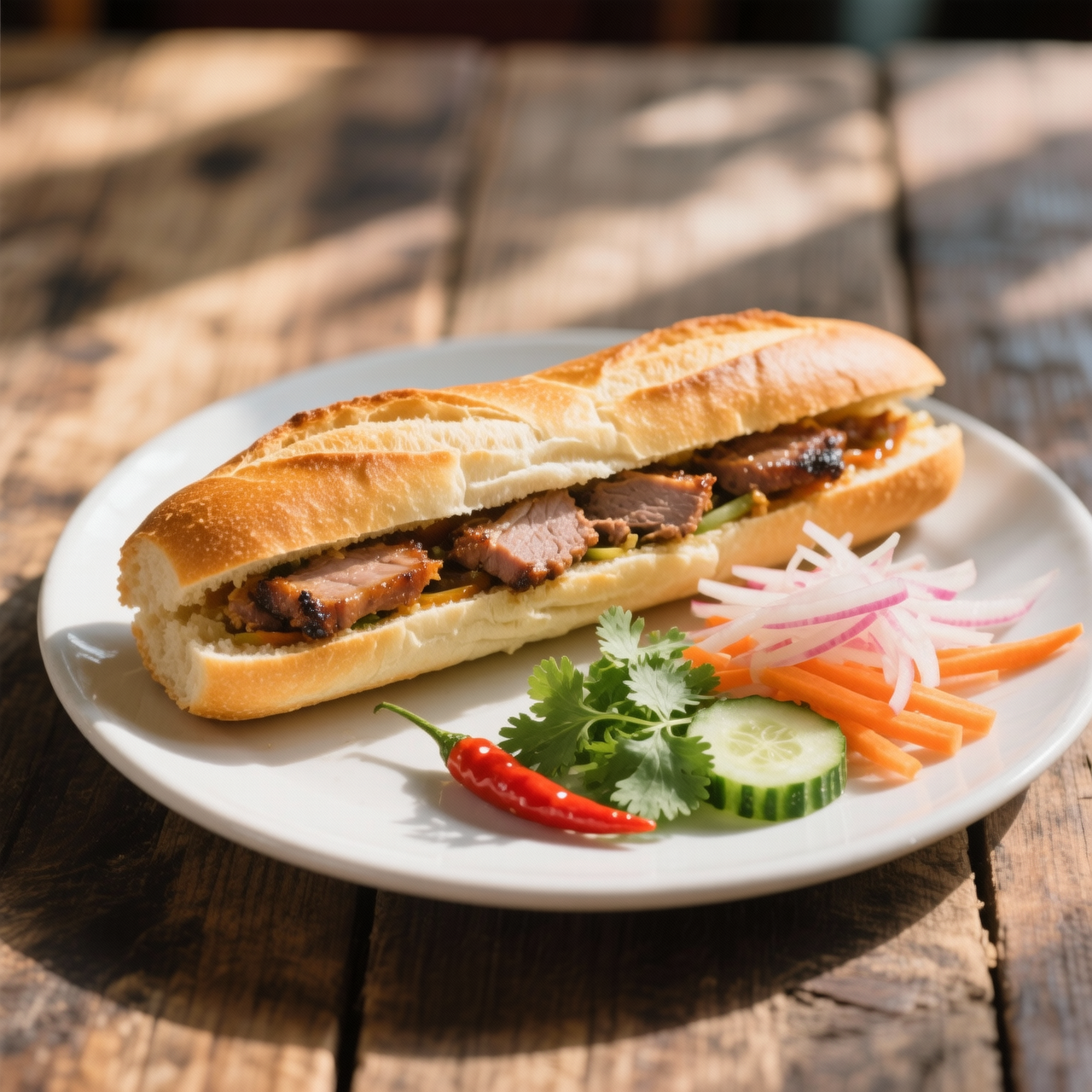
Banh Mi Baguette
I still remember the exact moment I realized how far the supermarket had drifted from the true soul of a banh mi. That impossibly light, crackling baguette you find in a proper Vietnamese bakery isn’t just bread; it’s the structural foundation of an entire culinary philosophy. Historically, French colonists introduced their dense wheat loaves to Vietnam, but local bakers radically transformed them by blending wheat with rice flour and adjusting hydration to create something far airier, thinner-crusted, and hollow enough to cradle fillings without overwhelming them. Today, shop-bought versions run around three to four dollars a loaf, but they’re gummy, overly chewy affairs loaded with dough conditioners and preservatives that completely betray the dish’s delicate balance. Making them from scratch matters because you’re reclaiming that vital textural contrast—the audible shatter of the crust giving way to a cloud-like, steaming interior that soaks up dressings without collapsing. The common pitfalls I see are overworking the dough, skipping the crucial rice flour ratio, and neglecting the steam during baking, which is the absolute secret to that signature crisp. When you knead too aggressively, you kill the large alveoli we’re chasing. If you skip the rice flour, you’ll just get a standard French loaf that’s too dense for quick-pickled vegetables. And without proper steam, the crust thickens and hardens instead of shattering. This recipe is built as a true batch hero: mix, shape, bake, and freeze them whole. Once thawed and crisped in a hot oven, they taste exactly like they just came out of a Saigon street stall.
Nutrition
| Per serving | Calories | Protein | Carbs | Fat | Sat fat | Fibre | Sugar | Sodium |
|---|---|---|---|---|---|---|---|---|
| beginner | 260kcal | 7g | 50g | 2g | 0g | 2g | 2g | 410mg |
| intermediate | 210kcal | 7g | 40g | 3g | 0g | 2g | 2g | 380mg |
| expert | 235kcal | 6g | 44g | 2g | 0g | 2g | 2g | 380mg |
Per serving · Ava-estimated — a guide, not a clinical figure.
- 500 gbread flour— High-protein flour ensures the characteristic chewy interior
- 320 mlwarm water— Temperature should be between 35 and 38 degrees Celsius
- 7 ginstant yeast— Directly mixable into dry ingredients without proofing
- 15 ggranulated sugar— Promotes yeast activity and crust caramelization
- 10 gfine sea salt— Regulates fermentation and strengthens gluten structure
- 20 mlneutral vegetable oil— Adds tenderness without compromising the crisp crust
- 30 grice flour— Used for dusting to achieve the signature crackly exterior
This beginner-friendly approach strips traditional baguette-making down to a forgiving, straight-mix method that still delivers the signature crisp crust and airy crumb without requiring overnight ferments or professional steam ovens. Unlike the £3–£4 shop-bought Banh Mi rolls, which rely on dough conditioners, preservatives, and artificial crust enhancers to fake texture, these rolls use just flour, water, yeast, salt, and a touch of vegetable oil for a genuinely clean, shelf-stable base. The key difference here is a relaxed folding technique and a single, room-temperature proof that removes the guesswork. Watch the dough hydration closely: it should feel tacky but not sticky, and the rolls will tell you they’re ready to bake when a gentle poke slowly springs back. Scoring is purely functional for oven spring, so shallow diagonal slashes are enough. Baking directly on a preheated sheet gives instant bottom heat for a crackly crust, while a quick water spray mimics professional steam. Once baked and cooled, these freeze beautifully for weeks, letting you pull out a fresh, additive-free roll without sacrificing that essential crunch.
Equipment
- Large mixing bowl— glass or stainless steel works best
- Rimmed baking sheet— preheats in the oven for better crust
- Sharp paring knife or bread lame— essential for clean scoring
- Clean kitchen towel— lightly dampened for covering
Method
- 1
Whisk the flour, instant yeast, salt, and sugar together in a large bowl, then pour in the warm water and vegetable oil.
Water should feel like a comfortable bath, roughly 35°C.
mixing~ 2 min - 2
Turn the shaggy dough onto a lightly floured surface and fold it over itself repeatedly for eight minutes until smooth.
Gentle folding builds enough gluten without aggressive stretching.
kneading~ 8 minTricky bit - 3
Divide the dough into four equal pieces and roll each into a tight, elongated log about 20cm long.
Tuck the seams underneath to prevent splitting during the rise.
shaping~ 5 min - 4
Place the shaped rolls on a parchment-lined baking sheet, cover with a damp towel, and let rest until visibly puffed.
The dough should slowly bounce back when gently pressed with a finger.
proofing~ 40 min - 5
Slash each roll diagonally three times with a sharp blade, spray the oven walls with water, and slide the tray inside to bake.
The water creates instant steam for maximum oven spring and crust crackling.
baking~ 25 min - 6
Transfer the baked baguettes to a wire rack and allow them to cool completely before slicing or freezing.
Cutting too early releases trapped steam and turns the crumb gummy.
cooling~ 30 min
Cooking from frozen
Thaw completely at room temperature, then crisp at 190°C for five minutes to restore the shattering crust.
Storage times are a guide — always use your judgement and store food safely.