
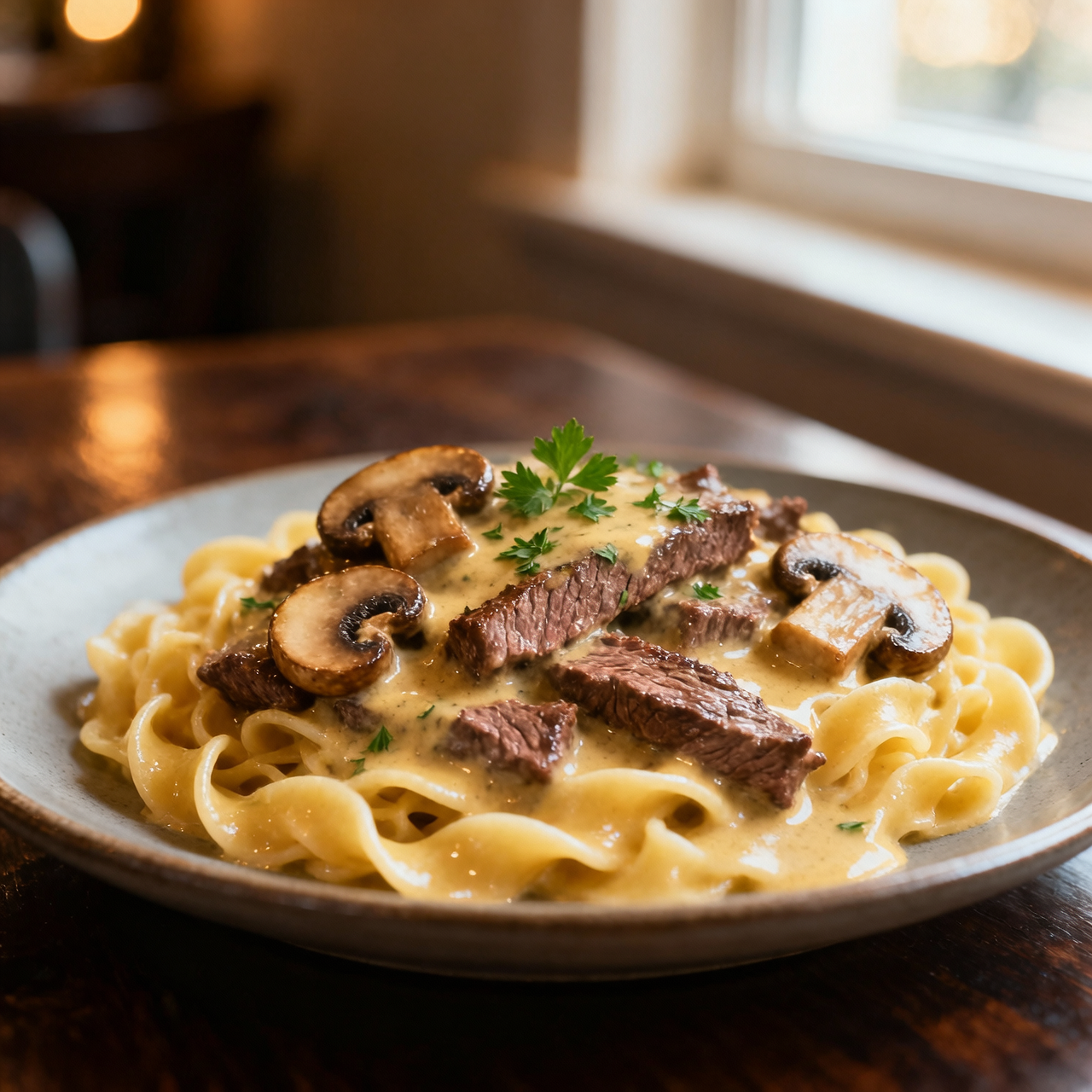
Beef Stroganoff
I have always believed that Beef Stroganoff is less about the cut of meat and more about the quiet patience of a simmering pan. Though its roots are firmly planted in nineteenth-century Russian aristocracy, named for Count Pavel Stroganoff, it is a dish that has wandered far from its original table, absorbing Italian techniques along the way. That is what fascinates me most: how a classic can travel, adapt, and still keep its soul. I care about this recipe because it teaches restraint. Too many home cooks rush the sear, crowd the pan, and drown the beef in heavy cream before it has had a chance to brown properly. The result is a pale, boiled stew rather than the rich, velvety dish it is meant to be. Another frequent misstep is overcomplicating the sauce with too many competing acids or skipping the mustard entirely, which is the quiet backbone of its flavor. I always insist on patting the beef dry, working in batches, and letting the fond do its work before deglazing with a splash of broth. When you finally fold in the sour cream, it must be off the direct heat, stirred gently until it just coats the back of a spoon. This is not a recipe for shortcuts. It demands attention, but it rewards you with something deeply comforting and elegantly balanced. In my kitchen, Stroganoff is a reminder that tradition is not about rigid rules. It is about understanding the purpose behind every step and honoring the ingredients enough to let them speak.
Ingredients
- 400 gbeef sirloin— trimmed of excess fat
- 150 gyellow onion— thinly sliced
- 200 gcremini mushroom— cleaned and sliced
- 60 gunsalted butter— cold
- 30 gall-purpose flour— sifted
- 5 gsmoked paprika— sweet or mild
- 15 gdijon mustard— whole grain or smooth
- 240 mlbeef broth— low sodium preferred
- 120 gsour cream— full fat
- 300 gegg noodle— wide cut
- 10 gflat-leaf parsley— fresh leaves only
- 5 gfine sea salt— kosher or table
- 2 gblack pepper— freshly cracked
Method
Pick a skill levelFocus on shortcuts, hand-holding technique, and building a confident first attempt. You will combine the flour, paprika, mustard, and broth into a pre-mixed paste before cooking, which completely bypasses the need to monitor roux formation or worry about lumps. The goal is to build confidence through predictable, linear steps. Watch for boiling the sauce once the dairy is introduced, which will cause the sour cream to curdle and lose its smooth texture. Keep the heat low during the final thickening phase. Stir constantly to prevent scorching. The beef is quickly seared in batches to avoid overcrowding, then set aside while the pre-mixed sauce base comes together in the same pan. This method guarantees a silky texture without demanding constant attention to temperature gradients. You will learn the foundational flavor profile of Stroganoff while bypassing the traditional timing pressure. Trust the process, keep your utensils ready, and do not skip the final resting period for the meat before combining it with the noodles.
Method
- 1
Slice the beef into thin strips against the grain and season generously with salt and pepper.
Keep the meat cold until it hits the pan.
slicing~ 2 min - 2
Boil a large pot of salted water and cook the egg noodles until just tender.
Drain immediately and toss with a teaspoon of butter.
boiling~ 8 min - 3
Whisk together the flour, paprika, mustard, and beef broth in a bowl until completely smooth.
This pre-mix prevents lumps during cooking.
mixing~ 2 min - 4
Heat half the butter in a heavy-bottomed pan over medium-high heat and sear the beef in two batches.
Do not overcrowd the pan or the meat will steam.
searing~ 4 minTricky bit - 5
Remove the beef, add the remaining butter, and saute the sliced onions and mushrooms until softened.
Scrape up any browned bits from the bottom of the pan.
sauteing~ 5 min - 6
Pour in the prepared broth mixture and simmer gently until the sauce thickens.
Stir continuously to prevent scorching.
reducing~ 6 minTricky bit - 7
Remove the pan from the heat and stir in the sour cream until fully incorporated.
Adding dairy off heat prevents curdling.
tempering~ 1 min - 8
Return the beef to the pan, toss with the cooked noodles, and garnish with fresh parsley.
Serve immediately while piping hot.
plating~ 1 min
Focus on home-cook standards, building a proper roux, deglazing effectively, and tempering the sour cream correctly. You will cook the mushrooms separately to develop deep browning, then sear the beef in the same fond. The flour is toasted directly in the butter before adding the broth, creating a smooth, velvety base without lumps. Watch the heat closely when incorporating the mustard and sour cream; high temperatures will cause the emulsion to break and the fat to separate. The noodles are cooked al dente and tossed directly with the sauce to absorb the flavors. This version teaches you how to layer umami and manage pan temperatures to achieve a cohesive, glossy finish. You will rely on your senses rather than a strict timer, listening for the sizzle to quiet as moisture evaporates and watching the sauce coat the back of a spoon. The result is a balanced, deeply savory dish that respects the traditional technique while remaining accessible for a weeknight dinner.
Method
- 1
Trim and slice the beef into uniform strips against the grain, then pat dry thoroughly.
Moisture prevents a proper crust from forming.
slicing~ 2 min - 2
Bring a large pot of salted water to a rolling boil and cook the egg noodles until al dente.
Reserve half a cup of starchy pasta water before draining.
boiling~ 8 min - 3
Melt half the butter in a cast iron skillet over high heat and sear the beef in a single layer.
Work in batches to maintain a hard, steady sizzle.
searing~ 4 minTricky bit - 4
Lower the heat to medium, add the remaining butter, and cook the onions and mushrooms until deeply browned.
Allow the vegetables to sit undisturbed for a minute before stirring.
caramelizing~ 7 minTricky bit - 5
Sprinkle the flour and paprika over the vegetables and cook for two minutes until fragrant.
Stir constantly to toast the raw flour taste away.
blooming~ 2 min - 6
Deglaze the pan slowly with beef broth, scraping the bottom to dissolve the fond.
The liquid will bubble vigorously as it hits the hot surface.
deglazing~ 2 min - 7
Simmer the sauce until it coats the back of a spoon, then whisk in the mustard and sour cream.
Remove from heat before adding dairy to maintain a smooth emulsion.
tempering~ 5 minTricky bit - 8
Fold the seared beef and noodles into the sauce, adjusting consistency with pasta water if needed.
Toss gently to coat everything evenly without breaking the meat.
tossing~ 2 min - 9
Finish with a generous sprinkle of fresh parsley and cracked black pepper.
Serve on warm plates for optimal temperature retention.
plating~ 1 min
Focus on traditional restaurant-grade execution, emphasizing precise heat management, concentrated reductions, and flawless emulsification. You will reduce the beef broth by half to concentrate its gelatin, creating a naturally thickened base that eliminates heavy roux work. The paprika and mustard are toasted in clarified butter to release their volatile oils before the flour is incorporated. Beef is sliced paper-thin against the grain, seared in a smoking hot pan for mere seconds to preserve tenderness, and rested before being folded into the sauce. The sour cream is tempered with warm sauce and finished strictly off the heat to maintain a flawless, glossy emulsion. Watch for the precise moment the butter separates slightly, indicating proper fat integration. This version demands patience, precise knife work, and an intuitive grasp of thermal dynamics, but rewards you with a dish that captures the exact historical profile of nineteenth-century Russian aristocracy. The result is intensely rich, structurally elegant, and deeply satisfying.
Method
- 1
Reduce the beef broth by half over low heat until it reaches a syrupy, gelatinous consistency.
This concentrates flavor and naturally thickens the final sauce.
reducing~ 20 minTricky bit - 2
Slice the chilled beef paper-thin against the grain and season with fine sea salt and cracked pepper.
Freezing the meat for twenty minutes makes slicing easier.
slicing~ 3 min - 3
Boil the egg noodles in heavily salted water until they are just shy of al dente.
Shock them in an ice bath to halt the cooking process immediately.
shocking~ 5 min - 4
Clarify the butter in a carbon steel pan over medium-low heat, separating the milk solids from the golden fat.
Discard the foam and reserve only the clear liquid.
clarifying~ 6 minTricky bit - 5
Sear the beef in the hot clarified butter for ten seconds per side until just browned.
Transfer immediately to a resting rack to preserve tenderness.
searing~ 2 minTricky bit - 6
Saute the mushrooms and onions in the remaining pan drippings until all moisture has evaporated.
Listen for the sizzle to return to a sharp, crisp crackle.
sweating~ 8 minTricky bit - 7
Toast the paprika and mustard in the pan fat for thirty seconds before whisking in the flour.
This unlocks the essential oils and eliminates raw starch notes.
blooming~ 1 min - 8
Gradually whisk in the reduced broth and simmer until the sauce reaches a glossy, nappe consistency.
Maintain a gentle bubble to avoid breaking the starch emulsion.
simmering~ 5 minTricky bit - 9
Temper the sour cream with a ladle of hot sauce before folding it completely off the heat.
The temperature must stay below eighty degrees Celsius to prevent splitting.
tempering~ 2 minTricky bit - 10
Combine the rested beef, drained noodles, and finished sauce, tossing gently with a silicone spatula.
Garnish with finely chopped parsley and serve immediately on heated porcelain.
plating~ 2 min