
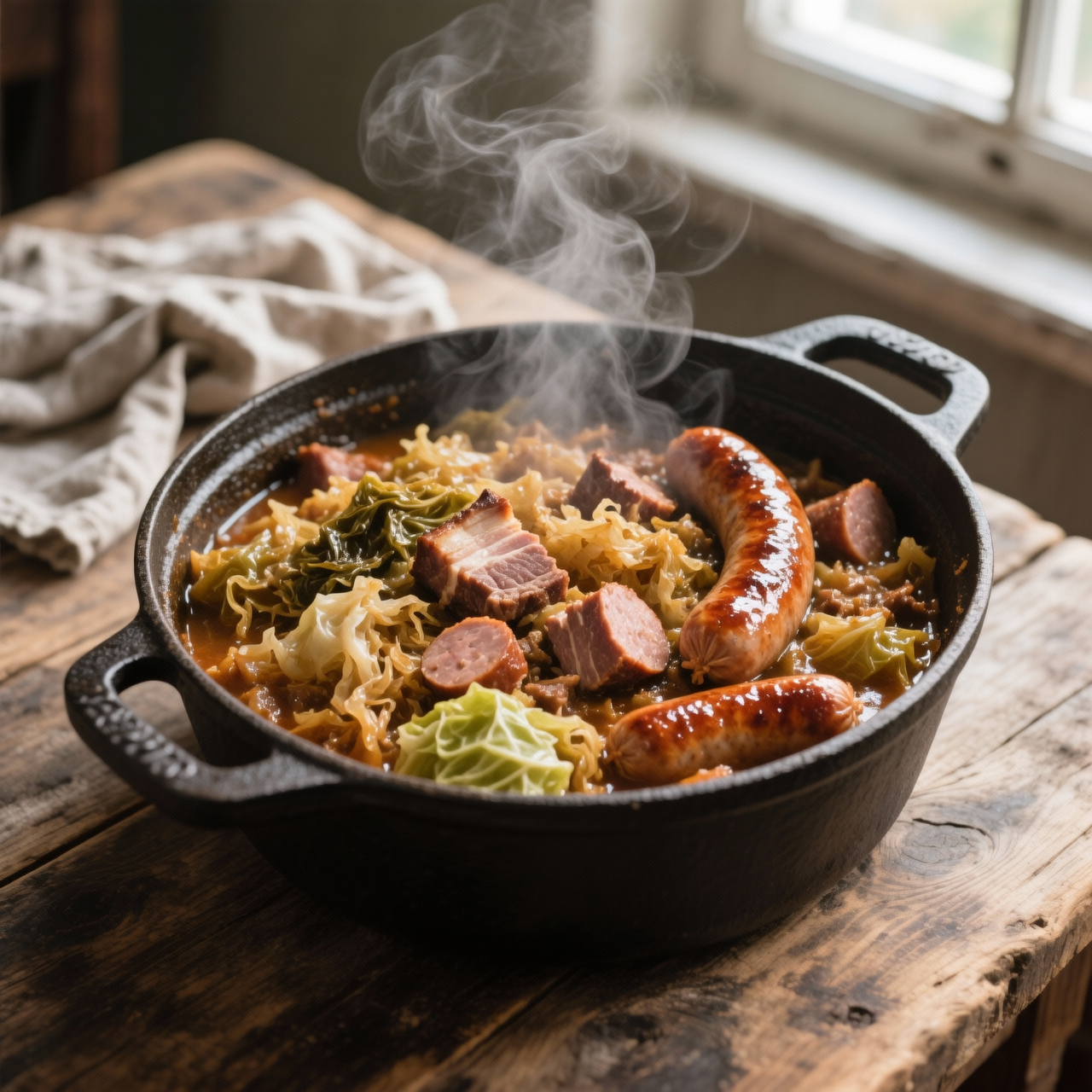
Bigos
When I first encountered Bigos, Poland’s legendary hunter’s stew, I realized it wasn’t merely a dish but a living archive of Slavic resilience. Born in the medieval woodlands where hunters preserved cabbage and game through long, unforgiving winters, it evolved into a national symbol of patience and resourcefulness. Every Polish family guards their own version, yet the soul of Bigos remains unchanged: a slow, deliberate marriage of sour and fresh cabbage, smoked meats, dried mushrooms, and warm spices that demand time to truly awaken. What makes this stew so profoundly meaningful is its refusal to be rushed. It teaches us that depth of flavor mirrors depth of character—both require endurance, repetition, and trust in the process. The true magic happens when you leave it to rest overnight, allowing the ingredients to negotiate their boundaries until they surrender into a unified, deeply savory harmony. Yet, for all its forgiving nature, Bigos is surprisingly unforgiving to the impatient cook. The most common pitfall I’ve witnessed is treating it like a quick weeknight meal, boiling the cabbage until it turns bitter or skipping the essential toasting of dried mushrooms. Others drown it in tomato paste or rely on overly acidic sauerkraut without balancing it with a touch of sweetness. Even worse is serving it fresh off the stove, before the flavors have had a chance to marry. If you want Bigos to reveal its full character, you must cook it low, taste it often, adjust with care, and above all, let it rest. Only then does it become what it was always meant to be.
Nutrition
| Per serving | Calories | Protein | Carbs | Fat | Sat fat | Fibre | Sugar | Sodium |
|---|---|---|---|---|---|---|---|---|
| beginner | 520kcal | 25g | 23g | 35g | 13g | 7g | 9g | 1200mg |
| intermediate | 520kcal | 25g | 23g | 35g | 13g | 7g | 9g | 1200mg |
| expert | 520kcal | 25g | 23g | 35g | 13g | 7g | 9g | 1200mg |
Per serving · Ava-estimated — a guide, not a clinical figure.
- 500 gsauerkraut— rinsed and thoroughly drained
- 300 ggreen cabbage— core removed
- 300 gpork shoulder— trimmed of excess fat
- 200 gsmoked pork sausage— traditional Polish variety preferred
- 15 gdried porcini mushroom— rehydrated and chopped
- 150 gyellow onion— finely diced
- 2 piecebay leaf— fresh or dried
- 4 pieceallspice berry— whole
- 3 gblack peppercorn— whole
- 6 piecejuniper berry— whole
- 30 gprune preserve— smooth consistency
- 150 mldry red wine— full-bodied varietal
- 30 grendered lard— unsalted
This version prioritizes approachability and confidence, relying on pre-shredded cabbage blends, jarred sauerkraut, and ready-sliced sausage to bypass labor-intensive prep. The goal is to master the core flavor balance without getting bogged down in knife work or spice grinding. Watch the heat closely during the initial browning phase; pre-mixed ingredients often contain added sugars that can scorch rapidly. Keep your flame at a steady medium-low once everything is combined. Stir every few minutes to prevent the bottom layer from sticking, and trust the jarred seasonings to carry the base profile. The shortcut here removes friction so you can focus entirely on the simmer. You will notice the stew thickening as the cabbage releases moisture and the meat softens. If it looks too dry, add a splash of broth or water rather than forcing it. Taste at the end and adjust with a pinch of salt or a teaspoon of honey if the fermented tang feels too sharp. This method guarantees a deeply satisfying result on your very first attempt, proving that authentic comfort food does not require a professional kitchen.
Equipment
- Heavy-bottomed pot— non-stick or enameled works well
- Wooden spoon— for gentle stirring
Method
- 1
Heat the lard in a large heavy-bottomed pot over medium heat until shimmering.
The pan should sizzle gently when a drop of water hits it.
heating~ 2 min - 2
Brown the pork shoulder and sausage slices in batches until deeply colored.
Do not crowd the pan to avoid steaming the meat.
searing~ 5 minTricky bit - 3
Add the onion, bay leaves, and jarred spice blend to the pot.
Cook until the onion turns translucent and fragrant.
sweating~ 4 min - 4
Stir in the sauerkraut, fresh cabbage, rehydrated mushrooms, wine, and prune preserves.
Scrape up any browned bits stuck to the bottom.
deglazing~ 3 min - 5
Cover tightly and simmer on low until the cabbage is completely tender.
Stir occasionally to prevent sticking and adjust heat if it bubbles too vigorously.
simmering~ 30 minTricky bit