
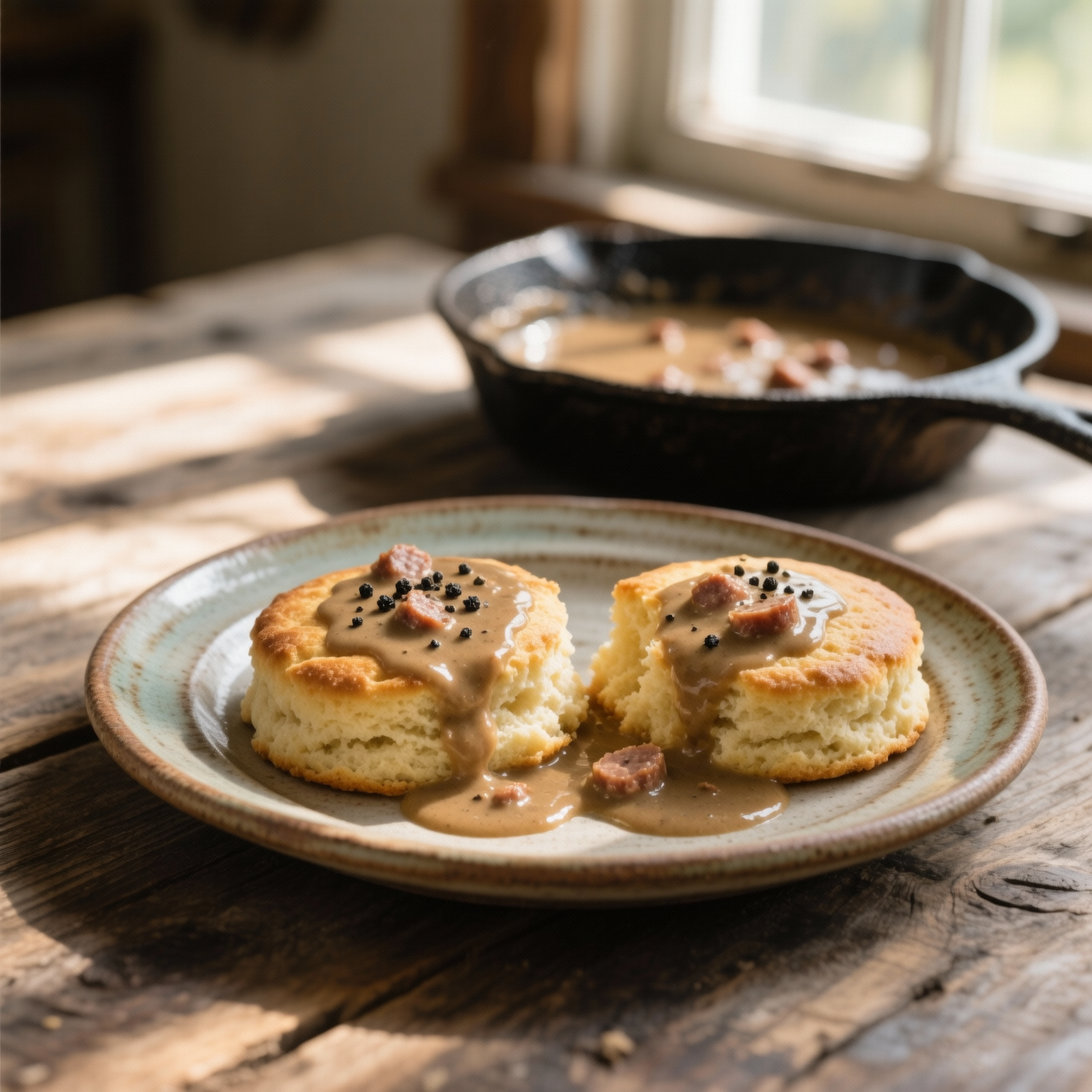
Biscuits and Sausage Gravy
I’ve always believed that biscuits and sausage gravy isn’t just breakfast; it’s a quiet act of Southern hospitality, born from necessity and perfected through generations. Long before modern pantries, resourceful cooks took cheap cuts of pork, rendered the fat, and stretched it with flour and milk to create a rich, peppery sauce that could transform a humble buttermilk biscuit into a sustaining meal. That history matters deeply to me because it reminds us that comfort food isn’t about luxury—it’s about making the most of what you have, with patience and care. When I stand at my stove, whisking a roux until it smells nutty and golden, I’m participating in a lineage of home cooks who understood that food is both fuel and love. Yet, this dish is notoriously easy to misstep. The most common pitfall is rushing the gravy, which leads to a thin, floury mess that clings awkwardly instead of coating the biscuit. Another is overworking the sausage, squeezing out the very fat you need to build the roux. And let’s not forget the biscuits themselves—handling the dough too much guarantees toughness rather than those flaky, buttery layers. I’ve learned that success hinges on restraint: cold butter, gentle folding, and letting the gravy simmer low and slow so the starches fully hydrate and the flavors marry. When you finally crack that black pepper over the top and watch the gravy pool into every crevice, you aren’t just serving breakfast. You’re honoring a tradition that asks for nothing but attention, and in return, gives you a plate of pure, unpretentious warmth.
Nutrition
| Per serving | Calories | Protein | Carbs | Fat | Sat fat | Fibre | Sugar | Sodium |
|---|---|---|---|---|---|---|---|---|
| beginner | 1210kcal | 33g | 103g | 74g | 38g | 4g | 10g | 2150mg |
| intermediate | 1210kcal | 33g | 103g | 74g | 38g | 4g | 10g | 2150mg |
| expert | 1210kcal | 33g | 103g | 74g | 38g | 4g | 10g | 2150mg |
Per serving · Ava-estimated — a guide, not a clinical figure.
- 480 gall-purpose flour— sifted before measuring for accuracy
- 170 gcold unsalted butter— cut into uniform small cubes
- 240 mlcold buttermilk— full-fat preferred for optimal tenderness
- 15 gbaking powder— double-acting for reliable lift
- 5 gbaking soda— activates upon contact with acidic buttermilk
- 10 gfine sea salt— divided for dough and gravy seasoning
- 8 gblack peppercorns— whole, freshly cracked
- 450 gfresh pork sausage meat— preferably with a twenty percent fat ratio
- 480 mlwhole milk— warmed slightly to prevent roux shock
- 60 mlheavy cream(optional)— optional for finishing richness
This version is designed to remove the intimidation factor while preserving the soul of the dish. You will lean on pre-portioned shortcuts and forgiving techniques that guarantee success on your first try. The biscuit dough is mixed using a simple fold-and-turn method rather than precise lamination, ensuring tender layers without demanding professional pastry skills. For the gravy, we bypass the delicate roux-building phase by utilizing a pre-blended slurry approach that eliminates lumps entirely. Watch your heat closely; keeping the pan on a steady medium-low prevents the milk from scorching and gives the sausage time to render its fat evenly. The goal here is confidence, not perfection. Do not fear sticky dough or slightly thickened gravy. If the mixture seems too dense, a splash of extra milk will bring it back. Season incrementally, tasting after each addition, because packaged ingredients often carry hidden sodium. Trust the process, keep your movements gentle, and remember that even rustic biscuits and gravy will taste like a triumph when made with care and patience.
Equipment
- large mixing bowl— glass or stainless steel works best
- heavy skillet— non-stick is perfectly acceptable here
- baking sheet— line with parchment for easy cleanup
- rubber spatula— flexible for gentle folding
Method
- 1
Preheat your oven to four hundred twenty-five degrees Fahrenheit.
Verify accuracy with a standalone thermometer.
preheating~ 10 min - 2
Whisk the flour, baking powder, baking soda, and salt together in a large bowl.
Distribute the leaveners evenly before adding fat.
aerating~ 2 min - 3
Cut the cold butter cubes into the dry mixture until pea-sized clumps remain.
A fork or pastry cutter works fine.
cutting in~ 3 minTricky bit - 4
Pour in the buttermilk and fold the mixture until the dough just comes together.
Stop immediately when dry spots disappear.
folding~ 2 minTricky bit - 5
Drop the dough onto a baking sheet and bake until golden brown.
Rotate the pan halfway through for even color.
baking~ 15 min - 6
Brown the sausage in a skillet over medium heat, breaking it into small crumbles.
Drain excess fat only if it pools excessively.
browning~ 8 min - 7
Stir a portion of the flour into the rendered fat until a smooth paste forms.
Cook briefly to remove the raw starch flavor.
blooming~ 2 min - 8
Slowly whisk in the warm milk and black pepper until the gravy coats a spoon.
Add liquid in thirds to guarantee a lump-free texture.
whisking~ 5 minTricky bit