
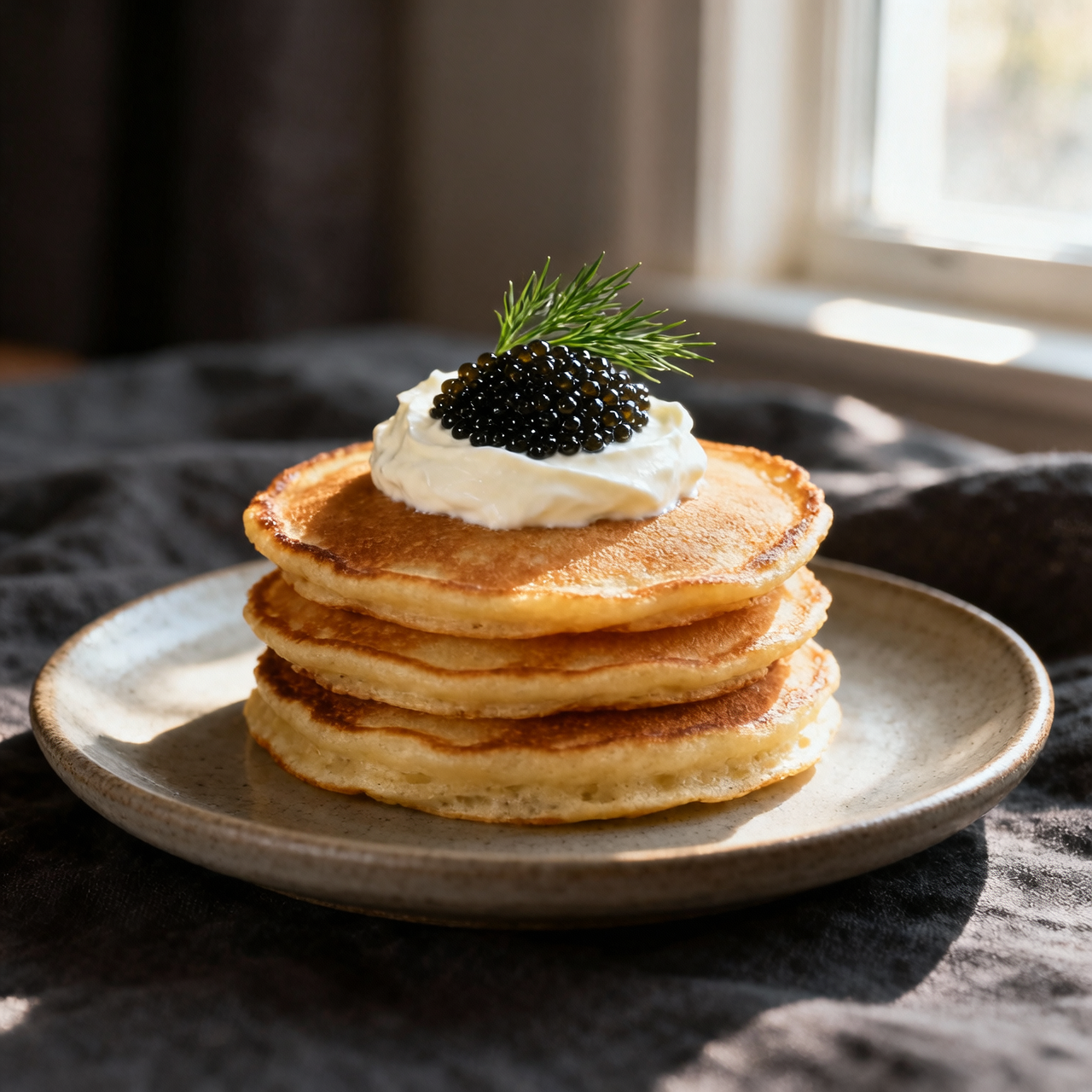
Blini with Caviar
I have always believed that the simplest dishes often carry the deepest histories, and nowhere is that more evident than in these delicate Russian and Ukrainian blini. Long before they became a celebrated starter on festive tables, thin buckwheat and wheat crepes were symbols of the sun, baked by Slavic cooks to welcome spring during Maslenitsa. The tradition of pairing them with salty caviar speaks to a time when winter stores were precious and every bite was a quiet celebration of survival and abundance. What makes this dish so profoundly meaningful to me is its balance of restraint and generosity; a perfectly cooked blin should be tender, slightly tangy, and barely thicker than parchment, serving as a neutral canvas that elevates rather than overpowers its toppings. Yet, I have watched countless cooks stumble at the most basic steps. The batter is often rushed, leading to dense or rubbery results instead of that signature lace-like edge. Resting the dough is nonnegotiable, as the flour needs time to fully hydrate and the leavening must work gently. Heat control is another frequent casualty; too hot, and the crepes scorch before they set; too cool, and they steam rather than fry, losing their delicate crispness. I also encourage modern cooks to explore plant-based caviar alternatives, honoring the vegetarian spirit of the original grain-focused tradition while keeping the luxurious mouthfeel intact. When approached with patience, this humble starter becomes a quiet meditation on heritage, technique, and the beauty of simplicity.
Nutrition
| Per serving | Calories | Protein | Carbs | Fat | Sat fat | Fibre | Sugar | Sodium |
|---|---|---|---|---|---|---|---|---|
| beginner | 545kcal | 16g | 55g | 30g | 13g | 5g | 9g | 750mg |
| intermediate | 545kcal | 16g | 55g | 30g | 13g | 5g | 9g | 750mg |
| expert | 545kcal | 16g | 55g | 30g | 13g | 5g | 9g | 750mg |
Per serving · Ava-estimated — a guide, not a clinical figure.
- 150 gbuckwheat flour— finely milled, for authentic earthiness
- 100 gall-purpose flour— sifted before measuring
- 350 mlwhole milk— warmed to body temperature
- 1 largeegg— room temperature
- 7 gactive dry yeast— check expiration date for viability
- 15 ggranulated sugar— white or raw
- 5 gfine sea salt— adjust to taste
- 30 gunsalted butter— melted and cooled slightly
- 50 gsturgeon caviar— kept refrigerated until plating
- 100 gcrème fraîche— full-fat, for proper richness
- 10 gfresh dill— finely chopped, for garnish
- 30 mlneutral oil— high smoke point, for pan
This version strips away the intimidation factor by prioritizing reliability over tradition. You will use a straightforward one-bowl mixing method to bypass the need for separate sponges or long proofing windows. The key here is temperature control and patience at the pan. Watch your batter closely; if it feels too thick after resting, thin it with a splash of milk rather than forcing it with excessive whisking, which will toughen the pancakes. I recommend using a reliable non-stick skillet and keeping your heat strictly at medium-low to prevent the delicate edges from scorching before the center sets. Do not rush the flipping process. Wait until the surface is completely matte and dotted with unmoving bubbles before you slide your spatula underneath. The goal is not a perfectly uniform disc, but a tender, slightly irregular cake that soaks up the toppings beautifully. Keep your caviar chilled until the final second, and let the residual warmth of the blini gently release its aroma. This approach guarantees a confident, restaurant-worthy result on your very first attempt without sacrificing the essential flavor balance.
Equipment
- large mixing bowl— glass or stainless steel
- whisk— wire or silicone
- non-stick skillet— 10-inch diameter recommended
- measuring cups— standard set
Method
- 1
Whisk warm milk, sugar, and instant yeast in a large bowl until completely dissolved.
Milk should feel like a warm bath, not hot.
blooming~ 1 min - 2
Add both flours, salt, melted butter, and egg, then whisk vigorously until smooth.
Stop whisking once no dry pockets remain.
emulsifying~ 2 min - 3
Let the batter rest at room temperature until visibly puffed and bubbly.
A warm spot speeds this up significantly.
proofing~ 20 min - 4
Heat a lightly oiled non-stick skillet over medium-low heat.
Test with a single drop of water; it should sizzle gently.
preheating~ 3 min - 5
Pour a quarter-cup of batter per pancake and cook until surface bubbles form and pop.
Do not press down with the spatula.
searing~ 3 min - 6
Flip and cook the second side until lightly golden, then transfer to a warmed plate.
Stack with parchment between each to prevent sticking.
flipping~ 2 min - 7
Top each warm pancake with a teaspoon of crème fraîche and a small spoon of caviar.
Serve immediately while hot.
plating~ 1 min