
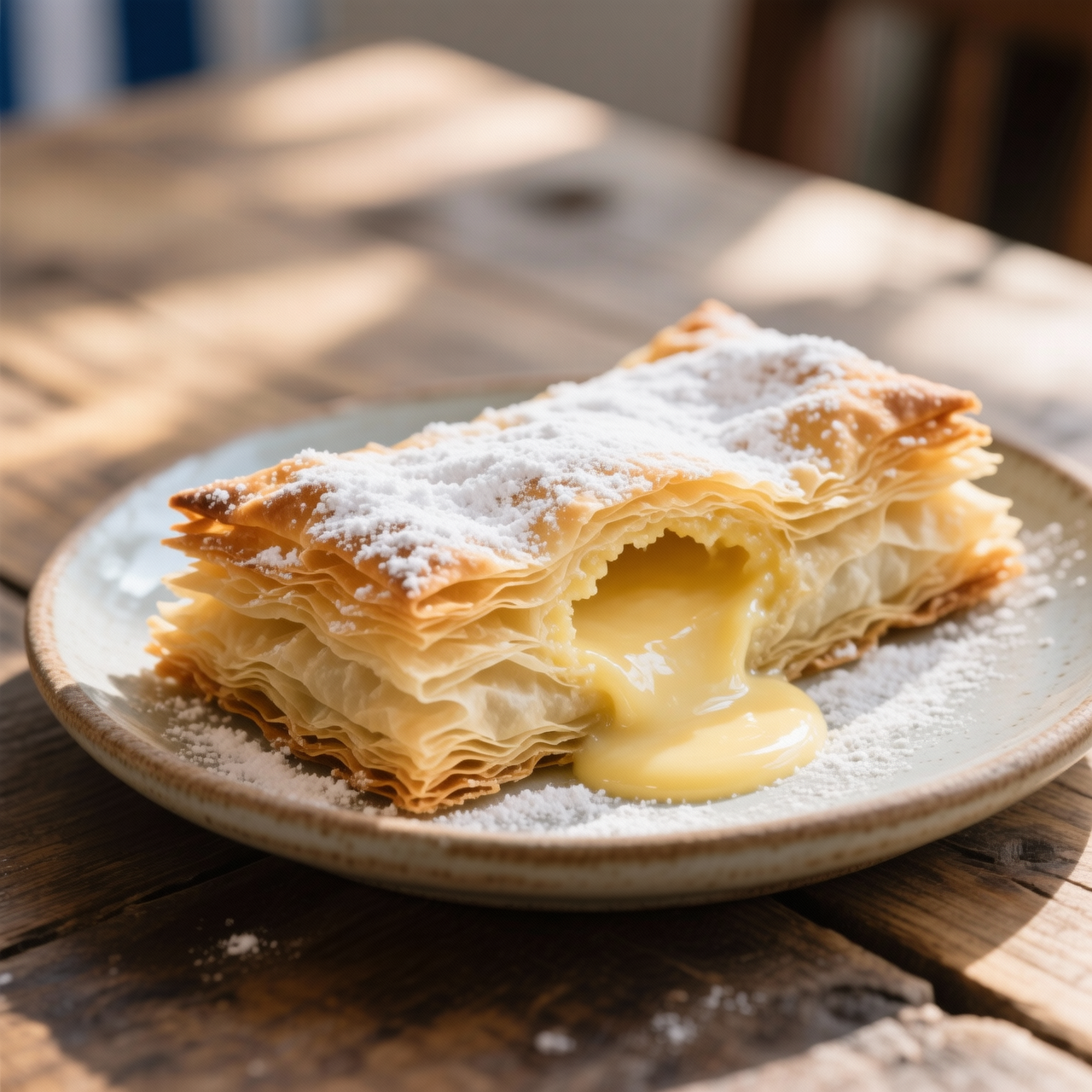
Bougatsa
I first tasted bougatsa in a cramped Thessaloniki bakery, but I quickly learned that chasing the real thing through commercial wrappers is a losing battle. Traditional bougatsa hails from northern Greece, born in the bustling pastry shops of Serres and Thessaloniki where a crisp, buttery phyllo shell cradles a velvety semolina custard. When you buy it pre-packaged or from chain bakeries, you are usually paying five euros or more for a heavy slice built on hydrogenated margarine, artificial vanilla, and stabilizers that keep the filling from weeping while robbing it of that clean, eggy richness. Making it from scratch is the only way to reclaim its soul, and I promise it is entirely achievable when you respect the technique. The most common pitfalls come down to moisture control and patience. If your custard is undercooked, the pastry will instantly turn soggy; if it is over-thickened with too much starch, you lose that signature silkiness that should melt on the tongue. Many home bakers also rush the phyllo layering, tearing the delicate sheets or brushing them with cold oil instead of gently warming butter, which shatters the flake rather than creating it. Another frequent mistake is skipping the resting period after baking, which causes the filling to spill out the moment you slice. By whisking your own custard with real milk, fine semolina, and a touch of lemon zest, then carefully folding it into hand-brushed layers of dough, you achieve a breakfast pastry that actually justifies the time. You get a shattering crust, a lightly sweet center, and the quiet pride of knowing exactly what went into every bite.
Nutrition
| Per serving | Calories | Protein | Carbs | Fat | Sat fat | Fibre | Sugar | Sodium |
|---|---|---|---|---|---|---|---|---|
| beginner | 485kcal | 12g | 62g | 20g | 11g | 2g | 26g | 340mg |
| intermediate | 460kcal | 11g | 52g | 22g | 13g | 2g | 19g | 380mg |
| expert | 580kcal | 12g | 45g | 38g | 20g | 2g | 18g | 320mg |
Per serving · Ava-estimated — a guide, not a clinical figure.
- 12 sheetsphyllo pastry sheet— Thawed overnight in the refrigerator if frozen
- 1000 mlwhole milk
- 150 ggranulated sugar
- 80 gcornstarch— Sifted to prevent clumping
- 3 wholelarge egg— Separated, yolks reserved for custard
- 100 gunsalted butter— Melted and kept warm for brushing
- 5 mlvanilla extract
- 3 gground cinnamon(optional)— For dusting after baking
- 15 gpowdered sugar(optional)— For dusting after baking
Bakery bougatsa costs four to six dollars per slice and typically relies on frozen, chemically preserved pastry sheets and custard thickened with industrial stabilizers that dull the delicate semolina flavor. This beginner version strips away the intimidation factor while keeping every component entirely from scratch. Instead of wrestling with brittle commercial phyllo, you will mix a forgiving, oil-enriched dough that rests briefly before rolling into thicker, highly manageable sheets. The custard simmers in a single pot using whole milk, fine semolina, eggs, and real vanilla, avoiding complex tempering steps. Watch the dough thickness carefully; aim for roughly one millimeter rather than transparency, which makes layering far less fragile for first attempts. Keep melted butter at room temperature so it coats evenly without pooling, and brush the top sheet thoroughly to guarantee a blistered, golden crust. The filling will firm as it cools, so resist cutting immediately. Rest the pastry for twenty minutes after baking. This streamlined approach guarantees a flaky, rich breakfast pastry with a clean custard center, proving that authentic Greek baking is entirely achievable on a weekday morning.
Equipment
- Heavy-bottomed saucepan— prevents custard from scorching during simmer
- Rolling pin— wooden or marble works equally well
- 9x13 baking dish— metal or glass, lightly greased
- Silicone pastry brush— easier to clean than natural bristle
Method
- 1
Whisk flour, fine salt, lukewarm water, and olive oil together until a shaggy dough forms.
Add water gradually; humidity affects absorption.
kneading~ 5 min - 2
Cover the dough tightly with a damp kitchen towel and let it rest at room temperature.
Relaxing gluten prevents shrinkage during rolling.
resting~ 15 min - 3
Simmer whole milk and granulated sugar in a heavy pan, then slowly whisk in fine semolina until the mixture thickens.
Stir constantly to avoid lumps forming at the bottom.
gelatinization~ 8 minTricky bit - 4
Remove the pan from heat and vigorously stir in lightly beaten eggs and vanilla extract until smooth.
Moving quickly prevents the eggs from scrambling.
tempering~ 2 minTricky bit - 5
Divide the rested dough into eight equal portions and roll each into thin, uniform circles on a lightly floured surface.
Aim for one millimeter thickness for structural stability.
rolling~ 10 minTricky bit - 6
Brush the bottom of the baking dish with melted butter and layer four dough sheets, brushing each layer thoroughly.
Overlap edges slightly to prevent gaps in the crust.
laminating~ 5 min - 7
Pour the warm custard evenly over the dough base and gently spread it to the edges.
Smooth the surface for an even bake.
spreading~ 1 min - 8
Arrange the remaining dough sheets on top, brush every layer with butter, and lightly score the surface before baking.
Scoring allows steam to escape and creates clean slice lines.
scoring~ 5 min
Cooking from frozen
Thaw overnight in the fridge, then warm at 160°C for 15 minutes to restore crispness.
Storage times are a guide — always use your judgement and store food safely.