
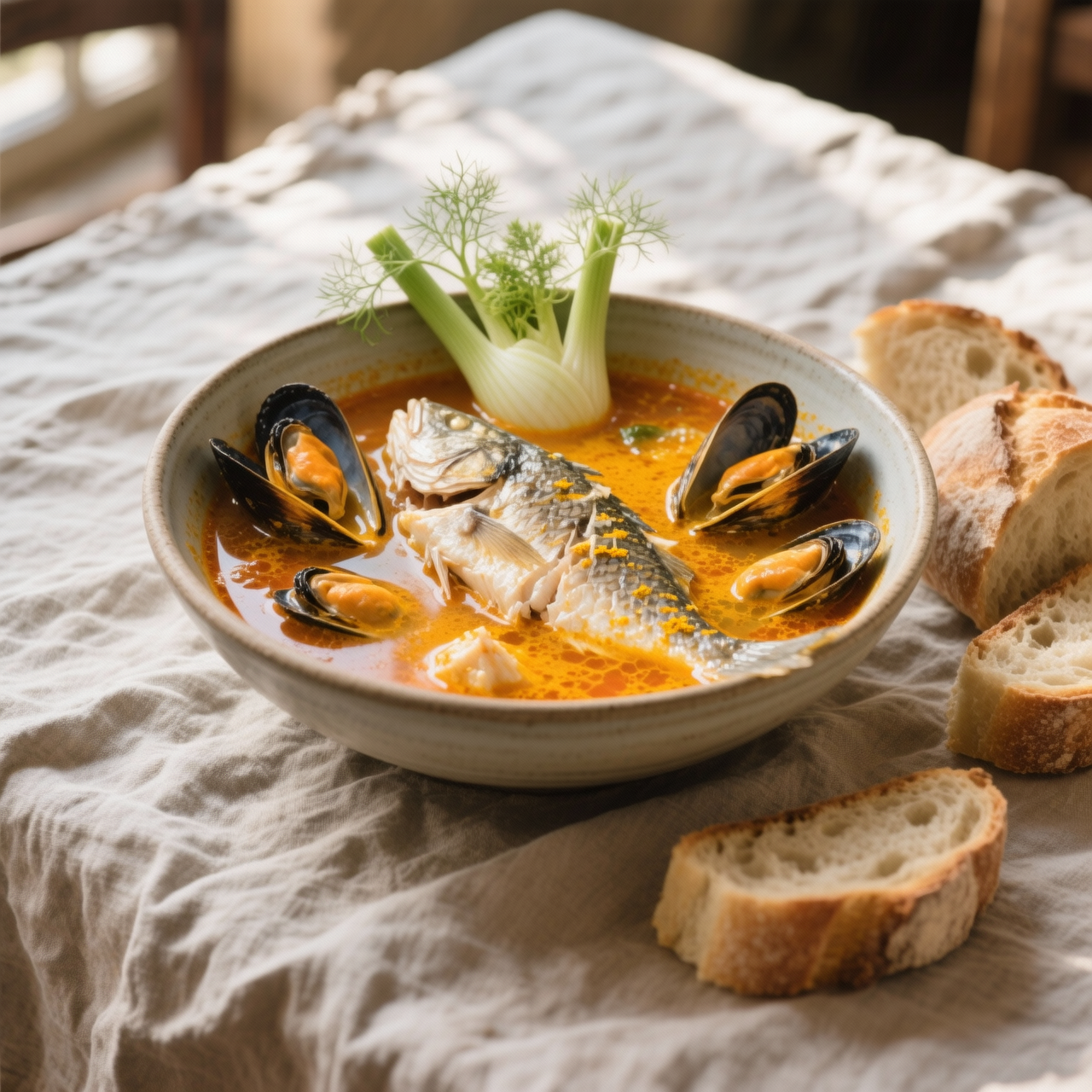
Bouillabaisse
I have always believed that Bouillabaisse is not merely a recipe; it is a living conversation between the Mediterranean and the sun-baked stones of Marseille. Born from the pragmatic necessity of local fishermen who simmered the day’s unsold rockfish in seawater alongside wild fennel and precious saffron, it has transformed from a humble harbor meal into a proud symbol of Provençal identity. For me, preparing it authentically requires patience and an unwavering respect for the catch. You cannot rush the foundation, nor can you disguise shortcuts with commercial stock or thawed seafood. The true magic unfolds through careful layering: sweet onions, garlic, and ripe tomatoes softened until they collapse, brightened with pastis or dry white wine, and finally elevated by saffron that dyes the broth a brilliant, sunlit gold. The most frequent mistake I encounter is aggressive boiling, which toughens delicate fillets and turns sweet shellfish into rubbery casualties. Equally damaging is omitting the rouille, the pungent garlic-saffron emulsion traditionally smeared on crusty bread and whisked into the bowl before serving. Without it, the dish loses its earthy backbone. I constantly tell my students that timing is nonnegotiable. The seafood enters at the very end, poaching gently until just opaque, and the heat is cut the moment it is ready. This is a dish that honors restraint, embraces the unpredictability of the sea, and proves that the finest culinary traditions thrive when we follow nature’s pace instead of imposing rigid schedules.
Nutrition
| Per serving | Calories | Protein | Carbs | Fat | Sat fat | Fibre | Sugar | Sodium |
|---|---|---|---|---|---|---|---|---|
| beginner | 760kcal | 64g | 34g | 34g | 6g | 4g | 8g | 630mg |
| intermediate | 760kcal | 64g | 34g | 34g | 6g | 4g | 8g | 630mg |
| expert | 760kcal | 64g | 34g | 34g | 6g | 4g | 8g | 630mg |
Per serving · Ava-estimated — a guide, not a clinical figure.
- 60 mlolive oil— extra virgin
- 250 gfennel bulb— thinly sliced, fronds reserved
- 150 gyellow onion— finely diced
- 100 gleek— white part only, rinsed and chopped
- 15 ggarlic clove— minced
- 30 gtomato paste— double concentrated
- 1 gsaffron thread— whole, not powdered
- 200 mldry white wine— unoaked
- 1000 mlfish fumet— cold
- 10 gorange peel— zest only, no pith
- 2 pcsbay leaf— dried
- 400 gsea bass fillet— skinless, cut into large portions
- 400 gred snapper fillet— skinless, cut into large portions
- 500 gmussel— debearded and scrubbed
- 200 gmonkfish tail— cubed
- 120 gbaguette slice— toasted for serving
- 80 gaioli— traditional garlic emulsion
This version is built for your first confident encounter with bouillabaisse, prioritizing approachability without sacrificing the dish’s soul. You will lean on a high-quality jarred tomato-fennel base to shortcut the foundational soffritto, allowing you to focus entirely on the delicate timing of the seafood. The primary goal here is to avoid the most common beginner mistake: turning a gentle simmer into a violent boil. Seafood proteins tighten instantly when shocked by aggressive heat, so keep your lid slightly ajar and your eye on the bubbles. You will add the firmest white fish first, giving it the longest window to absorb the saffron-infused broth, while the mussels and delicate snapper wait patiently until the final minutes. Do not stir once the seafood is submerged; let the residual heat finish the cooking process. Keep your serving bowls pre-warmed to maintain temperature as you plate. Taste the broth before adding salt, as commercial bases already carry significant seasoning. When the mussels open and the fish flakes with gentle pressure, it is ready. Trust the visual cues over the clock, and remember that a successful first attempt is measured by tender seafood and a broth that tastes distinctly of the sea, not by perfection.
Equipment
- Large Dutch oven— enamel-coated works well
- Wooden spoon— for gentle stirring
- Kitchen tongs— for handling seafood
- Small mixing bowl— for aioli prep
Method
- 1
Heat olive oil in a large Dutch oven over medium heat.
Wait for shimmering before adding vegetables.
sweating~ 3 min - 2
Add the fennel, onion, and leek to the pan.
Stir occasionally until softened.
sautéing~ 7 min - 3
Stir in the tomato paste, minced garlic, and saffron threads.
Cook until the paste darkens slightly.
blooming~ 2 min - 4
Pour in the white wine to deglaze the pot.
Scrape any browned bits from the bottom.
deglazing~ 1 min - 5
Add the fish fumet, orange peel, and bay leaf, then bring to a gentle simmer.
Reduce heat immediately after boiling starts.
simmering~ 15 minTricky bit - 6
Submerge the sea bass, snapper, and monkfish into the broth.
Keep the lid slightly ajar to maintain gentle heat.
poaching~ 8 minTricky bit - 7
Toss in the mussels and cover tightly until shells open.
Discard any mussels that remain closed after cooking.
steaming~ 4 minTricky bit