
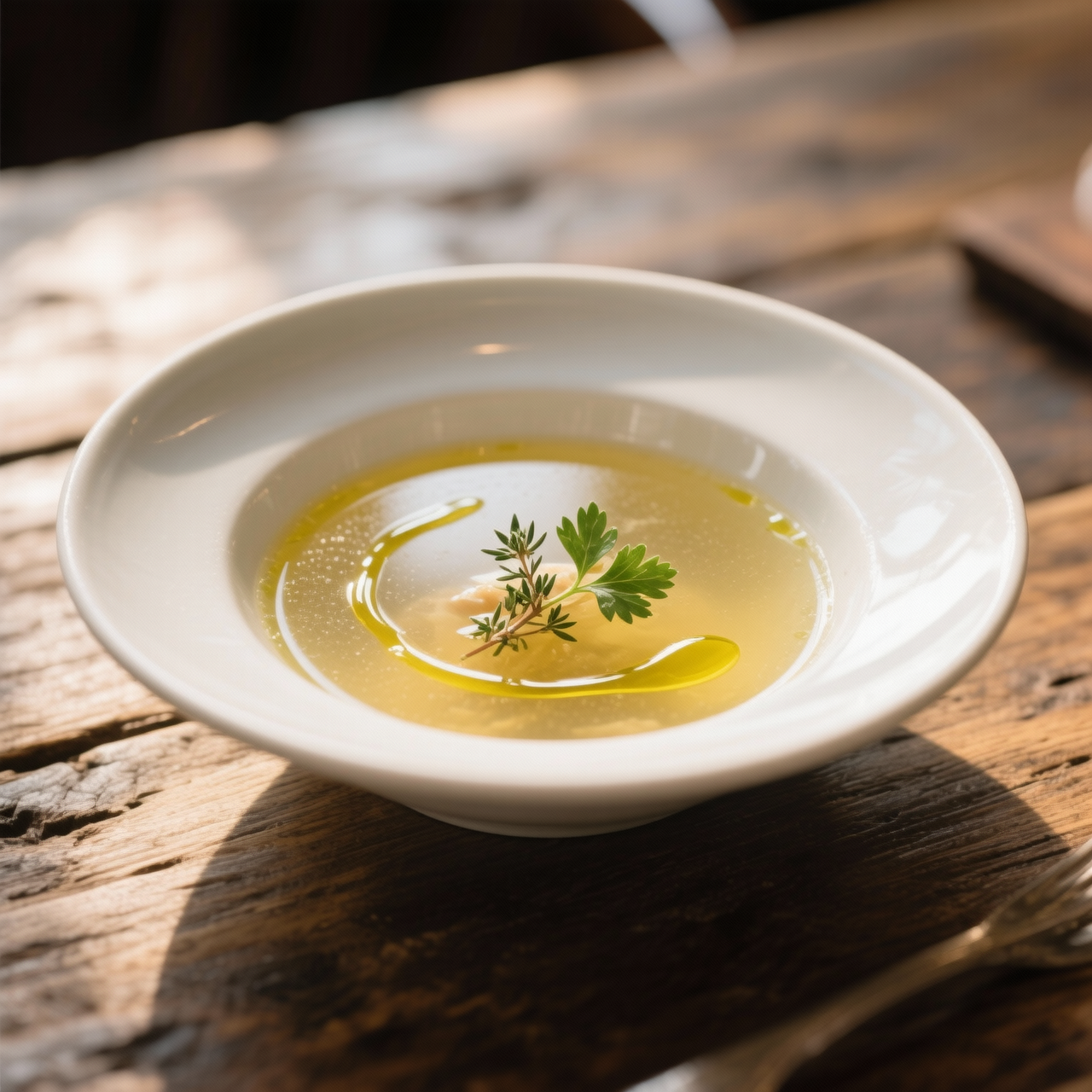
Brodo (Italian stock)
I’ve always believed that a proper brodo is the quiet backbone of Italian home cooking, the invisible thread that ties a humble minestrina to a luxurious risotto alla Milanese. Its origins stretch back centuries to the cucina povera of the Italian peninsula, where resourceful cooks learned that simmering leftover bones, vegetable scraps, and a few aromatic herbs could yield a deeply restorative liquid. Unlike its French counterpart, which often leans heavily on roasted bones and rich gelatin, a traditional Italian brodo prizes clarity, balance, and a gentle sweetness drawn from fresh celery, onion, and carrot. I make it because it transforms ordinary dishes into something nourishing and complete, yet so many cooks miss the mark. The most frequent mistake is rushing the process. Cranking the heat to a rolling boil will cloud the broth and turn the proteins bitter, stripping away the delicate nuance that takes hours to develop. Another common pitfall is overloading the pot with too many vegetables or heavy spices, which drowns out the subtle harmony of the base ingredients. I always skim the surface meticulously during that first gentle simmer, letting the stock breathe rather than choke. Salt is another trap; I leave it out entirely until the final dish, because reducing a seasoned brodo later only amplifies the salt to an inedible level. When you treat this liquid with patience, you’re not just making stock—you’re preserving a quiet, centuries-old ritual of care, one that asks for little but gives back everything.
Nutrition
| Per serving | Calories | Protein | Carbs | Fat | Sat fat | Fibre | Sugar | Sodium |
|---|---|---|---|---|---|---|---|---|
| beginner | 15kcal | 2g | 2g | 1g | 0g | 1g | 1g | 480mg |
| intermediate | 24kcal | 3g | 2g | 1g | 0g | 0g | 1g | 310mg |
| expert | 18kcal | 3g | 1g | 1g | 0g | 0g | 1g | 320mg |
Per serving · Ava-estimated — a guide, not a clinical figure.
- 500 gBeef shin bone— rinsed and patted dry
- 400 gChicken carcass— skin and giblets removed
- 150 gOnion— peeled and quartered
- 100 gCarrot— peeled and roughly chopped
- 80 gCelery stalk— trimmed and roughly chopped
- 2000 mlWater— cold
- 5 gBlack peppercorn— whole
- 2 gBay leaf— dried
- 10 gSalt(optional)— fine sea salt
This beginner-friendly approach to classic Italian brodo removes the intimidation of traditional stock-making by embracing reliable shortcuts without sacrificing depth. Instead of roasting bones or chopping a full mirepoix from scratch, we use high-quality store-bought chicken bouillon paste as our savory foundation, boosted by convenient pre-diced onions, carrots, and celery. The goal here is a confident first attempt that yields a clean, versatile liquid perfect for your everyday cooking. Watch for a gentle, barely-there simmer; aggressive boiling will cloud your stock and make it bitter. You will learn to skim any initial foam with a simple spoon, a quick habit that guarantees a crystal-clear result. Keep the heat steady, cover the pot loosely to prevent excessive evaporation, and let the flavors meld without constant stirring. Once cooled, portion the liquid into ice cube trays or freezer bags for instant risotto or soup bases. This streamlined method teaches you the core principles of building flavor layers while fitting neatly into a busy weeknight schedule.
Equipment
- Large heavy-bottomed pot— Stockpot or Dutch oven works perfectly
- Fine-mesh strainer— Essential for catching vegetable bits
- Ladle— Silicone or stainless steel
- Freezer-safe containers— Ice cube trays or quart bags
Method
- 1
Add water, bouillon paste, and pre-cut vegetables to a large pot.
Use filtered water if your tap water has strong mineral flavors.
dissolving~ 5 min - 2
Bring the mixture to a gentle boil over medium-high heat.
Watch closely to prevent the pot from boiling over.
bringing to a boil~ 8 minTricky bit - 3
Immediately reduce the heat to low and maintain a bare simmer.
Only a few tiny bubbles should break the surface; cover loosely.
simmering~ 45 min - 4
Skim off any gray foam that rises to the top with a slotted spoon.
Removing surface impurities keeps the final broth clear.
skimming~ 3 min - 5
Strain the liquid through a fine-mesh sieve into a large bowl.
Press lightly on solids; do not squeeze the pulp to avoid cloudiness.
straining~ 10 minTricky bit
Cooking from frozen
Thaw overnight in the refrigerator or gently warm in a saucepan over low heat before incorporating into your recipe.
Storage times are a guide — always use your judgement and store food safely.