
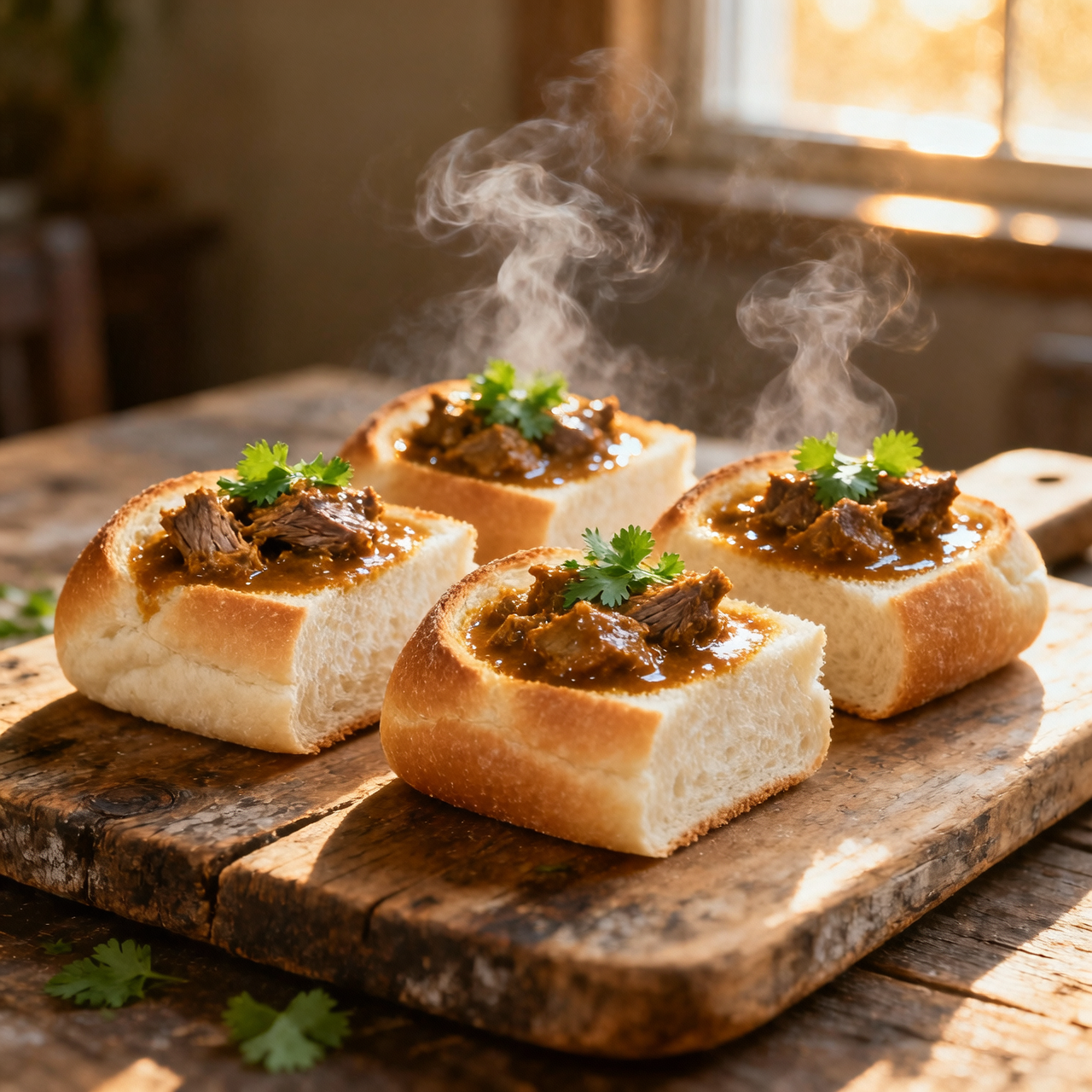
Bunny Chow
I first encountered Bunny Chow in the humid, spice-laced air of Durban’s Grey Street, where it isn’t just a meal but a living piece of South African history. Created by Indian migrant laborers in the mid-twentieth century, this ingenious dish was born out of necessity and resourcefulness. Without traditional utensils or flatbreads readily available, these workers hollowed out quarter-loaves of white bread to serve as edible vessels for rich, fiery curries. What began as a humble street food has since become a beloved national icon, bridging communities and showcasing the beautiful culinary syncretism of the region. To me, Bunny Chow represents the resilience of immigrant communities, transforming scarcity into something deeply comforting and profoundly flavorful. However, mastering it requires respecting a few delicate balances. The most common pitfall is neglecting the bread itself; if you slice the loaf too thin or fail to line the cavity with butter, it will instantly collapse into a mushy, unmanageable mess under the weight of the gravy. Equally crucial is the curry’s consistency. It must be thick enough to hold its shape yet rich enough to soak into the crust without making it soggy. Many home cooks also rush the hollowing process, tearing the bread instead of using a sharp serrated knife to create clean, sturdy walls. When done right, tearing into that crusty exterior and dipping it into the fragrant lamb or bean curry is nothing short of magical. It’s messy, deeply satisfying, and entirely worth the effort.
Nutrition
| Per serving | Calories | Protein | Carbs | Fat | Sat fat | Fibre | Sugar | Sodium |
|---|---|---|---|---|---|---|---|---|
| beginner | 945kcal | 42g | 82g | 53g | 18g | 9g | 13g | 1700mg |
| intermediate | 945kcal | 42g | 82g | 53g | 18g | 9g | 13g | 1700mg |
| expert | 945kcal | 42g | 82g | 53g | 18g | 9g | 13g | 1700mg |
Per serving · Ava-estimated — a guide, not a clinical figure.
- 1 loafwhite bread loaf— unsliced, soft crumb
- 600 glamb shoulder— trimmed and cubed
- 2 piecebrown onion— finely diced
- 6 piecegarlic clove— minced
- 40 gginger root— fresh, finely grated
- 400 gplum tomato— canned or fresh, chopped
- 60 mlvegetable oil— neutral, high smoke point
- 30 gcurry powder blend— Durban-style preferred
- 30 gtomato paste— concentrated
- 10 gfine salt
- 500 mlwater— for simmering
- 20 gfresh coriander leaf(optional)— roughly chopped
This version prioritizes confidence and consistency over complexity. You will rely on a pre-mixed curry powder blend and straightforward assembly to guarantee a reliable result without overwhelming technique. The primary focus here is structural integrity: hollowing the bread correctly so it acts as a sturdy vessel rather than collapsing under the weight of the curry. Watch your heat closely when combining the ingredients; medium heat is your ally for gently coaxing the onions to release moisture without browning or burning the spice blend. Stir frequently during the simmer to keep the gravy moving, which prevents the bottom from scorching while the lamb cooks through. Do not rush the hollowing process, as a torn base will leak precious gravy onto your plate. Keep the curry slightly loose in the pan, remembering that the bread will absorb excess liquid during serving. This approach strips away intimidation, giving you a foolproof framework to experience the core flavor profile of a true Durban classic. Once you master this rhythm, you will naturally develop the intuition needed for more advanced iterations.
Equipment
- Heavy-bottomed pan— non-stick is fine here
- Sharp serrated knife— for clean bread slicing
- Wooden spoon— for gentle stirring
Method
- 1
Preheat your oven to 180°C to gently warm the bread.
Makes hollowing easier without tearing.
warming~ 2 min - 2
Slice the unsliced loaf into four equal quarters and carefully hollow out each piece.
Leave a 1.5 cm base and wall thickness.
hollowing~ 5 minTricky bit - 3
Heat the vegetable oil in a heavy-bottomed pan over medium heat.
Oil should shimmer but not smoke.
heating~ 1 min - 4
Add the diced onions and cook until soft and translucent.
Stir frequently to prevent browning.
sweating~ 5 min - 5
Stir in the lamb, garlic, ginger, curry powder, tomato paste, tomatoes, and salt.
Mix thoroughly until the meat is evenly coated.
combining~ 3 min - 6
Pour in the water, bring to a gentle simmer, and cook until the lamb is tender and the gravy thickens.
Adjust heat to maintain a steady bubble.
simmering~ 20 min - 7
Spoon the finished curry into the hollowed bread quarters and garnish with fresh coriander.
Serve immediately while hot.
plating~ 2 min