
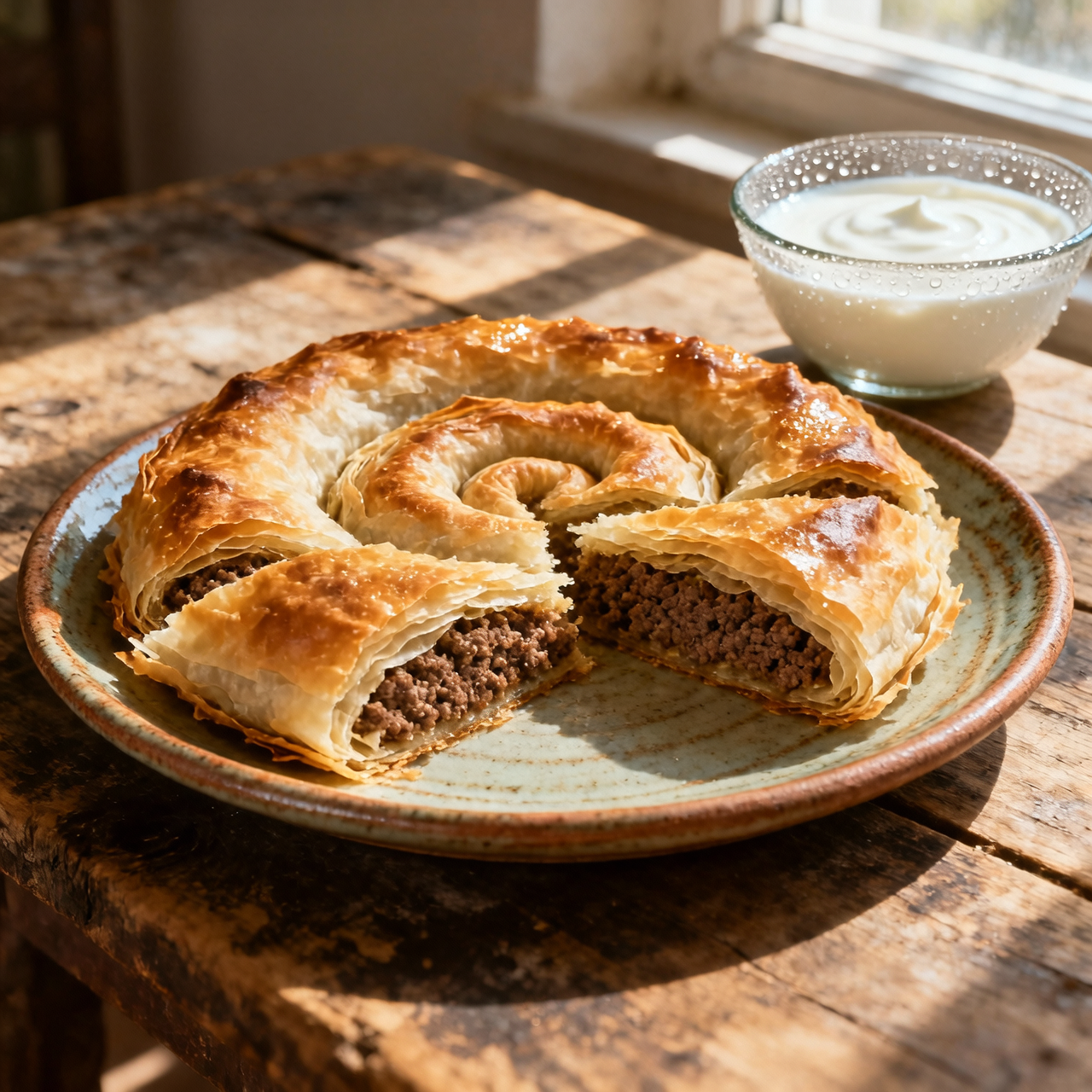
Burek
I’ve always believed that food carries the quiet weight of history, and nowhere is that more true than with burek. Born in the kitchens of the Ottoman Empire and carried across the Balkans by migrating hands and shifting borders, this flaky, meat-filled pastry isn’t just a snack—it’s a shared language. In my own kitchen, rolling out paper-thin dough until my forearms ache, I feel connected to generations who turned scarcity into something generous. Burek matters because it refuses to be rushed. It demands patience, a willingness to listen to the dough, and an understanding that perfection lies in imperfection. The most common mistake I see, whether in home kitchens or rushed bakeries, is overcomplicating the fillings or neglecting the resting time. Dough that hasn’t relaxed will snap back, tearing instead of stretching. Too much moisture from onions or undercooked meat turns the bottom soggy, while brushing each layer with just a whisper of oil or butter is what creates those signature glass-like shatters. I’ve ruined more than a few batches by trying to force the layers too thin too fast, forgetting that the magic happens when you let gravity and gentle hands do the work. When you finally lift a golden coil from the oven and hear that crisp sigh as it meets the cutting board, you understand why this dish has survived empires. It’s not about flawless technique; it’s about showing up, honoring the rhythm of the process, and sharing the warmth before it fades.
Ingredients
- 450 gphyllo dough— thawed completely if frozen
- 500 gground beef— 85% lean preferred
- 150 gyellow onion— finely diced
- 100 gunsalted butter— melted
- 120 gplain whole-milk yogurt— room temperature
- 1 wholelarge egg— lightly beaten
- 8 gfine sea salt— divided for filling and dough
- 3 gblack pepper— freshly ground
- 5 gsweet paprika— Hungarian preferred
Method
Pick a skill levelThis pathway prioritizes accessibility without sacrificing the soul of the dish. You will use pre-cut, store-bought phyllo and a straightforward raw meat mixture, eliminating the need for advanced dough handling or complex prep stations. The focus here is on gentle technique: keeping the sheets moist, brushing butter evenly without soaking them, and rolling with a light touch to prevent tearing. Watch closely for dry edges, which turn brittle and flake apart during baking, and resist the urge to overstuff, which causes the spiral to split open. I have designed the timing to be forgiving, allowing you to pause between layers if needed. The goal is a confident first attempt where the structural mechanics of laminating and coiling become intuitive. You will learn to recognize the exact moment the yogurt-egg glaze sets into a golden shell, and how to tap the crust for that hollow, crisp sound that signals success. Trust the process, work methodically, and do not fear imperfections. Even slightly uneven layers will bake into a deeply satisfying, flaky pastry that proves burek is entirely achievable in a standard home kitchen.
Method
- 1
Preheat your oven to 375°F (190°C) and line a baking sheet with parchment paper.
Even heat prevents burning.
preheating~ 10 min - 2
Combine the ground beef, diced onion, salt, pepper, and paprika in a mixing bowl until evenly distributed.
Do not overwork the meat.
mixing~ 2 min - 3
Unroll the phyllo dough and cover it immediately with a damp towel.
Work quickly once uncovered.
mise en place~ 1 min - 4
Lay the first sheet flat and brush the entire surface lightly with melted butter.
Focus on the edges.
basting~ 2 min - 5
Spread a thin line of the meat mixture along the long edge of the dough.
Keep the filling narrow and even.
piping~ 2 min - 6
Roll the dough tightly into a long log, then coil it into a spiral on the prepared baking sheet.
Tuck the end underneath to seal.
coiling~ 3 minTricky bit - 7
Repeat the layering and rolling process with the remaining sheets and filling, stacking coils side by side.
Leave a small gap for expansion.
layering~ 5 minTricky bit - 8
Whisk the yogurt and beaten egg together, then brush it generously over the entire burek.
This creates the golden crust.
glazing~ 2 min - 9
Bake for 35 minutes until the top is deeply golden and the crust sounds crisp when tapped.
Check at 30 minutes to avoid over-browning.
baking~ 35 min
Here we elevate the process to a home-cook standard, emphasizing control and flavor development. You will sauté the onions first to remove excess moisture and build a savory base, then blend them with the beef and spices. The dough handling shifts from simple unrolling to active tension management, requiring you to brush, roll, and coil with deliberate consistency. Watch for over-brushing, which creates a heavy, greasy bottom crust, and under-brushing, which leaves dry, brittle patches that shatter into crumbs. The yogurt-butter emulsion replaces plain melted butter to introduce subtle acidity and better fat distribution. Timing becomes tighter; once assembly begins, the dough must be baked promptly to prevent the layers from sticking together. Pay attention to oven placement and heat circulation, as proper airflow guarantees an even, lacquered exterior. The key to success at this level is rhythm: maintain a steady pace, keep your work surface organized, and slice only after a brief resting period to preserve the spiral’s architecture. This version bridges convenience and craft, yielding a restaurant-quality result that honors the dish’s traditional balance of crispness and richness.
Method
- 1
Sauté the diced onion in half the melted butter until translucent, then cool completely before mixing with the raw beef, salt, pepper, and paprika.
Cooling prevents premature cooking and dough tearing.
sweating~ 5 min - 2
Preheat the oven to 400°F (200°C) and position a rack in the center.
High initial heat sets the layers.
preheating~ 10 min - 3
Combine the remaining melted butter with yogurt to create a stable, brushable emulsion.
The yogurt tenderizes while the butter crisps.
emulsifying~ 1 min - 4
Lay one phyllo sheet on a clean work surface and brush evenly with the butter-yogurt mixture, ensuring full edge coverage.
Uneven brushing causes dry, brittle spots.
laminating~ 2 min - 5
Place the meat filling along one edge and roll firmly but gently, applying even tension without compressing the dough.
Air pockets will collapse during baking.
rolling~ 2 minTricky bit - 6
Coil the log into a tight spiral on a heavy baking sheet, pressing the end firmly into the base.
Structural integrity prevents unraveling.
coiling~ 2 min - 7
Repeat the brushing and rolling sequence, arranging each new coil snugly against the previous one.
Maintain uniform thickness.
stacking~ 5 minTricky bit - 8
Brush the assembled burek with the remaining emulsion and score the top lightly with a sharp knife to allow steam escape.
Shallow cuts prevent filling leakage.
scoring~ 1 min - 9
Bake for 40 minutes until the crust is uniformly mahogany and registers a hollow tap.
Rest 10 minutes before slicing for clean cuts.
baking~ 40 min
This is the uncompromising, traditional execution reserved for those seeking mastery. You will treat the phyllo like a living canvas, stretching it at room temperature until it is translucent enough to see your hand beneath, a process that demands patience and precise hydration control. The meat filling undergoes a high-heat sear before cooling completely, locking in Maillard complexity while preventing steam pockets from rupturing the delicate dough. Butter is clarified to remove milk solids, raising the smoke point and ensuring a clean, glass-like finish that shatters cleanly. Every brushstroke must be deliberate, creating a flawless lipid barrier between each microscopic layer. Watch for temperature fluctuations; dough that warms too quickly becomes elastic and difficult to coil, while cold dough cracks under tension. The scoring technique is surgical, directing steam release to prevent uneven puffing. Baking requires vigilant rotation and exact thermal thresholds. Success here is measured by acoustic resonance—the crust must ring like porcelain when tapped—and structural precision. This version strips away all shortcuts, demanding total command of lamination, heat transfer, and dough mechanics to achieve the legendary Balkan standard.
Method
- 1
Rest the phyllo dough at room temperature for 60 minutes, then stretch it gently on a floured cloth until translucent and paper-thin.
Dough should stretch without tearing to reveal your hand beneath.
stretching~ 60 minTricky bit - 2
Brown the beef in a dry cast-iron pan over high heat, then drain excess fat before folding in raw onion, salt, pepper, and paprika.
Maillard reaction builds depth; keep filling cool before assembly.
browning~ 8 min - 3
Clarify half the butter by simmering gently, skimming milk solids, and blending with yogurt to form a rich, high-smoke-point glaze.
Clarified butter prevents burning during long bakes.
clarifying~ 5 minTricky bit - 4
Layer each stretched sheet on a dampened work surface, brushing meticulously with the butter-yogurt blend in radial strokes.
Capillary action ensures uniform fat distribution.
laminating~ 10 min - 5
Distribute the cooled meat mixture along the leading edge, then roll with consistent, firm tension to form a uniform cylinder.
Avoid compressing the internal structure.
rolling~ 2 min - 6
Coil the log tightly into a perfect spiral, tucking the final edge beneath to create a seamless anchor point.
Tension dictates final crust shatter.
coiling~ 3 minTricky bit - 7
Continue layering and coiling, stacking each ring flush against the last while maintaining a consistent vertical rise.
Uniformity ensures even heat penetration.
stacking~ 8 min - 8
Apply a final heavy coat of the glaze, then use a razor to score a shallow crosshatch pattern across the surface.
Crosshatching maximizes steam release and surface area.
scoring~ 2 min - 9
Bake at 390°F (200°C) for 45 minutes until the crust achieves a deep amber hue and internal temperature reaches 165°F.
Rotate halfway for symmetrical caramelization.
baking~ 45 min