
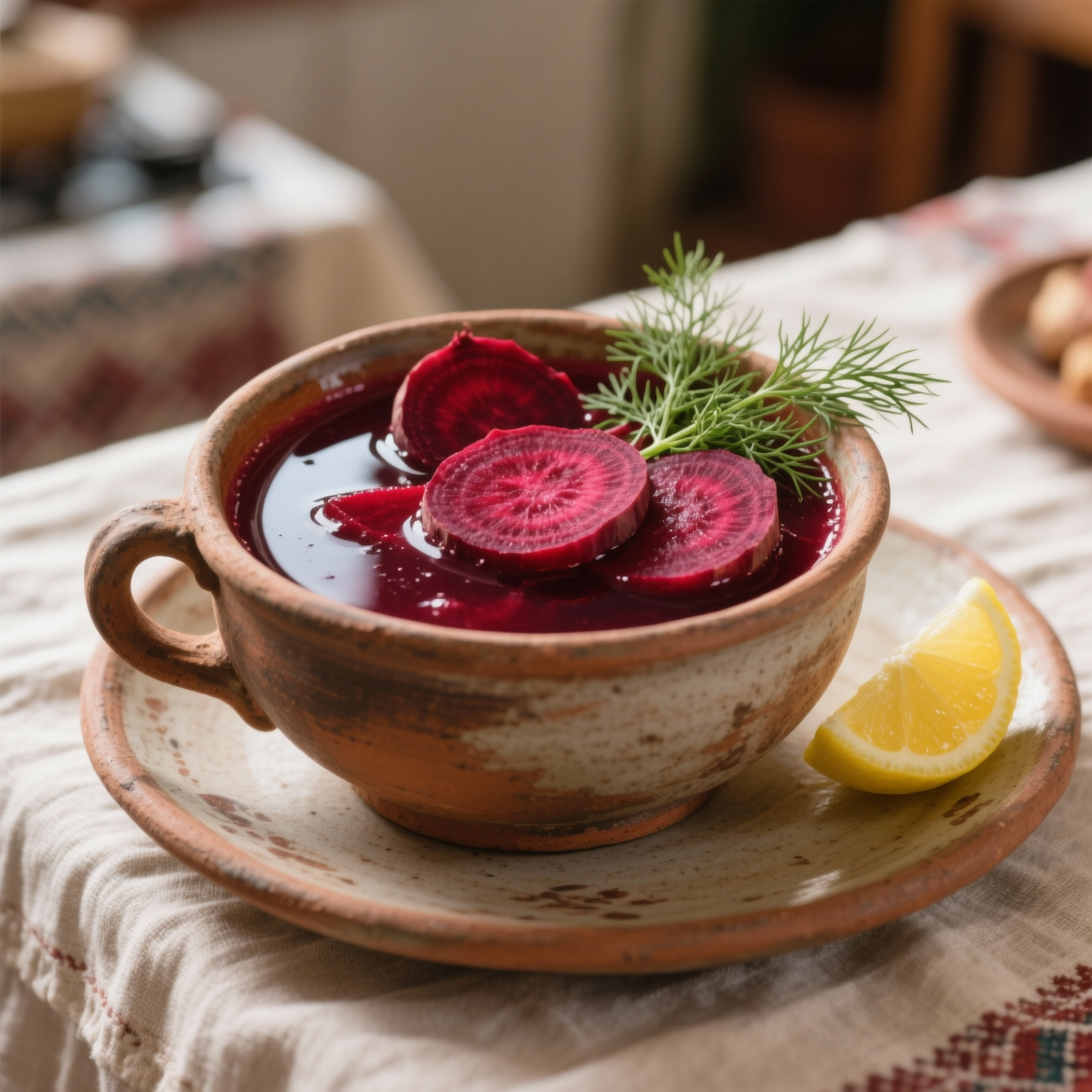
Buriakovy kvas (beet kvass)
As Ava, I often reflect on the deep, earthy roots of Ukrainian cuisine, and few things capture its soul quite like buriakovy kvas. This isn't the sweet, bread-based kvass you might sip at a lively summer festival; this is a robust, lacto-fermented beet elixir, the very heartbeat of a traditional red borscht. Its rich origins trace back centuries across the Ukrainian countryside, where resourceful cooks needed a reliable way to preserve the autumn harvest and create a vibrant, tangy base that would give borscht its signature crimson hue and complex, sour depth. Making it is an act of patience and intuition. You simply submerge dark, earthy beets in water with a touch of rye bread or just salt and sugar, letting wild lactobacillus work its magic over several days. The most common pitfall I see is rushing the fermentation or using the wrong beets; you need deep, dark red beets, not golden ones, and you must keep the vegetables fully submerged to prevent mold. Another mistake is letting it ferment in a warm spot, which can lead to an overly alcoholic or vinegary taste rather than that bright, clean lactic tang. When done right, this batch hero transforms a simple soup into a profound culinary experience, offering a probiotic richness that store-bought broths simply cannot replicate. It is a beautiful testament to the Ukrainian philosophy of letting time and nature elevate humble ingredients into something truly extraordinary.
Nutrition
| Per serving | Calories | Protein | Carbs | Fat | Sat fat | Fibre | Sugar | Sodium |
|---|---|---|---|---|---|---|---|---|
| beginner | 25kcal | 1g | 4g | 0g | 0g | 1g | 2g | 950mg |
| intermediate | 75kcal | 3g | 16g | 1g | 0g | 4g | 9g | 1750mg |
| expert | 35kcal | 1g | 7g | 0g | 0g | 0g | 6g | 850mg |
Per serving · Ava-estimated — a guide, not a clinical figure.
- 1000 gbeetroot— washed, peeled, and cut into large chunks
- 2000 mlwater— filtered or boiled and cooled to room temperature
- 15 gsalt— non-iodized
- 10 gsugar(optional)— white or cane
This beginner-friendly approach to traditional Ukrainian buriakovy kvas simplifies the fermentation process, making it an accessible batch hero for your red borscht. Instead of relying on wild yeast from scratch or complex sourdough starters, this method uses a commercial vegan probiotic starter or a splash of raw apple cider vinegar to kickstart lacto-fermentation reliably. We also use pre-grated beets to maximize surface area, ensuring a robust, tangy flavor and deep ruby color in just two to three days. Watch for the formation of a slight white film on the surface; this is normal kahm yeast and can be skimmed off, but if you see fuzzy mold, discard the batch. The liquid should smell pleasantly earthy and sour, not rotten. This shortcut method guarantees a confident first attempt at this vibrant, probiotic-rich condiment. It is an excellent, zero-waste way to build deep umami and color. Once strained, keep it refrigerated to halt fermentation, using it as a vibrant base for borscht or a refreshing, gut-healthy tonic.
Equipment
- 2-liter glass jar— Wide mouth, non-reactive
- Fine-mesh strainer— For filtering the final kvass
- Cheesecloth or coffee filter— To cover the jar while allowing it to breathe
Method
- 1
Dissolve the sea salt and sugar in one cup of warm water until completely dissolved.
Ensure the water is not hot enough to kill the starter culture.
dissolving~ 2 min - 2
Peel and coarsely grate the beets, or use pre-grated beets to save time.
Pre-grated is a great beginner shortcut that maximizes surface area.
grating~ 5 min - 3
Place the grated beets in the glass jar and pour the cooled saltwater mixture over them.
Leave at least two inches of headspace at the top for fermentation gases.
combining~ 1 min - 4
Stir in the vegan probiotic starter or apple cider vinegar to inoculate the brine.
This guarantees a successful ferment without relying on unpredictable wild yeasts.
inoculating~ 1 min - 5
Cover the jar with cheesecloth, secure it with a rubber band, and let it sit at room temperature for three days.
Keep out of direct sunlight and skim any white film that forms on the surface.
fermenting~ 4320 minTricky bit - 6
Strain the liquid through a fine-mesh sieve into a clean bottle, discarding the spent beets.
Store the kvass in the refrigerator to halt fermentation; it will keep for up to a month.
straining~ 2 min
Cooking from frozen
Thaw in the refrigerator overnight; shake well before using as a borscht base.
Storage times are a guide — always use your judgement and store food safely.