
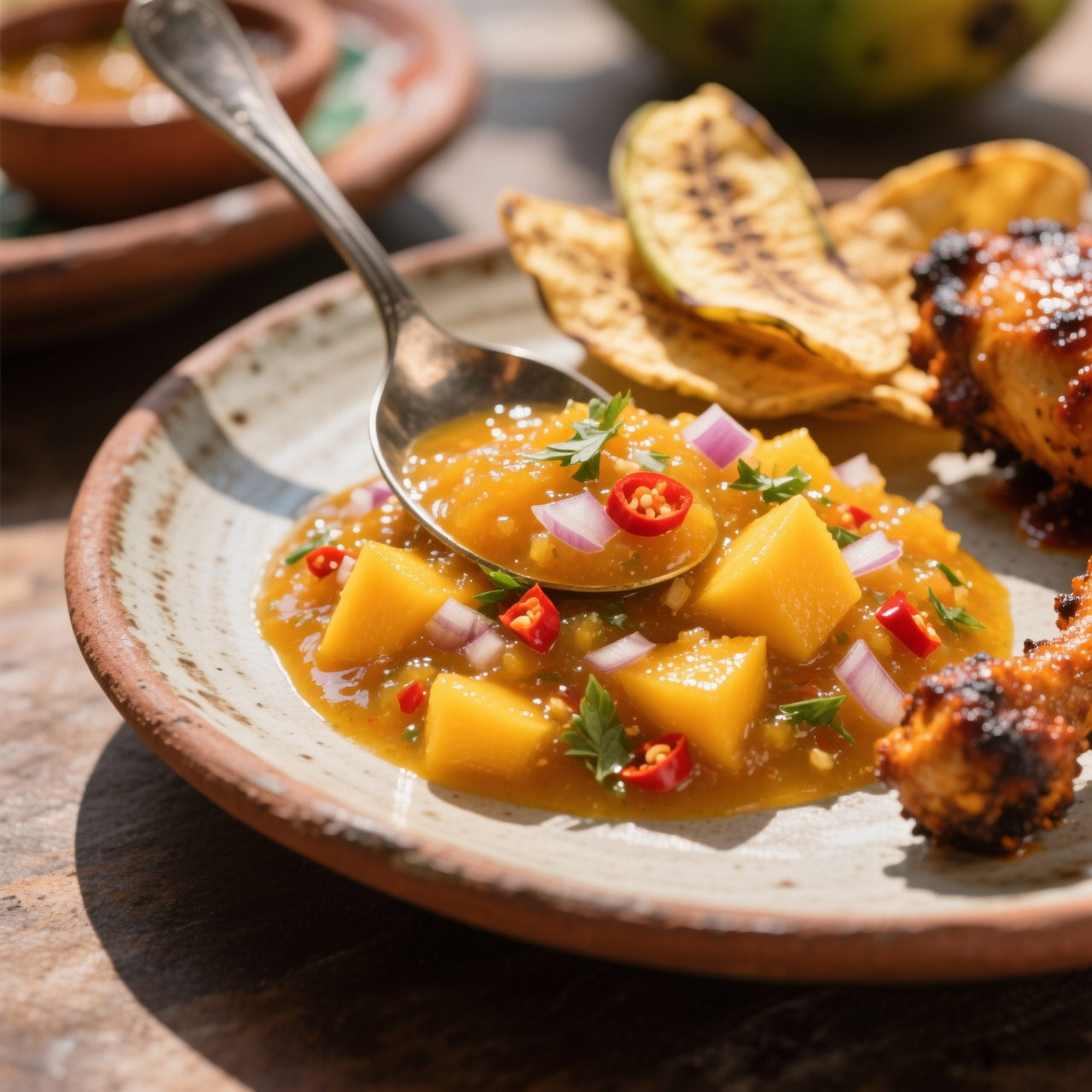
Mango chutney
When I think of Caribbean mango chutney, I’m immediately transported back to the humid, fragrant kitchens of Trinidad and Tobago, where the air hangs thick with the scent of simmering fruit and scotch bonnet peppers. This isn’t just a condiment; it’s a delicious historical document. Brought to the Caribbean by Indian indentured laborers in the nineteenth century, chutney was adapted to showcase the islands’ abundant, jewel-toned mangoes. As a vegan staple, it relies entirely on the natural pectin of the fruit and the preserving power of vinegar and sugar to achieve that perfect, jammy consistency. Making a massive batch for the year is a labor of love, but it rewards you with jars of sunshine to brighten up curries, flatbreads, and roasted vegetables all winter long. The most common pitfall I see is choosing the wrong mango. You want them ripe enough to be sweet and fragrant, but firm enough to hold their shape during the long simmer; if they are too mushy, you end up with applesauce instead of chutney. Another mistake is rushing the reduction. The mixture needs to cook low and slow until the syrup thickens and coats the back of a spoon, ensuring it seals properly in the jar and won't spoil. Finally, respect the scotch bonnet—handle it with gloves, because while that fiery kick is essential to the authentic Caribbean profile, it will make your hands burn for days if you aren't careful.
Nutrition
| Per serving | Calories | Protein | Carbs | Fat | Sat fat | Fibre | Sugar | Sodium |
|---|---|---|---|---|---|---|---|---|
| beginner | 85kcal | 1g | 21g | 0g | 0g | 1g | 16g | 120mg |
| intermediate | 145kcal | 1g | 36g | 1g | 0g | 2g | 28g | 120mg |
| expert | 140kcal | 1g | 35g | 1g | 0g | 2g | 28g | 120mg |
Per serving · Ava-estimated — a guide, not a clinical figure.
- 1500 gmango— peeled, pitted, and diced into 1cm cubes
- 300 gbrown sugar— dark brown or muscovado
- 100 graisin— sultanas can be substituted
- 200 gred onion— finely chopped
- 20 ggarlic clove— minced
- 30 gfresh ginger— peeled and grated
- 10 gScotch bonnet pepper— finely chopped, seeds removed for less heat
- 250 mlwhite vinegar— cane vinegar is traditional
- 30 gtamarind paste(optional)— unsweetened
- 15 gsalt— fine sea salt
- 10 gmustard seed— whole
- 5 gcumin seed— whole
- 2 gclove— whole
- 5 gallspice berry— whole
This beginner-friendly approach to Caribbean mango chutney embraces convenient shortcuts to deliver authentic sweet, spicy, and tangy flavors without the hours of peeling, chopping, and spice grinding. By utilizing pre-diced mangoes and a high-quality jarred Caribbean green seasoning or curry paste, you bypass the most tedious prep work while still achieving a vibrant, complex condiment. The technique focuses heavily on gentle simmering and patience. Your primary goal is to reduce the mixture until it reaches a thick, jam-like consistency, so keep a close eye on the heat to prevent the natural sugars from scorching at the bottom of the pan. This foolproof method guarantees a confident first attempt at making a pantry-stable preserve. It yields a generous batch, allowing you to easily jar it up and enjoy the bright, tropical tastes of the islands all year long with minimal effort and maximum flavor.
Equipment
- Heavy-bottomed pan— Enameled cast iron or non-stick is best to prevent sugar scorching
- Sterilized glass jars— Ensure they have tight-fitting lids for proper storage
- Wooden spoon— Use for frequent stirring without scratching the pan
Method
- 1
Combine pre-diced mangoes, jarred green seasoning, brown sugar, and apple cider vinegar in a heavy-bottomed pan.
Stir well to ensure the sugar is fully submerged in the liquid.
combining~ 5 min - 2
Bring the mixture to a gentle boil over medium heat, then immediately reduce the heat to low.
Watch for sudden bubbling over; adjust heat as needed.
boiling~ 10 min - 3
Simmer uncovered, stirring frequently, until the mangoes break down and the liquid reduces to a thick, syrupy glaze.
If it looks too dry, add a splash of water to prevent burning.
simmering~ 30 minTricky bit - 4
Carefully ladle the hot chutney into sterilized glass jars, seal tightly, and let cool to room temperature before refrigerating.
Leave a quarter-inch headspace at the top of each jar.
jarring~ 10 min
Cooking from frozen
Thaw overnight in the fridge and stir well to recombine any separated liquids.
Storage times are a guide — always use your judgement and store food safely.