
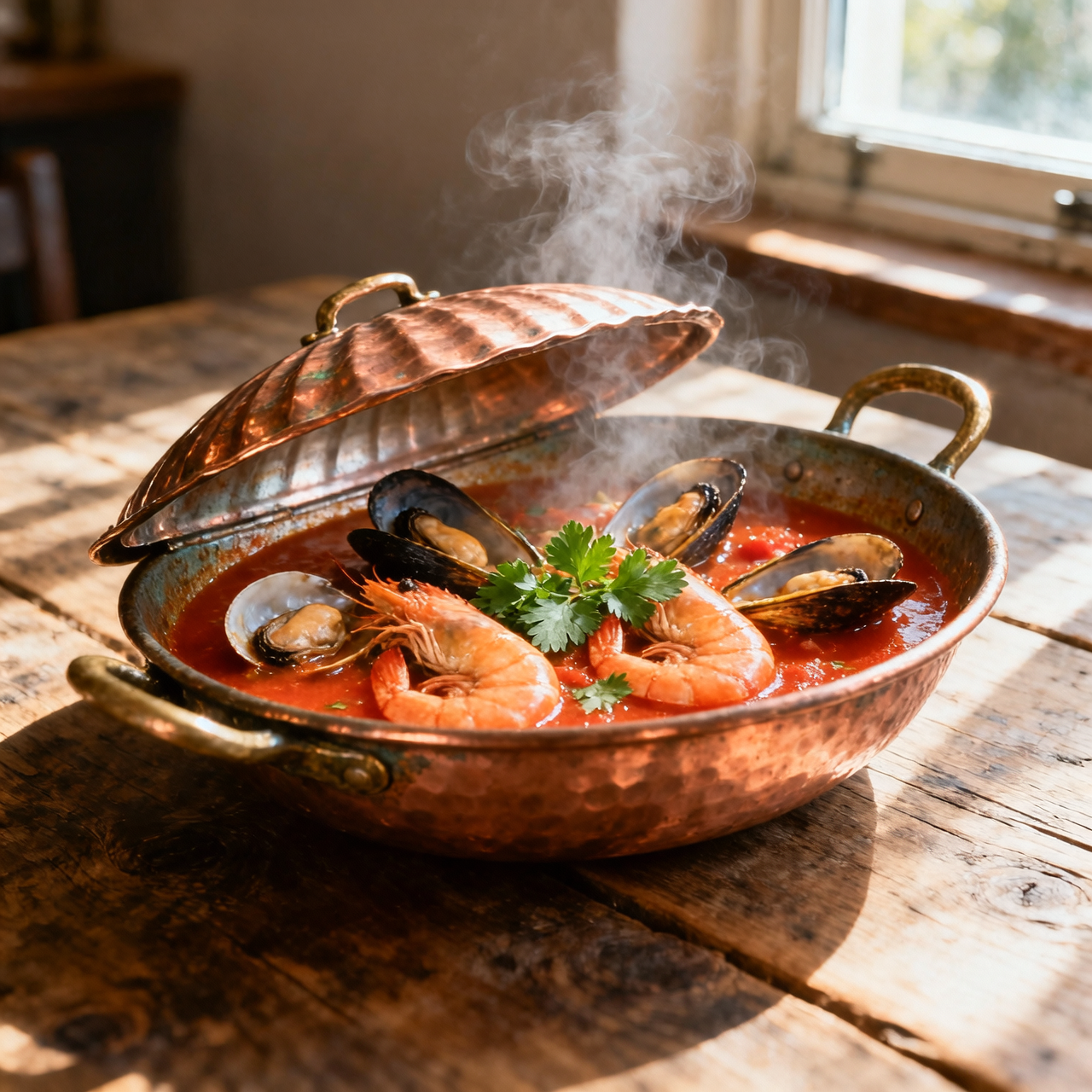
Cataplana de Marisco
I’ve always been drawn to the cataplana de marisco, a dish that carries the salt-kissed soul of Portugal’s Algarve coast, even if I’ve occasionally found myself adapting its rhythms to an Italian kitchen’s sensibility. At its heart, it’s a celebration of the sea, traditionally cooked in a copper clam-shaped vessel that seals in steam and concentrates the briny sweetness of clams, prawns, and firm white fish. What makes this dish matter to me isn’t just its vibrant history as a fisherman’s quick-fire meal, but the way it demands presence. You can’t rush a cataplana, and you certainly can’t ignore the balance of aromatics. Too many home cooks drown it in heavy tomato sauce or overcook the seafood into rubbery oblivion, missing the point entirely. The magic lies in the layering: a gentle sauté of garlic and onion in good olive oil, a splash of dry white wine to lift the shells open, and just enough fresh herbs to whisper rather than shout. Another frequent misstep is neglecting the vessel itself. If you don’t have a traditional cataplana pan, a heavy Dutch oven with a tight-fitting lid will work, but you must respect the sealing process. The steam must circulate, the ingredients must baste in their own juices, and the timing must be precise. When you finally crack that copper lid or lift the heavy iron cover, you should be met with an oceanic perfume, not a boiled stew. It’s a reminder that great seafood cooking is less about intervention and more about listening to the ingredients. I make this dish to honor that quiet alchemy, to bring a piece of the Mediterranean’s edge to my table, and to remember that simplicity, when treated with reverence, is the truest form of mastery.
Nutrition
| Per serving | Calories | Protein | Carbs | Fat | Sat fat | Fibre | Sugar | Sodium |
|---|---|---|---|---|---|---|---|---|
| beginner | 425kcal | 42g | 19g | 18g | 3g | 4g | 5g | 1025mg |
| intermediate | 425kcal | 42g | 19g | 18g | 3g | 4g | 5g | 1025mg |
| expert | 425kcal | 42g | 19g | 18g | 3g | 4g | 5g | 1025mg |
Per serving · Ava-estimated — a guide, not a clinical figure.
- 60 mlExtra virgin olive oil— cold-pressed, unfiltered
- 1 mediumYellow onion— finely diced
- 4 cloveGarlic clove— peeled and thinly sliced
- 15 gSweet paprika— Spanish pimentón dulce preferred
- 400 gRipe tomato— roughly chopped
- 120 mlDry white wine— unoaked, crisp
- 300 gLive clam— purged in cold water
- 300 gLive mussel— debearded and scrubbed
- 300 gLarge raw shrimp— shell-on, deveined
- 200 gCleaned squid ring— fresh or thawed
- 15 gFresh coriander— leaves and tender stems
- 5 gSea salt— coarse grain
- 3 gBlack peppercorn— freshly cracked
- 1 wholeLemon— for serving wedges
This version prioritizes confidence over tradition, using a heavy Dutch oven or large skillet to replicate the cataplana’s steam-trapping effect without specialized copperware. You will follow a straightforward, linear sequence that eliminates guesswork. The aromatics are sautéed gently, the wine is reduced quickly to concentrate flavor without bitterness, and the seafood is added in a strict, staggered order to prevent overcooking. Watch for the moment the shells begin to crack open; that is your cue to remove the pot from the heat immediately. The residual steam will finish the job, keeping every bite tender. Do not be tempted to lift the lid during the final resting phase, as escaping steam will dry out the delicate proteins. If a shell remains stubbornly closed after resting, discard it for safety. This approach guarantees a restaurant-quality broth with zero fuss, making it ideal for weeknight entertaining or your first coastal braise. Focus on clean ingredient prep and precise timing, and the dish will practically cook itself.
Equipment
- Heavy-bottomed pot with tight-fitting lid— Dutch oven works perfectly
- Silicone tongs— for safe seafood handling
- Large mixing bowl— for prepping aromatics
Method
- 1
Heat olive oil in a heavy-bottomed pot over medium heat until shimmering.
Oil should ripple but not smoke.
sweating~ 1 min - 2
Add diced onion and sliced garlic, stirring constantly until translucent.
Lower heat if edges begin to brown.
sautéing~ 2 min - 3
Sprinkle sweet paprika over the softened aromatics and stir continuously for thirty seconds to release its oils.
Paprika burns instantly if left unattended.
blooming~ 1 minTricky bit - 4
Pour in the chopped tomatoes, white wine, salt, and pepper, then bring to a gentle simmer.
Bubbles should be slow and steady.
reducing~ 5 min - 5
Nestle the clams, mussels, shrimp, and squid rings evenly into the simmering broth, cover tightly, and cook until the majority of shells have opened.
Do not stir once the seafood is in place.
steaming~ 7 minTricky bit - 6
Remove the pot from heat, let it rest covered for two minutes, then garnish with fresh coriander and serve immediately with lemon wedges.
Resting ensures even internal temperature.
resting~ 2 min