
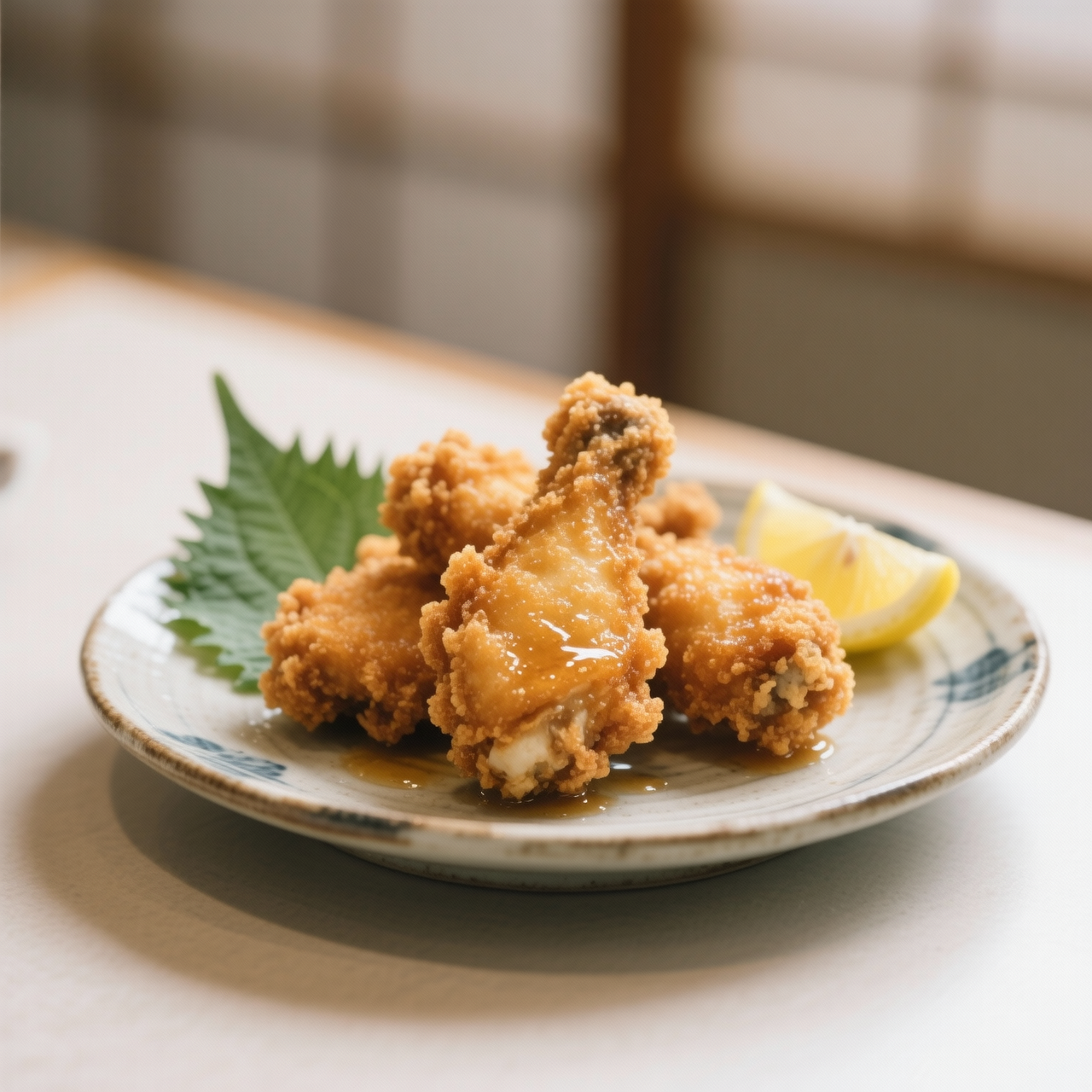
Chicken Karaage
I first learned about karaage from a Tokyo street vendor who sold it wrapped in wax paper, steam escaping the folds like a quiet promise. It’s a Japanese technique born from postwar ingenuity, where bite-sized chicken is marinated in a deeply savory blend of soy, sake, ginger, and garlic before being dusted in potato starch and fried until glassy and impossibly crisp. I’m sharing this recipe as a direct, uncompromising replacement for those frozen nugget boxes that crowd supermarket freezers. You’ll pay nearly five pounds for a plastic tray of heavily processed, uniformly shaped patties bound with cheap fillers and masked by artificial flavorings. They taste of salt and compromise, and they never deliver that satisfying shatter of real crust or the juicy, aromatic interior you get when you build flavor from scratch. The beauty of karaage lies in its straightforward method, yet it is surprisingly easy to misstep. The most common pitfalls are rushing the marinade, skipping the double-dusting step, or frying at inconsistent temperatures, which yields a soggy coating or a dry, stringy bite. You must allow the chicken to rest long enough for the umami to fully penetrate, then coat it lightly just before it hits the oil. No jarred pastes, no pre-mixed breading, and no frozen shortcuts are permitted. Every component is measured, mixed, and fried by hand, because that is how you reclaim your table from industrial mediocrity. When done right, the result is a deeply savory, texturally perfect main that proves real ingredients will always outpace a microwave dinner.
Nutrition
| Per serving | Calories | Protein | Carbs | Fat | Sat fat | Fibre | Sugar | Sodium |
|---|---|---|---|---|---|---|---|---|
| beginner | 560kcal | 34g | 24g | 28g | 6g | 0g | 2g | 680mg |
| intermediate | 485kcal | 29g | 18g | 31g | 6g | 1g | 3g | 610mg |
| expert | 420kcal | 28g | 22g | 24g | 5g | 1g | 4g | 890mg |
Per serving · Ava-estimated — a guide, not a clinical figure.
- 500 gchicken thigh— boneless and skin-on, cut into bite-sized pieces
- 30 mlsoy sauce— preferably Japanese
- 15 mlsake
- 15 mlmirin
- 10 gginger— freshly grated
- 10 ggarlic— freshly minced
- 60 gpotato starch— for dredging
- 500 mlvegetable oil— for deep frying
- 1 wholelemon(optional)— cut into wedges for serving
This beginner-friendly approach strips away the intimidation of double-frying while keeping every element strictly from scratch. Store-bought chicken nuggets typically cost eight to twelve dollars a bag, yet deliver a cardboard-like texture, excessive sodium, and a long list of stabilizers. Here, you will achieve that satisfying crunch and juicy interior using only whole pantry staples. The marinade relies on a quick blend of soy sauce, fresh ginger, garlic, and rice vinegar, requiring just fifteen minutes of hands-on time. Instead of a complex potato starch blend, we use a straightforward cornstarch dredge that crisps beautifully at a single, steady frying temperature. The key to success is patience with your oil: let it reach a gentle shimmer before adding the chicken, and never crowd the pan, which causes the temperature to plummet and leads to soggy breading. Watch the chicken closely as it browns; the starch coating can go from golden to dark in seconds. Rest the pieces on a wire rack immediately after frying so steam escapes, preserving that signature karaage snap. You will gain confidence in basic deep-frying without relying on any processed shortcuts or pre-mixed packets.
Equipment
- Heavy-bottomed skillet or Dutch oven— at least 2 inches deep for safe frying
- Wire cooling rack— keeps fried chicken crisp by allowing airflow
- Instant-read thermometer(optional)— helps maintain 325°F oil temperature
Method
- 1
Cut boneless, skinless chicken thighs into uniform bite-sized pieces.
Aim for 1.5-inch chunks to ensure even cooking.
dicing~ 3 min - 2
Whisk together soy sauce, freshly grated ginger, minced garlic, rice vinegar, and granulated sugar, then thoroughly coat the chicken.
Allow the mixture to sit at room temperature for twenty minutes to penetrate the meat.
marinating~ 20 min - 3
Place cornstarch in a shallow dish and press each marinated piece into it until lightly coated.
Shake off any loose powder to prevent the oil from turning gummy.
dredging~ 5 min - 4
Pour neutral oil into a heavy pan and heat it until it reaches a steady 325°F.
Use a thermometer to verify; too hot burns the crust, too cool makes it greasy.
temperature_control~ 10 minTricky bit - 5
Carefully lower the coated chicken into the oil in a single layer and fry until golden brown.
Never overcrowd the pan, as it drops the temperature and causes sogginess.
frying~ 8 minTricky bit - 6
Transfer the cooked pieces directly to a wire cooling rack to drain before serving.
Avoid paper towels, which trap steam and ruin the crisp coating.
resting~ 3 min
Cooking from frozen
Thaw completely in the refrigerator, then recrisp on a wire rack in a 190°C oven for 12 to 15 minutes until piping hot.
Storage times are a guide — always use your judgement and store food safely.