
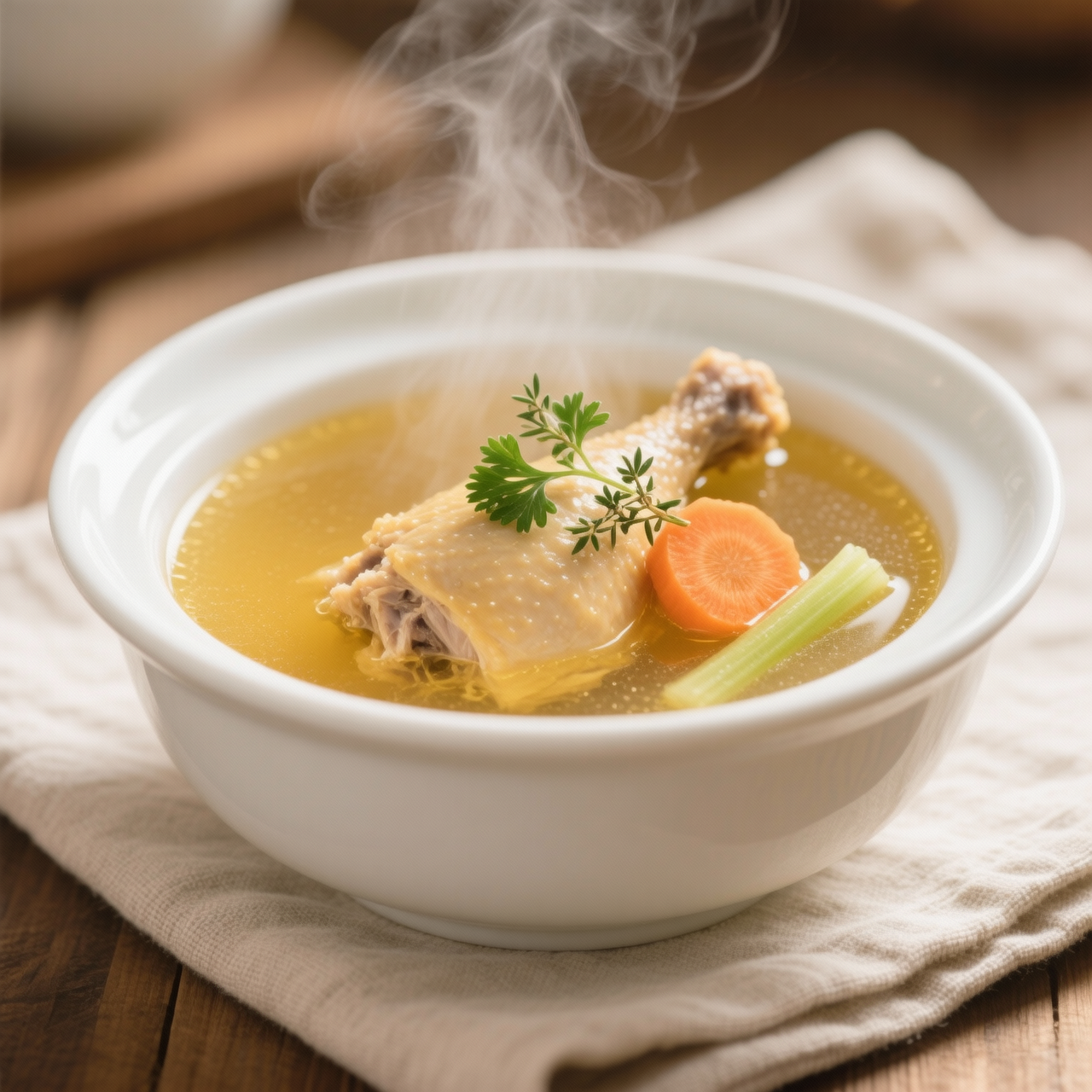
Chicken stock
Chicken stock is the quiet heartbeat of the kitchen, a universal foundation that I consider the true starting point of almost everything I cook. Long before modern flavor enhancers, cooks across the globe discovered that simmering poultry bones with aromatic vegetables and water yielded a liquid gold capable of transforming humble ingredients into profound meals. It matters because it is the baseline of depth; without a good stock, your sauces lack body, your risottos taste flat, and your soups are merely hot water with floating bits. Yet, I see so many people ruin it with common pitfalls. The biggest mistake is boiling it vigorously, which emulsifies the fat and proteins into a cloudy, greasy mess. Always keep it at a bare, lazy simmer. Another trap is over-salting early on; as the stock reduces, that salt concentrates and can ruin your final dish. I prefer to season at the end. When I make a batch, I treat it as a batch hero. I simmer it for hours, strain it carefully, and then I freeze it. Freezing it in ice cube trays or silicone molds gives me perfect, pre-portioned flavor bombs. Those little cubes are essentially pure salt and MSG—umami in their most concentrated, usable form. Whenever I need to deglaze a pan, cook a grain, or just elevate a quick weeknight dinner, I toss in a few cubes. It is the ultimate culinary shortcut that actually tastes like you spent all day cooking. By mastering this one foundational liquid, you unlock a world of richer, deeper, and more cohesive flavors in every single dish you create.
Nutrition
| Per serving | Calories | Protein | Carbs | Fat | Sat fat | Fibre | Sugar | Sodium |
|---|---|---|---|---|---|---|---|---|
| beginner | 35kcal | 3g | 3g | 1g | 1g | 1g | 1g | 850mg |
| intermediate | 25kcal | 3g | 1g | 1g | 1g | 0g | 0g | 650mg |
| expert | 25kcal | 2g | 1g | 1g | 1g | 0g | 0g | 850mg |
Per serving · Ava-estimated — a guide, not a clinical figure.
- 1500 gchicken carcass— roughly chopped into smaller pieces to fit the pot
- 3000 mlwater— cold, enough to cover the bones by a few inches
- 2 pieceonion— halved, skin left on for deeper color
- 2 piececarrot— roughly chopped
- 2 piececelery— roughly chopped
- 20 ggarlic— smashed, skin removed
- 10 gblack peppercorn— whole
- 2 piecebay leaf— dried
- 30 gparsley— stems and leaves
- 10 gthyme— fresh sprigs
- 15 gsalt(optional)— optional if reducing to cubes later
- 5 gMSG(optional)— optional, for enhanced umami if freezing as cubes
This beginner-friendly approach to chicken stock bypasses the traditional 12-hour simmer by utilizing a high-quality jarred chicken bouillon paste as a flavor shortcut. While purists might scoff, this method delivers a remarkably rich, savory foundation in under an hour, making it perfect for weeknight cooking. The paste, essentially a concentrated blend of salt, MSG, and chicken fat, provides the deep umami that usually takes hours to extract from bones. Your main goal here is to build a fresh aromatic base to elevate the jarred paste, ensuring the final stock tastes vibrant and homemade rather than flat and processed. Keep an eye on the heat; a gentle simmer is crucial to keep the liquid clear and prevent the vegetables from turning to mush, which would cloud your stock. Because the paste is highly concentrated, taste before adding any extra salt. This version is a true batch hero: freeze the leftover stock in ice cube trays or silicone molds for instant, perfectly portioned flavor bombs ready to deploy in future sauces, soups, and risottos.
Equipment
- Medium stockpot— A heavy-bottomed pot ensures even heat distribution
- Fine-mesh strainer— Cheesecloth can be used for an even clearer stock
Method
- 1
Roughly chop the yellow onion, carrots, and celery into large, uniform chunks.
Keep pieces large so they are easy to strain out later.
mirepoix~ 5 min - 2
Heat a neutral oil in the stockpot over medium heat and sauté the chopped vegetables until slightly softened.
Do not let them brown; you want a sweet, clean flavor base.
sweating~ 5 min - 3
Add the chicken carcass, cold water, and chicken bouillon paste to the pot, stirring vigorously to fully dissolve the paste.
Starting with cold water helps extract flavors gently and keeps the stock clear.
dissolving~ 2 min - 4
Bring the mixture to a boil, then immediately reduce the heat to maintain a very gentle simmer for 30 minutes.
Skim off any gray foam that rises to the top for a cleaner taste.
simmering~ 30 minTricky bit - 5
Remove the pot from the heat and carefully pour the stock through a fine-mesh strainer into a large heatproof bowl.
Discard the solids; do not press them through the strainer.
straining~ 5 min - 6
Let the strained stock cool to room temperature before portioning into airtight containers or ice cube trays for the freezer.
Refrigerate uncovered until completely cold to let the fat solidify on top for easy removal.
cooling~ 20 min
Cooking from frozen
Thaw overnight in the fridge or melt directly in a saucepan over low heat.
Storage times are a guide — always use your judgement and store food safely.