
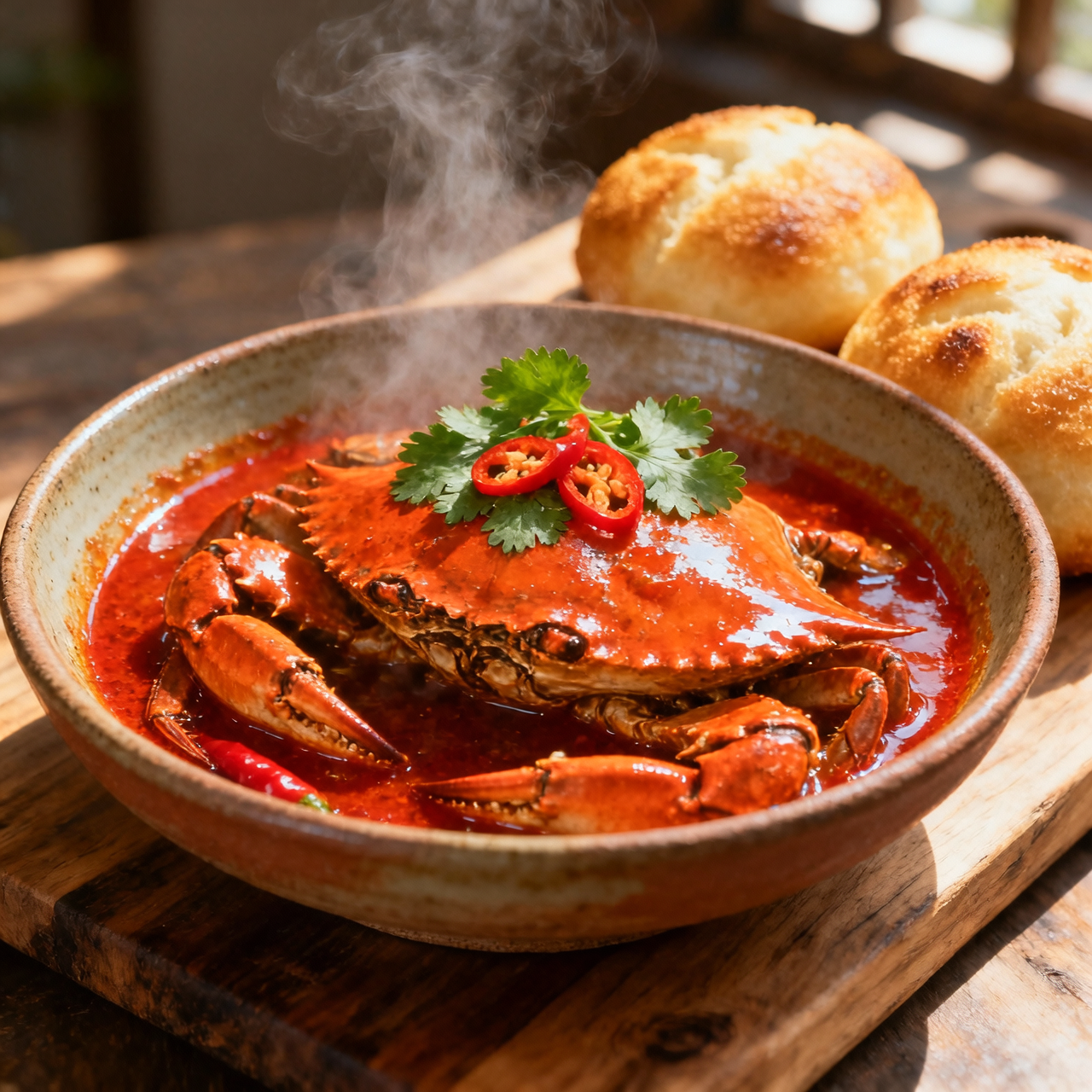
Chilli Crab
When I first learned to make chilli crab, I quickly understood why it’s more than just a dish—it’s a living archive of Singapore’s coastal heritage. Born in the 1950s from the kitchens of Peranakan and Chinese hawkers, particularly credited to Madam Cher Yam Tian, it emerged when resourceful cooks paired sweet tomato ketchup with fiery chillies to mask the briny tang of freshly caught mud crabs. I’ve always loved how the recipe refuses to be pinned down; it’s a beautiful negotiation between Malay, Chinese, and colonial influences, simmered down into something entirely our own. To me, it matters because it embodies the Singaporean spirit: bold, unapologetically messy, and meant to be shared with your hands, your family, and a stack of steamed mantou to mop up every last drop of that gloriously thick, crimson sauce. Yet so many home cooks miss the mark by treating it like a simple stir-fry. The most common pitfalls I see are rushing the sauce reduction, which leaves it watery instead of luxuriously clingy, and drowning the crab in raw chilli paste without balancing the sweetness and umami. Others overcook the shellfish, turning tender meat rubbery, or forget to crack and score the shells properly so the sauce can actually penetrate. I always remind myself to build the base slowly, let the tomatoes break down completely, and finish with a gentle swirl of beaten egg only when the heat is low. Patience, not perfection, is what makes this dish sing.
Nutrition
| Per serving | Calories | Protein | Carbs | Fat | Sat fat | Fibre | Sugar | Sodium |
|---|---|---|---|---|---|---|---|---|
| beginner | 290kcal | 23g | 23g | 12g | 2g | 2g | 12g | 850mg |
| intermediate | 290kcal | 23g | 23g | 12g | 2g | 2g | 12g | 850mg |
| expert | 290kcal | 23g | 23g | 12g | 2g | 2g | 12g | 850mg |
Per serving · Ava-estimated — a guide, not a clinical figure.
- 1500 gmud crab— live, cleaned and cracked into sections
- 300 gtomato— ripe, finely chopped or crushed
- 60 gshallot— peeled
- 30 ggarlic— cloves peeled
- 20 gginger— fresh, peeled
- 40 gred chilli— fresh, seeds optional for heat
- 45 gtomato ketchup— standard variety
- 30 mloyster sauce— traditional fermented
- 15 mllight soy sauce— low sodium preferred
- 20 ggranulated sugar— white cane sugar
- 10 gcornflour— for slurry
- 250 mlwater— room temperature
- 30 mlvegetable oil— neutral high smoke point
- 1 wholeegg— lightly beaten
- 1 wholelime— for fresh juice
- 10 gcilantro— fresh leaves, roughly chopped
This pathway prioritizes accessibility and confidence, allowing you to achieve a recognizable chilli crab profile without mastering complex paste preparation. You will rely on a high-quality jarred chilli crab sauce as your flavor foundation, which already contains the precise balance of sweet, sour, and spicy notes. The primary goal here is timing and temperature management rather than ingredient manipulation. You will learn to gently simmer pre-cleaned crab sections until just opaque, avoiding the rubbery texture that comes from aggressive boiling. The technique emphasizes careful thickening with a simple cornflour slurry and mastering the gentle egg-drop method to create silky ribbons in the hot gravy. Watch for the moment the sauce coats the back of a spoon; this indicates proper viscosity. The shortcut paste means you skip tedious grinding and oil separation, freeing you to focus entirely on plating and serving alongside fried bread. By removing the guesswork from spice blending, you can confidently execute the dish’s signature glossy finish and deliver a comforting, restaurant-familiar experience on your very first attempt.
Equipment
- Heavy-bottomed pan— non-stick is fine here
- Measuring spoons— for accurate sauce ratios
- Whisk— for cornflour slurry
Method
- 1
Combine vegetable oil and jarred chilli crab sauce in the pan over medium heat.
Stir constantly until the paste sizzles gently.
blooming~ 2 min - 2
Add cleaned crab sections and coat thoroughly with the heated sauce.
Turn pieces once to ensure even coverage.
searing~ 3 min - 3
Pour in water, ketchup, and soy sauce, then bring to a gentle simmer.
Bubbles should barely break the surface.
simmering~ 5 minTricky bit - 4
Whisk cornflour with cold water until smooth, then stir into the bubbling gravy.
Add slowly to prevent lumps.
thickening~ 2 minTricky bit - 5
Drizzle beaten egg slowly into the center while stirring gently in one direction.
Stop stirring after one full rotation.
tempering~ 1 min - 6
Remove from heat, squeeze fresh lime juice over the top, and garnish with cilantro.
Serve immediately while piping hot.
finishing~ 1 min