
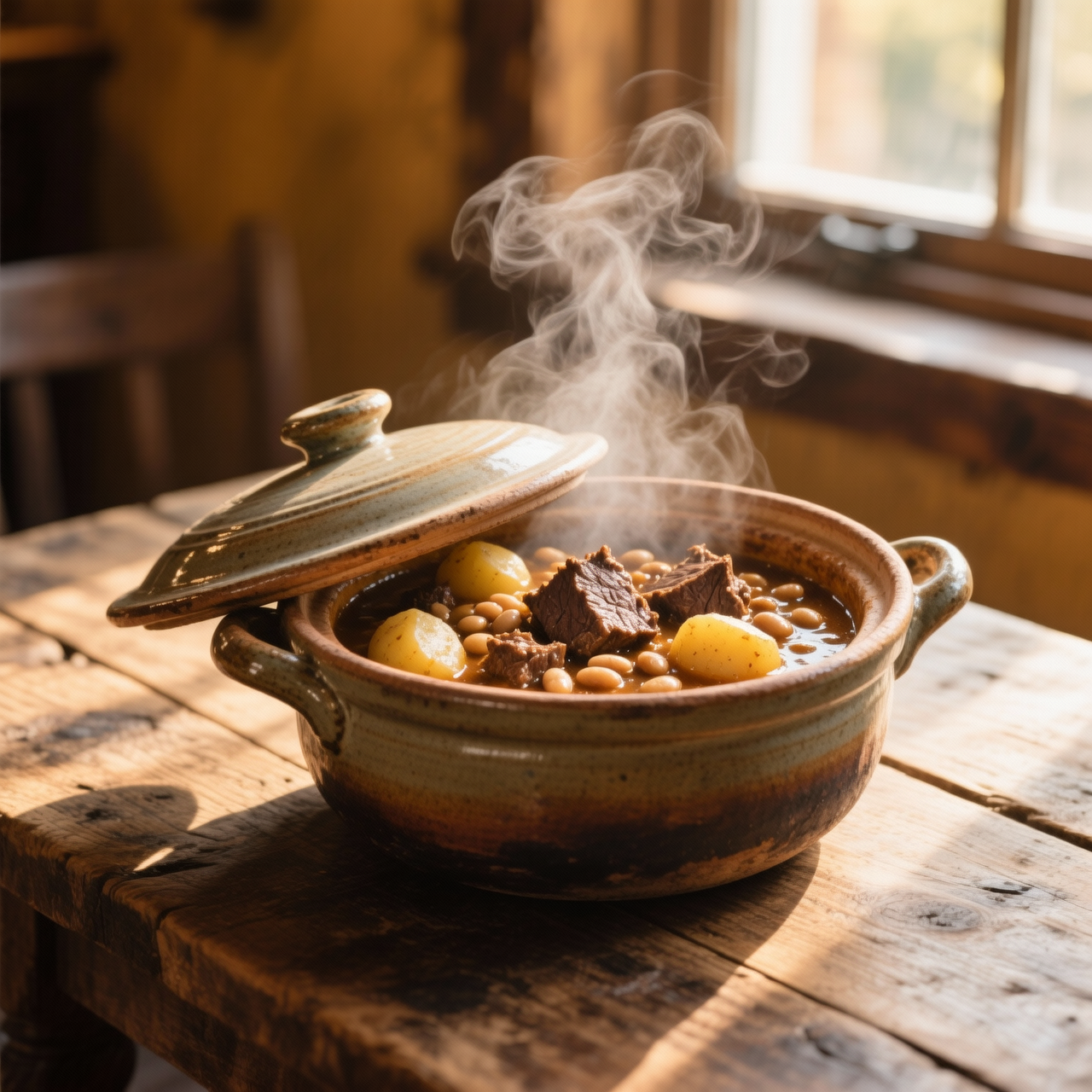
Cholent
I have always believed that cholent is less a dish than a living artifact, simmering quietly through centuries of Jewish diaspora life. Its origins stretch back to the Talmudic era, born from a strict Sabbath prohibition against lighting fires or cooking from Friday sundown to Saturday night. To honor the day of rest without arriving at an empty table, our ancestors learned the ancient art of slow heat retention, burying clay pots in communal ovens and trusting the embers to transform humble barley, beans, and tough cuts of meat into something profoundly nourishing. This slow alchemy matters to me because it carries the weight of continuity; every spoonful tastes like survival, like generations of grandmothers who measured time not by clocks but by the gradual softening of wheat berries. Yet for all its rustic simplicity, cholent is notoriously unforgiving to the impatient cook. The most common pitfall is rushing the soak, leaving beans stubbornly hard even after twelve hours. Others drown the pot in water, diluting the rich, earthy broth that should cling to the meat like velvet. Some make the fatal mistake of lifting the lid too often, breaking the thermal seal and stalling the gentle braise. I have learned to treat it with reverence: soak everything overnight, layer the ingredients deliberately, and once the oven door closes, let the pot work in sacred silence. The reward is a deeply cohesive, almost custardy stew that feels less prepared than remembered.
Nutrition
| Per serving | Calories | Protein | Carbs | Fat | Sat fat | Fibre | Sugar | Sodium |
|---|---|---|---|---|---|---|---|---|
| beginner | 810kcal | 48g | 85g | 31g | 11g | 19g | 6g | 1580mg |
| intermediate | 810kcal | 48g | 85g | 31g | 11g | 19g | 6g | 1580mg |
| expert | 810kcal | 48g | 85g | 31g | 11g | 19g | 6g | 1580mg |
Per serving · Ava-estimated — a guide, not a clinical figure.
- 600 gbeef brisket— trimmed of excess surface fat
- 200 gdried cannellini bean— sorted for debris
- 150 gpearl barley— whole grain
- 400 grusset potato— waxy-fleshed preferred
- 200 gyellow onion— firm, unblemished
- 30 ggarlic clove— fresh, not dried
- 60 gtomato paste— concentrated, not diluted
- 10 gsmoked paprika— finely ground
- 5 gcumin seed— whole
- 5 gblack peppercorn— whole
- 15 gcoarse sea salt— uniodized
- 1500 mlwater— filtered
This version is engineered for your first successful attempt, prioritizing confidence over culinary bravado. We rely on pre-toasted, jarred spice pastes and a forgiving slow-cooker method that eliminates the anxiety of stovetop scorching. The ingredients remain identical to the traditional canon, but their assembly is streamlined into clear, sequential layers. You will learn to trust the hydration ratios without constant stirring, and we build in explicit checkpoints to verify liquid levels and meat tenderness. Watch closely for the initial boil before transitioning to low heat; this ensures the beans begin softening properly and the barley does not settle into a dense, uncooked mat at the bottom. I have stripped away the guesswork by providing exact visual and tactile cues for doneness, so you can step away without worrying about a ruined pot. The goal here is not to reinvent the wheel, but to experience the profound, slow-cooked transformation that defines this dish. By the time you lift the lid, you will have a deeply cohesive stew that honors its heritage while fitting comfortably into a modern, time-constrained kitchen.
Equipment
- slow cooker— minimum six quart capacity
- measuring cups— standard set
Method
- 1
Rinse the dried beans and pearl barley under cold running water until clear.
Discard any shriveled or discolored pieces.
rinsing~ 2 min - 2
Place the beef brisket, beans, barley, diced potatoes, and chopped onion into the slow cooker insert.
Layer evenly to promote uniform heat distribution.
layering~ 3 min - 3
Whisk the tomato paste, spices, salt, and one cup of warm water until completely smooth.
The mixture should pour freely without lumps.
whisking~ 2 min - 4
Pour the spice slurry over the meat and vegetables, then add the remaining water.
Liquid must just cover the top layer of ingredients.
hydrating~ 1 min - 5
Set the appliance to low and cover securely without lifting the lid for eight hours.
Each peek drops the internal temperature by twenty minutes.
simmering~ 480 minTricky bit - 6
Uncover and gently fold the contents once to redistribute the thickened broth.
The beans should yield to gentle pressure without collapsing.
folding~ 5 min