
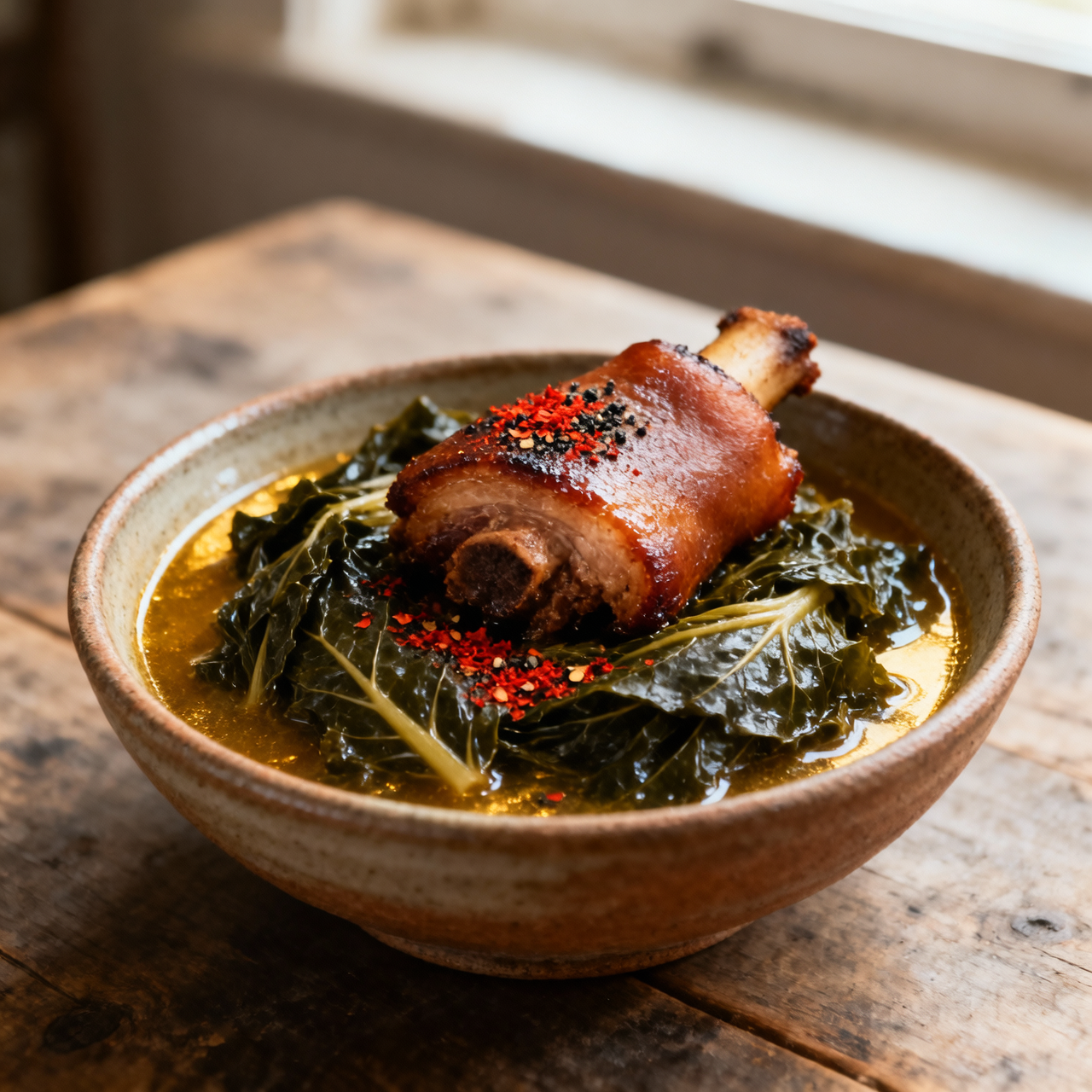
Collard Greens with Smoked Hock
Growing up in the Delta, I learned early that collard greens with smoked hock aren’t just a side dish; they are a quiet testament to survival and slow patience. The tradition stretches back through generations of cooks who transformed tough, bitter leaves into something deeply nourishing by pairing them with the only meat scraps available. Over time, that necessity evolved into a cornerstone of Southern Sunday tables, a ritual where the heavy cast iron simmers long enough to soften both the greens and the day’s worries. What makes this recipe matter to me is its unapologetic honesty. It refuses to rush. The magic lives in the low, steady heat that breaks down the fibrous stalks and draws every ounce of savory richness from the smoked hock into the broth, or pot liquor, as we rightly call it. Too many home cooks rush this dish, treating it like a quick sauté, and end up with bitter, stringy leaves swimming in watery stock. Another frequent misstep is skipping the vinegar at the end. A splash of apple cider vinegar right before serving isn’t optional; it is the bright counterpoint that cuts through the heavy smoke and salt, waking up the entire pot. When you approach this with reverence for the time it demands and respect for the ingredients, you do not just get dinner. You get a bowl of history, warmth, and quiet resilience that anchors the table. I always let the greens rest off the heat for ten minutes before serving, allowing the flavors to settle and the leaves to drink up that golden broth one last time.
Nutrition
| Per serving | Calories | Protein | Carbs | Fat | Sat fat | Fibre | Sugar | Sodium |
|---|---|---|---|---|---|---|---|---|
| beginner | 340kcal | 22g | 20g | 20g | 6g | 10g | 4g | 2000mg |
| intermediate | 340kcal | 22g | 20g | 20g | 6g | 10g | 4g | 2000mg |
| expert | 340kcal | 22g | 20g | 20g | 6g | 10g | 4g | 2000mg |
Per serving · Ava-estimated — a guide, not a clinical figure.
- 900 gcollard greens— fresh, tough central ribs removed and leaves roughly chopped
- 450 gsmoked pork hock— fully cured and smoked, skin intact
- 180 gyellow onion— peeled and diced
- 15 ggarlic— peeled and smashed
- 45 gcreole seasoning paste— commercial jarred or freshly ground
- 950 mlchicken or pork stock— low-sodium, unsalted preferred
- 30 mlrendered pork fat— clarified lard or bacon drippings
- 30 mlapple cider vinegar— raw, unfiltered
- 2 gred pepper flakes— whole, lightly toasted
- 3 gblack pepper— freshly cracked
- 8 gfine sea salt— adjust to taste based on hock salinity
This version prioritizes confidence and consistency by leaning on trusted, time-tested shortcuts. You will use a jarred creole seasoning paste and rely on visual cues rather than precise temperatures to guide your cooking. The goal is to demystify the long simmer, teaching you exactly how the greens transform from stiff to silken. Watch for the moment when the pot liquor thickens slightly and the leaves lose their raw, grassy edge. A common beginner mistake is lifting the lid too often, which drops the temperature and extends the cooking time unnecessarily. Trust the covered pot to do its work. You will also learn how to balance the natural bitterness of the greens with just enough vinegar to brighten the finished dish without making it taste sharp. By keeping the heat steady and the seasoning simple, you will achieve a deeply comforting, restaurant-style result with minimal stress. Focus on patience, and the pot liquor will reward you with a rich, spoonable broth that clings to every tender leaf.
Equipment
- Heavy-bottomed pot— standard stockpot or Dutch oven
- Chef's knife— for chopping greens
- Wooden spoon— heat-resistant
Method
- 1
Wash the collard greens thoroughly and remove the tough central ribs before roughly chopping the leaves.
Use a salad spinner to dry them quickly.
prepping~ 5 min - 2
Heat the rendered pork fat in a heavy pot over medium heat and soften the diced onion until translucent.
Onions should sizzle gently, not brown.
sweating~ 4 min - 3
Add the smoked hock, creole seasoning paste, stock, and red pepper flakes to the pot, then pack the chopped greens tightly on top.
The liquid will barely cover the greens initially.
layering~ 2 min - 4
Cover the pot and simmer gently until the greens are completely tender and the hock meat falls from the bone.
Check for tenderness every twenty minutes to prevent overcooking.
braising~ 40 minTricky bit - 5
Remove the hock, stir in the apple cider vinegar, and season the pot liquor with black pepper and sea salt to taste.
Taste the broth before adding more salt, as the hock is already cured.
balancing~ 3 min