
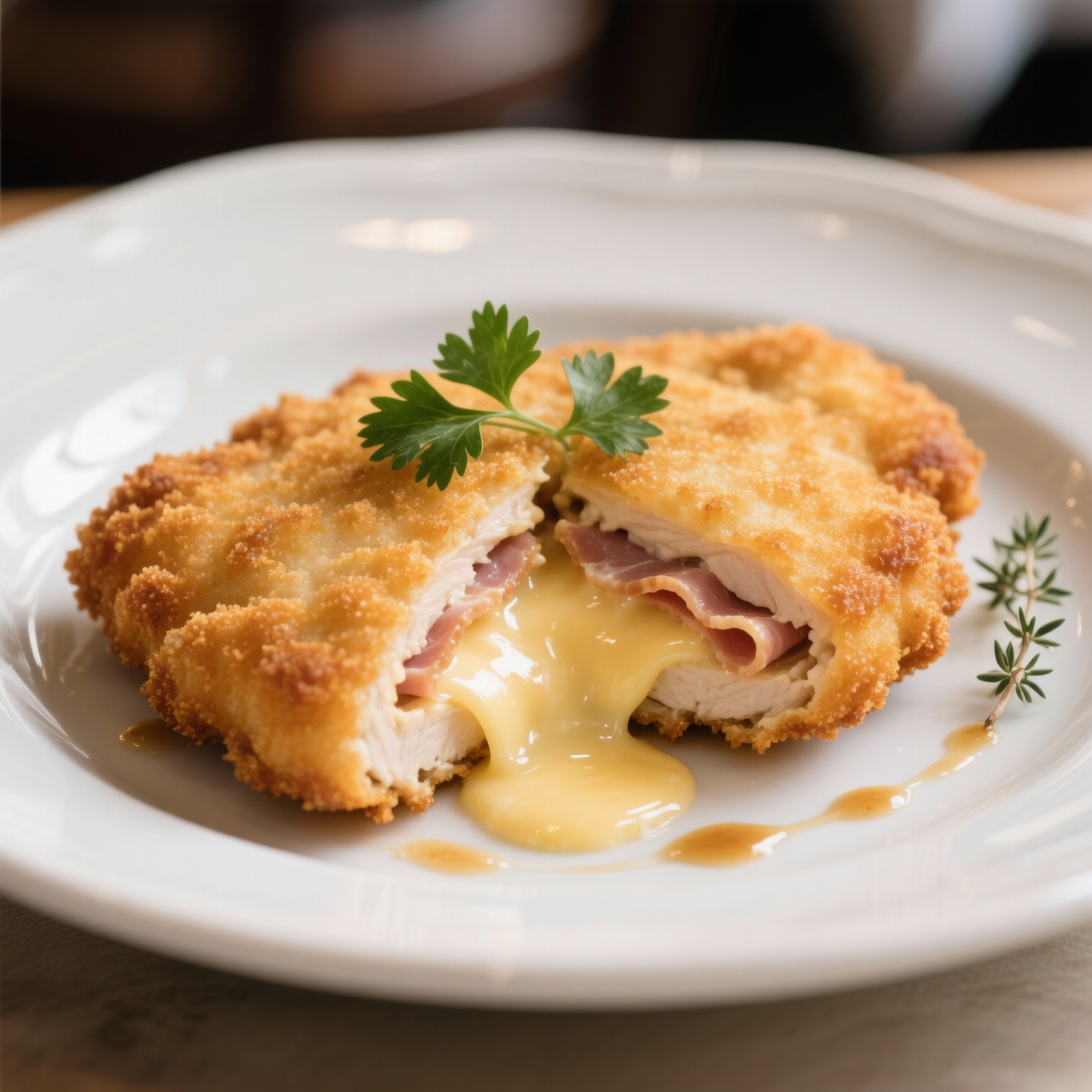
Cordon bleu (breaded stuffed chicken)
When I first encountered cordon bleu in a supermarket freezer aisle, it was shrink-wrapped like a pale, breaded brick, costing nearly as much as a decent bottle of wine while delivering nothing but chalky cheese and greasy, pre-formed poultry. Making it from scratch is an act of culinary rebellion that restores dignity to the dish. Though its name evokes Parisian elegance, the stuffed cutlet actually traces its roots to mid-century Swiss kitchens, where it was adopted and refined by French chefs who understood the alchemy of a crisp crust and molten interior. This matters because a properly built cordon bleu is a study in structural patience, not assembly-line convenience. The common pitfalls are almost entirely mechanical: tearing the meat when you butterfly it, overfilling the pocket until it splits under heat, or letting the breading soak up oil instead of sealing it. I always start with boneless chicken breasts pounded to an even quarter-inch, layered with high-quality smoked ham and a firm, nutty cheese like Gruyère or Emmental. The dredge is strictly flour, egg, and freshly pulsed stale sourdough—never those neon orange supermarket crumbs that taste like salt and regret. Roll it tight, pin it, chill it thoroughly, then double-coat. The real magic happens in the freezer; once fully crumbed, they can be stored raw and baked straight from frozen, yielding a shatteringly crisp shell with a perfectly thawed, steaming center. It takes twenty extra minutes of your time, but you reclaim the entire flavor profile from the corporate food processors who reduced a classic to a cardboard approximation.
Nutrition
| Per serving | Calories | Protein | Carbs | Fat | Sat fat | Fibre | Sugar | Sodium |
|---|---|---|---|---|---|---|---|---|
| beginner | 540kcal | 38g | 32g | 24g | 8g | 2g | 3g | 720mg |
| intermediate | 540kcal | 42g | 22g | 24g | 9g | 2g | 2g | 820mg |
| expert | 540kcal | 44g | 24g | 26g | 10g | 2g | 2g | 820mg |
Per serving · Ava-estimated — a guide, not a clinical figure.
- 600 gchicken breast— boneless, skinless, pounded to even thickness
- 120 gcooked ham— thinly sliced, low-sodium preferred
- 150 ggruyère cheese— thinly sliced or coarsely grated
- 100 gall-purpose flour— for initial dredging
- 2 largeegg— lightly beaten for egg wash
- 200 gbreadcrumb— fine dry or panko, holds structure well when frozen
- 5 gsalt— fine sea salt
- 2 gblack pepper— freshly ground
- 30 mlvegetable oil(optional)— for light brushing before baking
Store-bought chicken cordon bleu typically costs four to six dollars per piece and relies on injected brines, heavy synthetic batters, and rubbery processed cheese that inevitably leaks during cooking. This beginner version strips away the guesswork while keeping everything strictly from scratch. You will skip the stressful deep-frying step entirely, opting instead for a forgiving oven-bake method that delivers a crisp crust without constant oil monitoring. The breading station uses a straightforward three-bowl system that anyone can master, and the recipe is designed to scale easily for freezer storage. Watch closely for three key moments: keeping the meat and fillings cold before rolling so the cheese stays put, sealing the edges firmly to prevent leaks, and letting the coated rolls rest on a tray before freezing so the crust fully sets. Baking directly from frozen guarantees even heat distribution and eliminates the panic of timing a thaw. You end up with a reliable, restaurant-quality result that actually highlights fresh ham and real cheese, proving that simple technique beats expensive convenience foods every time.
Equipment
- Rolling pin— plastic wrap between pin and meat prevents sticking
- Shallow bowls— three for flour, egg, and breadcrumbs
- Baking sheet with wire rack— elevates rolls for even airflow
- Instant-read thermometer(optional)— ensures safe internal temperature without guessing
Method
- 1
Pound chicken breasts to a uniform quarter-inch thickness between plastic wrap.
Use a rolling pin or meat mallet. Even thickness prevents tearing.
pounding~ 2 min - 2
Layer a slice of ham and a portion of cheese on each cutlet, leaving a half-inch border.
Keep ingredients cold so the cheese doesn’t soften too early.
layering~ 3 min - 3
Roll the chicken tightly around the filling and press the edges to seal.
Secure with a toothpick if the seam feels loose.
rolling~ 2 minTricky bit - 4
Arrange shallow bowls with flour, whisked eggs, and plain breadcrumbs for a three-step dredge.
Keep one hand dry and one wet to prevent clumpy coating.
dredging~ 5 min - 5
Coat each roll thoroughly in flour, dip completely in egg, then press firmly into breadcrumbs.
Pat the crumbs on rather than rubbing to avoid bare spots.
breading~ 4 min - 6
Place crumbed rolls on a parchment-lined tray and freeze until completely solid.
This sets the crust and prevents leaks during baking.
flash freezing~ 3 min - 7
Bake frozen rolls on a wire rack set over a baking sheet until golden and internal temperature reaches 74°C.
Do not thaw; bake directly at 200°C for 30-35 minutes.
convection baking~ 30 minTricky bit
Cooking from frozen
Freeze crumbed raw portions, then bake straight from frozen at 200°C for 25–30 minutes until golden and piping hot.
Storage times are a guide — always use your judgement and store food safely.