
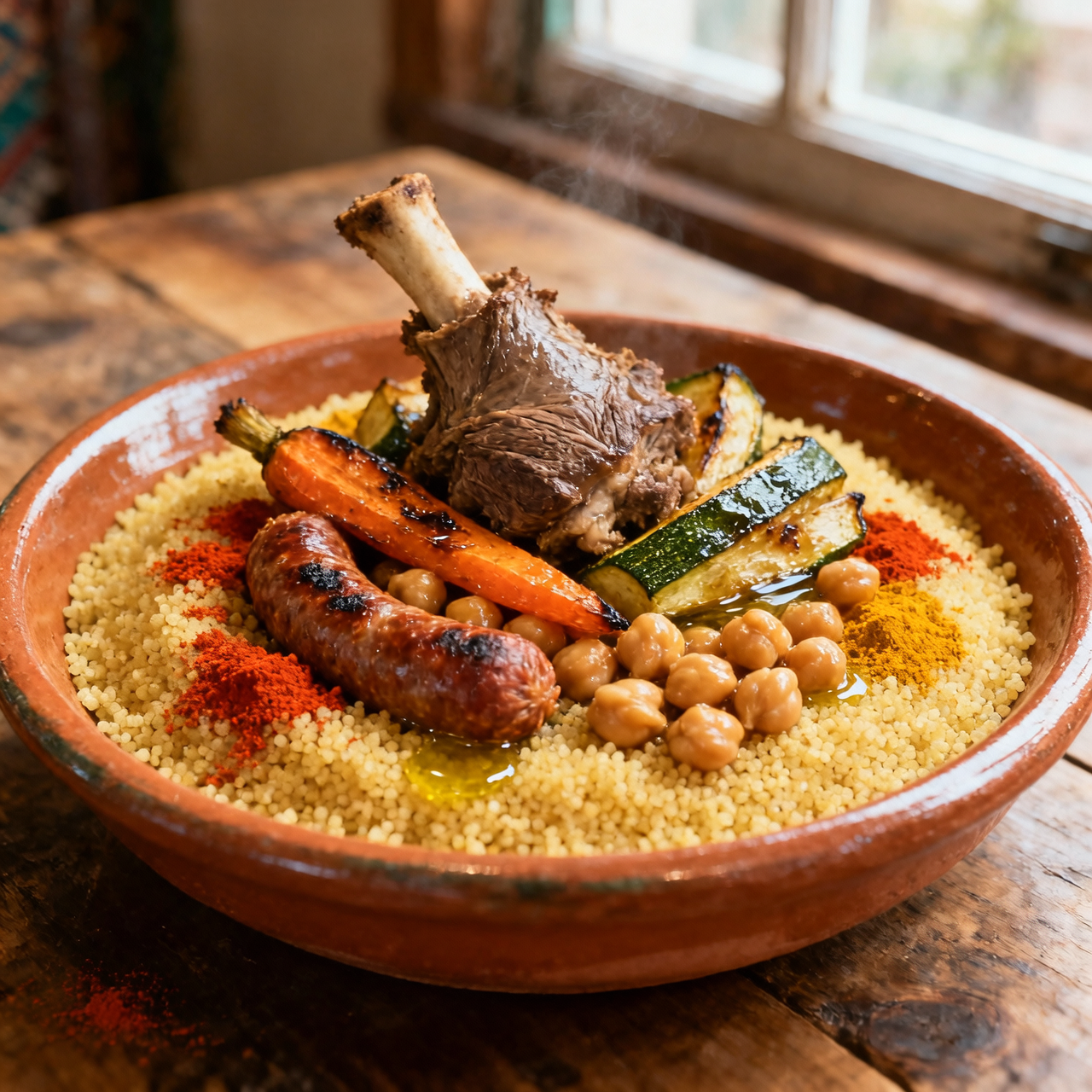
Couscous Royale
When I first learned to prepare couscous royale in a sunlit kitchen outside Marrakech, I realized this dish is less a recipe and more a ritual of patience and generosity. Rooted in the ancient Berber traditions of North Africa, the royale variation elevates humble steamed semolina into a celebration of abundance, traditionally reserved for Friday gatherings, weddings, and family milestones. What makes this dish matter to me is how it bridges generations; every fold of the semolina and every slow-simmered ladle of broth carries the weight of shared history. Yet, I have watched countless home cooks stumble over the same quiet mistakes. The most frequent pitfall is treating the grains as an afterthought, boiling them directly in water rather than coaxing them through three careful steamings above the rich, spiced broth. Rushing this process yields a heavy, clumped mass rather than the impossibly light, fluffy clouds that define a true royale. Another misstep lies in overcrowding the couscoussier, which suffocates the grains and leaves pockets of undercooked hardness. I always remind myself that the spice balance must breathe, allowing ras el hanout and harissa to harmonize rather than compete, and that the meats require distinct cooking times to preserve their individual textures. When I honor the slow rhythm of the steam and respect the integrity of each ingredient, the dish transcends mere sustenance. It becomes an edible testament to Moroccan hospitality, where every bite whispers welcome.
Nutrition
| Per serving | Calories | Protein | Carbs | Fat | Sat fat | Fibre | Sugar | Sodium |
|---|---|---|---|---|---|---|---|---|
| beginner | 1250kcal | 68g | 105g | 62g | 18g | 14g | 11g | 1250mg |
| intermediate | 1250kcal | 68g | 105g | 62g | 18g | 14g | 11g | 1250mg |
| expert | 1250kcal | 68g | 105g | 62g | 18g | 14g | 11g | 1250mg |
Per serving · Ava-estimated — a guide, not a clinical figure.
- 400 gcouscous— fine grain semolina
- 500 glamb shoulder— cut into 2-inch chunks
- 400 gchicken thigh— bone-in, skin removed
- 200 gmerguez sausage— fresh, uncooked links
- 300 gcarrot— peeled and halved lengthwise
- 250 gzucchini— trimmed and quartered
- 200 gchickpea— canned, drained and rinsed
- 250 gonion— yellow, roughly chopped
- 60 mlolive oil— extra virgin
- 30 gras el hanout— toasted spice blend
- 20 gharissa paste— adjust to heat preference
- 1000 mlvegetable broth— low sodium, unsalted preferred
- 40 gfresh cilantro— tender leaves and stems
This version prioritizes confidence over complexity, giving you a reliable path to a satisfying bowl without specialized gear. Instead of juggling multiple pots, we use a single large Dutch oven for both the broth and a makeshift steaming setup. The spice blend and harissa are added directly to the pot, eliminating the need for separate blooming steps. You will focus heavily on timing the addition of vegetables so everything finishes tender at once. The couscous is hydrated using the absorption method rather than traditional steaming, which drastically cuts down on active supervision. Watch closely for the moment the granules look glossy; that is your cue to cover and rest. Overworking the grain while hot will cause it to break down into a heavy mash, so resist the urge to stir aggressively. Keep your heat at a steady medium-low during the simmer, and rely on a wide fork to gently separate the grains. This approach guarantees a forgiving first attempt while preserving the dish’s essential character.
Equipment
- Large Dutch oven— heavy-bottomed with tight lid
- Wide serving fork— metal or wood
- Fine-mesh strainer(optional)— for draining broth if needed
Method
- 1
Place the onions, olive oil, ras el hanout, and harissa paste in a large heavy pot over medium heat.
Stir until fragrant, about 2 minutes.
sautéing~ 2 min - 2
Add the lamb and chicken, then pour in the vegetable broth and bring to a gentle simmer.
Do not boil rapidly.
simmering~ 15 min - 3
Stir in the carrots, chickpeas, and merguez, then cover partially and cook until the meat is nearly tender.
Skim any foam that rises to the surface.
braising~ 20 minTricky bit - 4
Remove the pot from heat, transfer the solids to a large bowl, and set aside.
Keep the broth warm on low heat.
separating~ 3 min - 5
Place the couscous in a wide heatproof bowl, pour 400 ml of the hot broth over it, and cover tightly for 10 minutes.
Do not lift the cover early.
absorbing~ 10 minTricky bit - 6
Fluff the grains gently with a wide fork, fold in the zucchini and cilantro, and serve immediately.
Add more broth if the grains feel dry.
fluffing~ 2 min