
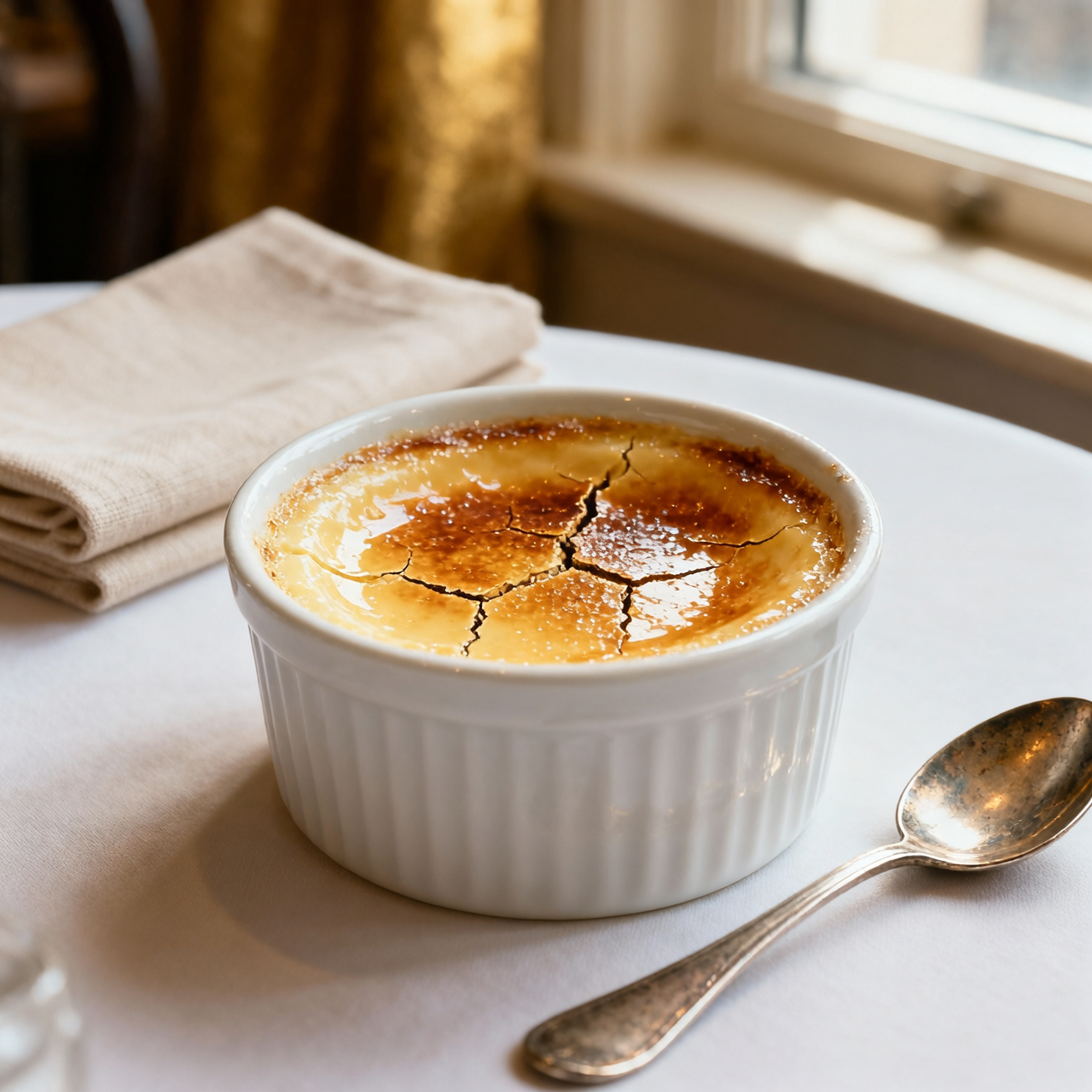
Creme Brulee
When I first encountered crème brûlée in a quiet Parisian bistro, it felt less like a dessert and more like a quiet lesson in patience and precision. The dish traces its lineage to seventeenth-century French court kitchens, where cooks first married rich dairy with vanilla and a crisp, caramelized sugar shell. To me, it remains the ultimate test of a pastry chef’s restraint, a delicate balance between indulgence and technique that demands respect at every step. What makes it so profoundly significant is how it transforms the simplest ingredients into something almost architectural. You are essentially coaxing cream, egg yolks, and sugar into a silk-like custard, then crowning it with a glassy sugar crust that shatters on command. Yet this elegance is precisely where most cooks falter. The most frequent misstep is rushing the bake, allowing the water bath to boil rather than simmer, which curdles the delicate proteins and ruins the velvet texture. Others scorch the sugar topping by hovering too close with the torch, leaving behind bitter carbon instead of a clean, amber finish. I’ve learned that true mastery here means trusting the low, steady heat and resisting the urge to check too soon. When done right, the spoon meets that first crackle, and the contrast between warm caramel and cool, yielding custard speaks to centuries of French culinary tradition. It’s a reminder that the finest things in the kitchen rarely come from force, but from careful, deliberate attention.
Nutrition
| Per serving | Calories | Protein | Carbs | Fat | Sat fat | Fibre | Sugar | Sodium |
|---|---|---|---|---|---|---|---|---|
| beginner | 715kcal | 10g | 30g | 63g | 38g | 0g | 30g | 270mg |
| intermediate | 715kcal | 10g | 30g | 63g | 38g | 0g | 30g | 270mg |
| expert | 715kcal | 10g | 30g | 63g | 38g | 0g | 30g | 270mg |
Per serving · Ava-estimated — a guide, not a clinical figure.
- 600 mlheavy cream— full-fat, cold
- 8 piecesegg yolk— room temperature
- 100 ggranulated sugar— divided for custard and topping
- 1 piecevanilla bean— Madagascar Bourbon preferred
- 2 gfine sea salt— to enhance sweetness
This version prioritizes confidence and accessibility, stripping away intimidation while preserving the soul of the dish. Instead of wrestling with a whole vanilla pod, you will use a high-quality jarred vanilla bean paste that guarantees even flavor distribution without the fuss of scraping seeds. The custard is mixed using a straightforward whisking method rather than a tempering process, and the water bath is stabilized with simple kitchen towels to prevent sloshing. Watch your oven temperature closely; a reliable thermometer is highly recommended since home ovens often run hot. The most critical moment is the bake, where you must resist the urge to open the door. If the edges set but the center still jiggles like soft gelatin, it is perfectly done. Overbaking will create a dense, rubbery texture, while underbaking leaves a soupy core. This approach guarantees a smooth, reliable result on your very first attempt, building the foundational intuition you will need for more advanced techniques later.
Equipment
- mixing bowl— glass or stainless steel
- kitchen towel— folded to line baking dish
- culinary torch(optional)— propane or butane fuel
Method
- 1
Preheat oven to 150°C and place a folded kitchen towel on the bottom of a large baking dish.
Towel prevents ramekin rattling.
prep~ 3 min - 2
Heat heavy cream and salt in a saucepan until steaming, then immediately remove from heat.
Do not boil.
scalding~ 4 minTricky bit - 3
Whisk egg yolks and half the sugar until pale, then slowly pour the warm cream into the mixture.
Add in three steady additions.
tempering~ 2 minTricky bit - 4
Stir in the vanilla bean paste and strain the mixture through a fine mesh sieve into a pouring jug.
Removes chalazae.
straining~ 2 min - 5
Divide the custard evenly among four ramekins and carefully transfer them to the prepared baking dish.
Wipe spills before adding water.
portioning~ 2 min - 6
Pour hot tap water into the dish until it reaches halfway up the ramekins, then bake until set but jiggly.
Center should still wobble.
bain-marie~ 45 minTricky bit - 7
Chill completely, sprinkle remaining sugar over the top, and caramelize evenly with a culinary torch.
Keep torch moving constantly.
torching~ 1 minTricky bit