
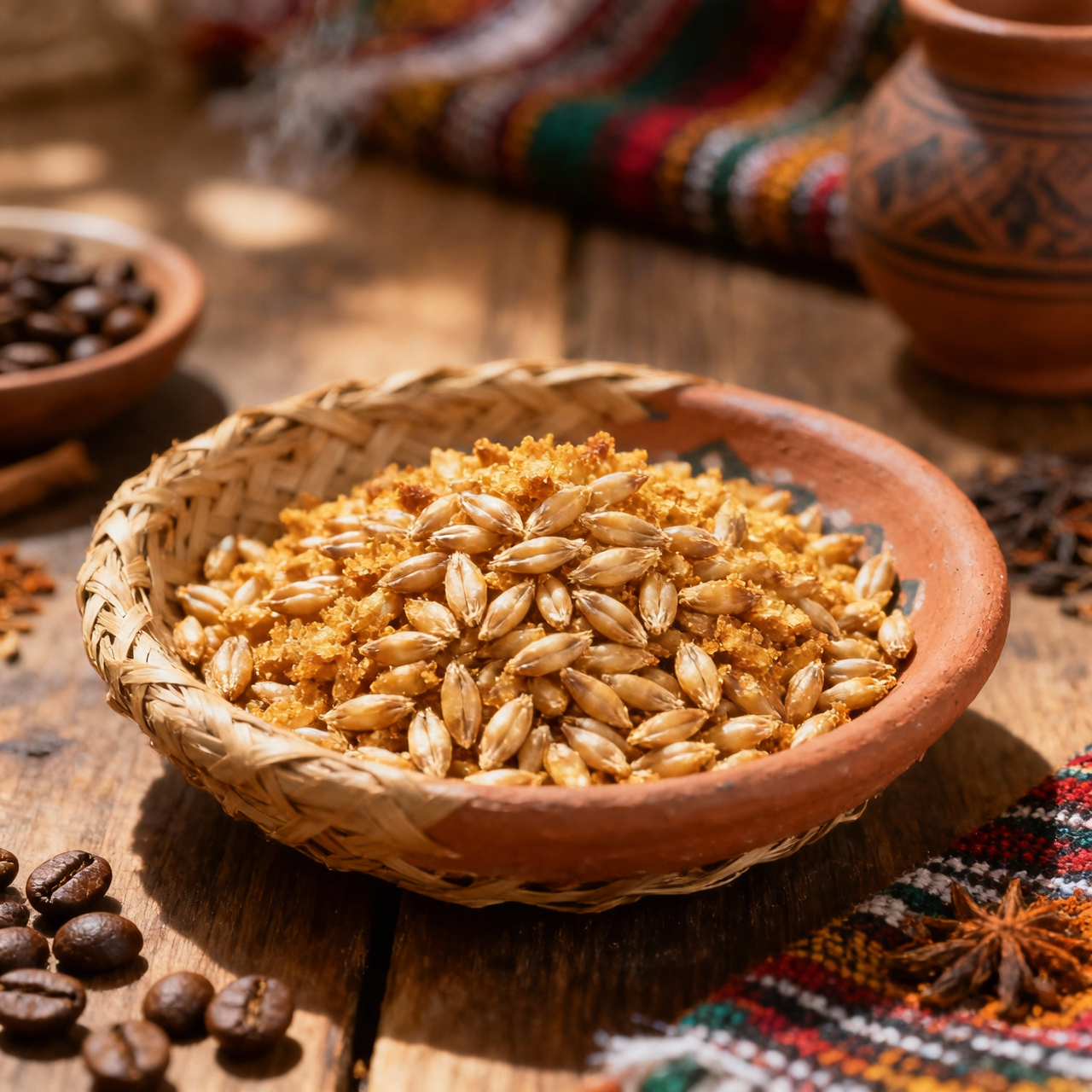
Dabo kolo (roasted barley nibbles)
I’ve always loved the ritual of sharing dabo kolo, those tiny, toasted barley bites that have sustained Ethiopian travelers and market-goers for centuries. Historically, this snack emerged from the practical need to preserve grain while traveling across the highlands, transforming simple barley into something deeply satisfying through dry-roasting and gentle toasting. Making it yourself matters because you control the exact degree of roast, the balance of warm spices, and the absence of industrial shortcuts that ruin the texture. Walking through a modern supermarket, you’ll find imported “roasted barley snacks” in glossy pouches that easily run you five or six dollars for a handful of stale, overly salty, and sometimes chemically puffed grains. They’re often cut with cheaper wheat flour, doused in artificial flavorings, and stripped of the nutty, earthy depth that defines the authentic version. When you make it from scratch, you’re just working with whole barley, a touch of oil, salt, and maybe a whisper of berbere or cumin, toasted slowly until every kernel pops with a dry, glass-like crunch. The most common pitfalls I see are rushing the heat and overcrowding the pan, which leads to steamed, chewy pieces instead of crisp ones, and forgetting to stir constantly until the barley turns a deep mahogany. Patience is your only real ingredient here. Keep the flame low, use a wide skillet, and let the grains toast evenly until they smell like toasted nuts. Once cooled completely, they’ll stay perfectly crunchy in an airtight tin for weeks. This isn’t just a snack; it’s a quiet, centuries-old practice that rewards your attention with every handful.
Nutrition
| Per serving | Calories | Protein | Carbs | Fat | Sat fat | Fibre | Sugar | Sodium |
|---|---|---|---|---|---|---|---|---|
| beginner | 365kcal | 9g | 51g | 14g | 2g | 4g | 1g | 340mg |
| intermediate | 215kcal | 5g | 31g | 8g | 1g | 4g | 1g | 260mg |
| expert | 265kcal | 6g | 36g | 11g | 2g | 5g | 1g | 180mg |
Per serving · Ava-estimated — a guide, not a clinical figure.
- 200 gbarley— hulled, rinsed and thoroughly dried
- 30 mlvegetable oil— for shallow frying or dry roasting
- 5 gsalt— fine grain
- 10 gberbere(optional)— Ethiopian spice blend
Dabo kolo is a beloved Ethiopian snack of tiny, crunchy fried dough pieces, traditionally tossed with warm spices. At this beginner level, we skip the traditional resting and complex dough rolling in favor of a straightforward, no-knead method that firms up quickly before frying. This approach eliminates the need for precise dough hydration while still delivering that signature crisp bite and tender interior. Watch your oil temperature closely; it should hover around 175°C (350°F). If it runs too hot, the nibbles will scorch before cooking through; too cool, and they will absorb excess grease and turn heavy. While supermarket shelves often stock imported dabo kolo for upwards of $8 per small tin, those commercial versions rely on stale, oxidized oils and heavy preservatives to survive long transit, leaving a flat, cardboard-like crunch. Making them fresh at home costs a fraction of that and yields a bright, deeply toasted flavor with a satisfying snap. Keep the spice toss light and even, shaking the bowl rather than stirring, to preserve their delicate shape. Once cooled, store them in an airtight tin for up to two weeks.
Equipment
- Heavy-bottomed deep pan— cast iron or stainless steel holds steady heat best
- Digital thermometer(optional)— keeps oil safely between 170°C and 180°C
- Wire cooling rack— prevents trapped steam from softening the crust
Method
- 1
Combine barley flour, all-purpose flour, salt, and ground spices in a large mixing bowl until evenly distributed.
Sifting prevents spice clumps and ensures uniform flavor.
dry blending~ 1 min - 2
Stir in lukewarm water gradually until a stiff, cohesive dough forms, then cover the bowl and let it rest.
Resting relaxes the starch network for easier shaping.
resting~ 10 min - 3
Divide the dough into small portions and roll each into marble-sized balls on a lightly floured surface.
Uniform size ensures every piece fries at the same rate.
portioning~ 5 min - 4
Heat neutral oil in a deep, heavy pan to 175°C and carefully lower the dough balls in small batches.
Crowding drops the oil temperature and causes sogginess.
deep-frying~ 5 minTricky bit - 5
Turn the nibbles gently until evenly golden and crisp, then transfer to a wire rack to drain completely.
Draining prevents residual oil from softening the crust.
draining~ 3 min - 6
Toss the warm nibbles with a final pinch of salt and toasted cumin in a large bowl before cooling.
Seasoning while warm helps the spices adhere without making them wet.
seasoning~ 1 min
Cooking from frozen
Thaw uncovered at room temperature, then refresh in a dry pan over low heat for two minutes to restore crispness.
Storage times are a guide — always use your judgement and store food safely.