
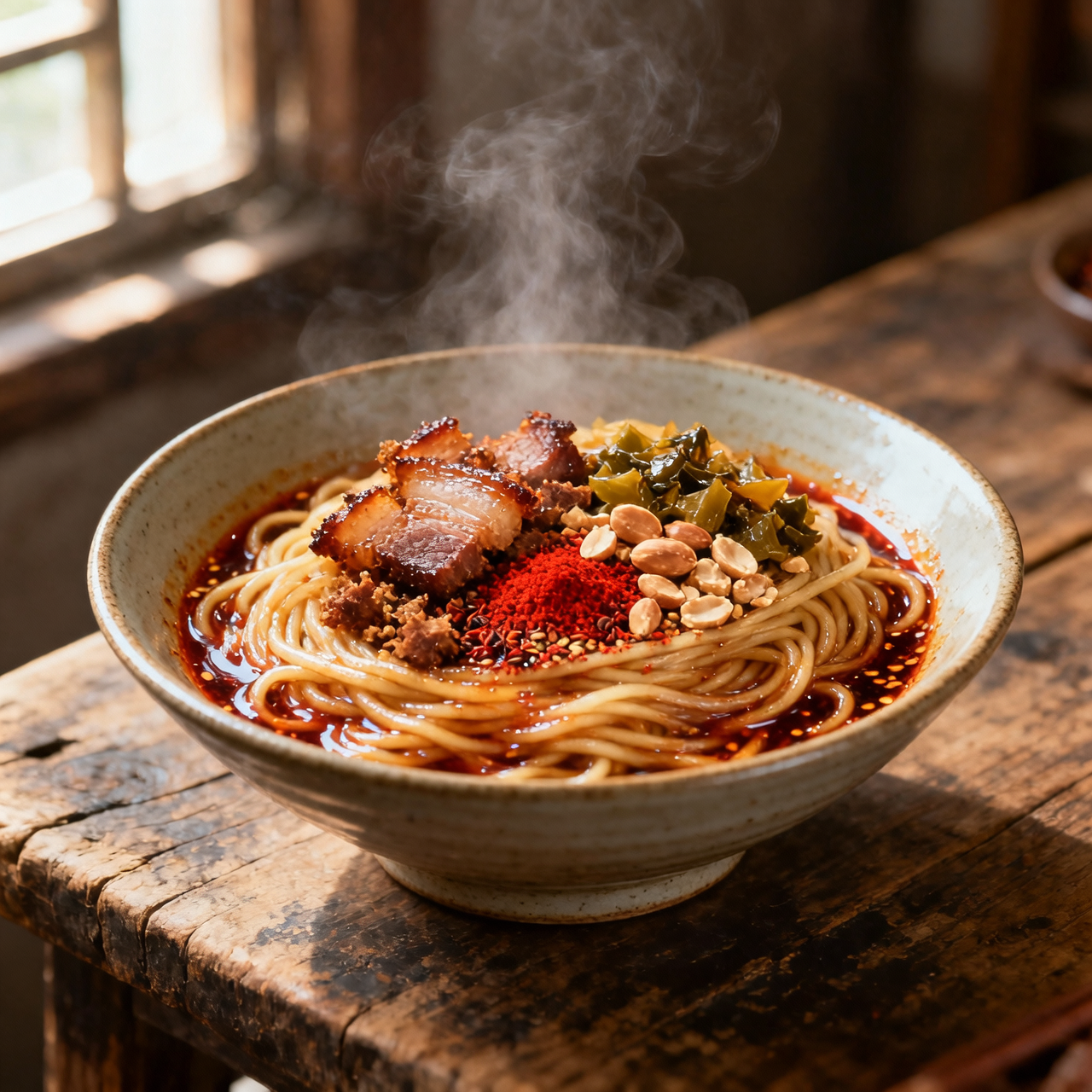
Dan Dan Mian
I still remember the first time I tasted Dan Dan Mian on a damp Chengdu evening, the kind where the humidity wraps around you like a heavy blanket and every street corner smells of toasted sesame, Sichuan peppercorns, and slow-rendered pork. Born from the shoulder poles of itinerant vendors who carried their entire kitchen on a single bamboo beam, this dish was never meant to be a quiet, polite affair. It is loud, unapologetically aromatic, and deeply rooted in the working-class rhythm of Sichuan province. What makes it so vital, in my eyes, is how it transforms humble ingredients into something that feels both grounding and electrifying. The balance of mala—that signature numbing spice paired with a slow-building heat—requires a respect for ratios that many overlook. I have seen countless versions ruined by an overzealous hand with chili oil or, worse, the complete omission of the preserved mustard greens that give the dish its necessary acidic backbone. Another frequent misstep is boiling the noodles to death; they must retain a slight chew to stand up to the rich, savory sauce. Some cooks also skip the crucial step of toasting the Sichuan peppercorns before grinding them, leaving behind a flat, dusty bitterness instead of that bright, citrusy buzz. When I approach this recipe, I am not just assembling ingredients; I am honoring a lineage of street vendors who understood that food should wake you up, challenge you, and leave you reaching for another bowl. It is a dish of contrasts, and getting those contrasts right is the only way to truly understand it.
Nutrition
| Per serving | Calories | Protein | Carbs | Fat | Sat fat | Fibre | Sugar | Sodium |
|---|---|---|---|---|---|---|---|---|
| beginner | 770kcal | 25g | 85g | 38g | 9g | 5g | 4g | 930mg |
| intermediate | 770kcal | 25g | 85g | 38g | 9g | 5g | 4g | 930mg |
| expert | 770kcal | 25g | 85g | 38g | 9g | 5g | 4g | 930mg |
Per serving · Ava-estimated — a guide, not a clinical figure.
- 400 gWheat noodle— fresh alkaline, about 2mm thick
- 250 gGround pork— 80/20 fat to lean ratio
- 50 gSichuan preserved mustard green— rinsed and finely diced
- 60 gToasted sesame paste— unsweetened, 100% sesame
- 30 mlLight soy sauce
- 20 mlZhenjiang black vinegar
- 40 mlSichuan chili oil— with sediment
- 8 gSichuan peppercorn— freshly toasted and ground
- 15 gGarlic— minced
- 15 gGinger— finely grated
- 20 gScallion— green parts only, thinly sliced
- 30 mlLard(optional)— or neutral vegetable oil
- 10 gWhite sugar
- 100 mlChicken stock(optional)— low sodium
This version prioritizes accessibility without sacrificing the core flavor profile. You will use a high-quality jarred chili crisp and pre-thinned sesame sauce to bypass the most time-consuming prep steps. The focus is entirely on mastering the assembly order and achieving the correct noodle texture. Watch your heat carefully when browning the pork; medium-low prevents scorching the sugar and soy while ensuring even caramelization. Do not rush the sauce emulsification. Whisk the paste, vinegar, and chili oil thoroughly before adding the hot noodle water, as this crucial step determines whether the final bowl feels cohesive or separated. Keep the preserved vegetables lightly toasted to wake up their flavor without making them bitter. The goal here is a confident first attempt that delivers the signature numbing-spicy balance on a busy weeknight.
Equipment
- Large pot— for boiling noodles
- Skillet— non-stick or stainless steel
- Whisk— silicone tipped
Method
- 1
Bring a large pot of water to a rolling boil and cook the noodles until al dente.
Taste a strand to confirm springiness.
blanching~ 5 min - 2
Heat the skillet over medium heat and fry the ground pork until crispy and golden brown.
Break clumps apart with a spatula.
browning~ 8 min - 3
Combine the sesame paste, soy sauce, black vinegar, sugar, and chili oil in a serving bowl and whisk vigorously.
Mixture will thicken initially before smoothing out.
emulsifying~ 2 minTricky bit - 4
Add two ladles of the hot noodle cooking water to the sauce base and stir until fully dissolved.
Temperature shock helps the paste loosen evenly.
tempering~ 1 min - 5
Toss the drained noodles in the sauce until every strand is coated and serve immediately topped with pork and scallions.
Work quickly while the noodles are hot.
tossing~ 3 min