
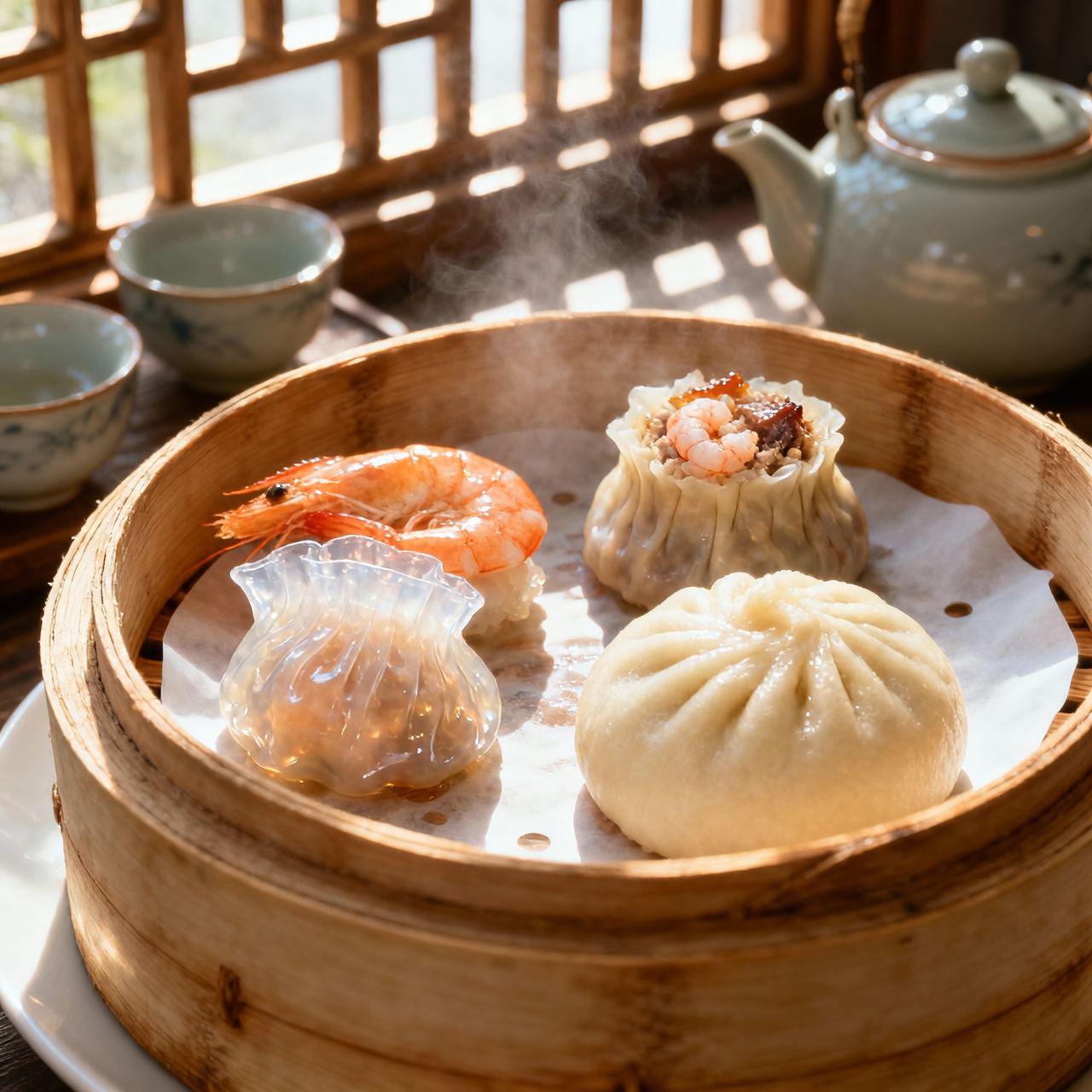
Dim Sum Trio
I have always believed that dim sum is not merely a meal but a conversation, a shared rhythm of bamboo steamers lifting and falling across crowded teahouse tables. When I first set out to recreate a classic Cantonese dim sum trio featuring har gow, siu mai, and char siu bao, I quickly learned that authenticity lives in the margins of patience and precision. These three items trace their roots to the bustling tea houses of Guangzhou, where merchants would gather for yum cha to rest, trade, and nourish themselves with bite-sized delights. The trio matters because it captures the full spectrum of Cantonese culinary philosophy: translucent elegance in the shrimp dumpling, open-faced generosity in the pork siu mai, and pillowy comfort in the barbecue pork bun. Yet I have watched countless home cooks stumble over the same quiet traps. Rushing the starch dough for har gow yields tough wrappers instead of that coveted glass-like bite. Overworking the siu mai filling turns it dense rather than springy, while steaming the char siu bao at too high a heat causes the delicate top to split open prematurely. The secret I have found is not in chasing perfection but in honoring the process by resting the dough, folding with gentle hands, and listening to the steam. When you slow down, the trio stops being a test and becomes a living tradition you can actually taste.
Nutrition
| Per serving | Calories | Protein | Carbs | Fat | Sat fat | Fibre | Sugar | Sodium |
|---|---|---|---|---|---|---|---|---|
| beginner | 725kcal | 33g | 92g | 25g | 6g | 3g | 13g | 1250mg |
| intermediate | 725kcal | 33g | 92g | 25g | 6g | 3g | 13g | 1250mg |
| expert | 725kcal | 33g | 92g | 25g | 6g | 3g | 13g | 1250mg |
Per serving · Ava-estimated — a guide, not a clinical figure.
- 300 glarge shrimp— peeled, deveined, and patted dry
- 250 gground pork— 80/20 fat ratio preferred
- 100 gbamboo shoots— canned or vacuum-packed, rinsed and finely diced
- 80 gwater chestnuts— fresh or canned, finely minced
- 40 gscallions— white and light green parts only, finely chopped
- 15 gfresh ginger— peeled and grated
- 30 mlsoy sauce— regular strength
- 20 mloyster sauce— standard bottled
- 10 mlsesame oil— toasted
- 150 gwheat starch— not wheat flour
- 200 gall-purpose flour— bleached or unbleached
- 5 ginstant yeast— active dry may be substituted
- 40 ggranulated sugar— divided for dough and filling
- 5 gbaking powder— aluminum-free preferred
- 30 mlvegetable oil— neutral
- 5 gsalt— fine sea salt
- 2 gwhite pepper— freshly ground
- 1 pieceegg— large, beaten
This version prioritizes confidence over perfection, embracing trusted shortcuts to bypass the most intimidating dough and sauce preparations. You will use pre-portioned dumpling skins and a simplified two-dough method for the buns, relying on the shared pantry to build authentic flavor without wrestling with hydration ratios. Watch your moisture levels closely; canned bamboo shoots and shrimp release water that can turn a delicate wrapper into a soggy mess. Pat every component dry before mixing, and resist the urge to overstuff. The goal here is familiarity with the steaming rhythm and the classic pleating motions, not architectural mastery. Keep your steamer lid on between checks, and trust the twelve-minute mark for doneness. If a dumpling cracks, patch it with a drop of water and press firmly. This approach guarantees a restaurant-style presentation with home-kitchen reliability, giving you the foundational muscle memory needed to graduate to the intermediate tier.
Equipment
- Bamboo steamer— lined with parchment
- Mixing bowls— medium and large sizes
- Rolling pin— wooden or silicone
- Silicone spatula— heat-resistant
- Damp kitchen towel— for covering dough
Method
- 1
Combine ground pork, diced shrimp, minced water chestnuts, bamboo shoots, scallions, ginger, soy sauce, oyster sauce, sesame oil, sugar, salt, and white pepper in a large bowl.
Mix until just combined; do not overwork.
folding~ 2 min - 2
Divide the filling mixture evenly into three separate portions for har gow, siu mai, and char siu bao.
Weigh if precision is desired.
portioning~ 1 min - 3
Roll out pre-made wheat starch wrappers on a lightly floured surface until translucent and pliable.
Keep unused skins under a damp cloth to prevent drying.
rolling~ 5 minTricky bit - 4
Form har gow by placing a spoonful of shrimp filling in the center, folding the wrapper into a crescent, and pinching the edges tightly.
Press firmly to seal seams.
pleating~ 3 minTricky bit - 5
Shape siu mai by placing pork filling in round wrappers, leaving the tops open, and squeezing the base to form a cup.
Garnish tops with a single diced shrimp.
shaping~ 3 min - 6
Arrange all dumplings in a parchment-lined bamboo steamer, cover, and steam over vigorously boiling water until cooked through.
Do not overcrowd; leave space for expansion.
steaming~ 12 min