
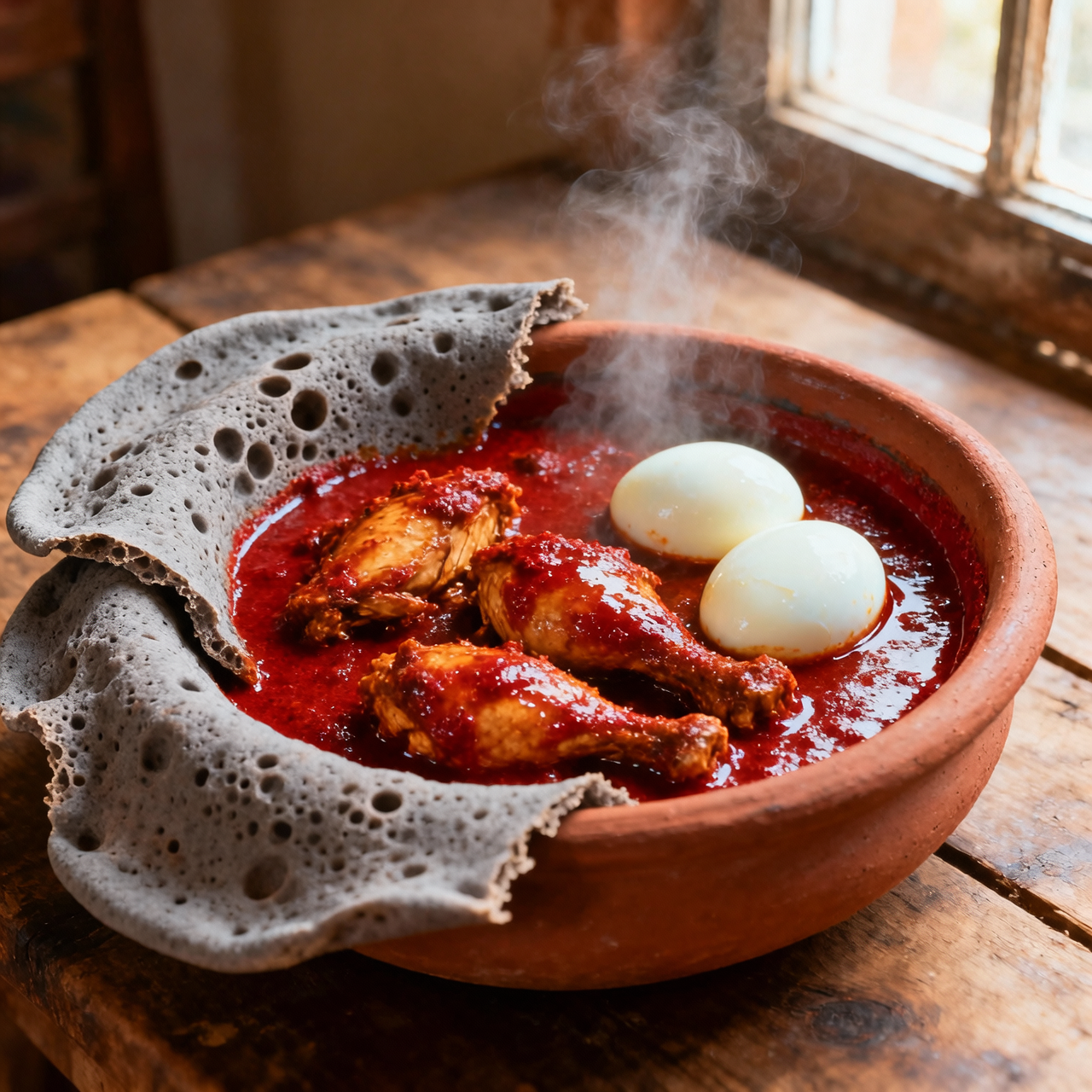
Doro Wat with Injera
When I first encountered Doro Wat, I was immediately struck by how it embodies the very soul of Ethiopian hospitality. This rich, slow-simmered chicken stew, deeply colored by berbere and traditionally served atop spongy injera, traces its roots back centuries to the highlands of Ethiopia, where communal dining has always been an act of profound respect. I’ve come to see this dish not merely as a meal, but as a living archive of trade routes, spice exchanges, and generational patience. The slow caramelization of onions, the careful blooming of chilies, and the deliberate balancing of niter kibbeh all speak to a culinary philosophy that values depth over haste. What makes it matter to me is the way it demands presence; you cannot rush it, and you certainly cannot fake the patience it requires. Yet, I’ve watched countless home cooks stumble at the same few hurdles. The most frequent mistake is skimping on the onion reduction, which robs the stew of its foundational sweetness and thickness. Another is using pre-ground berbere that’s lost its volatile oils, resulting in a flat, dusty heat rather than a complex, aromatic warmth. Some also neglect the traditional hard-boiled egg, missing the way its yolk absorbs the sauce to become its own treasure. When you finally tear a piece of freshly fermented injera and scoop up that deep mahogany broth alongside tender chicken, you’re participating in a ritual that has sustained families for generations. It’s a dish that asks for your time, but repays it in kind.
Ingredients
- 800 gchicken thigh— bone-in, skin-on
- 300 gyellow onion— finely diced
- 15 ggarlic— minced
- 15 gginger— grated
- 45 gberbere spice blend— divided for paste and seasoning
- 60 gniter kibbeh— spiced clarified butter
- 30 gtomato paste— concentrated
- 4 wholehard-boiled egg— peeled, scored lightly
- 200 gteff flour— one hundred percent whole grain
- 400 mlwater— filtered, divided for batter and stew
- 10 gsea salt— fine grain
- 15 mllemon juice— freshly squeezed
Method
Pick a skill levelThis version is designed to remove the intimidation factor while preserving the essential flavor profile. Instead of spending hours toasting and grinding whole spices, you will rely on a high-quality jarred berbere paste and a pre-mixed teff blend to accelerate the process. The focus here is on heat management and timing. You must keep the burner low when introducing the spice paste, as commercial blends often contain fine powders that scorch instantly. The chicken is simmered gently in a covered pan rather than slow-braised for hours, which keeps the timeline manageable without sacrificing tenderness. Watch the sauce closely as it thickens; it should coat the back of a spoon but still remain fluid enough to soak into the injera. Do not skip the resting period before serving, as this allows the flavors to marry and the heat to distribute evenly. By following these streamlined steps, you will achieve a confident first attempt that honors the spirit of the dish without requiring specialized equipment or days of preparation.
Method
- 1
Dice the yellow onion into uniform half-inch pieces.
Keep pieces consistent for even cooking.
dicing~ 5 min - 2
Sweat the diced onion in a dry heavy skillet over medium-low heat until fully translucent.
Stir frequently to prevent sticking.
sweating~ 10 minTricky bit - 3
Add niter kibbeh and tomato paste to the softened onions.
Cook until the oil begins to separate.
blooming~ 3 min - 4
Whisk in the jarred berbere spice blend along with minced garlic and grated ginger.
Reduce heat immediately to avoid scorching.
toasting~ 2 minTricky bit - 5
Pour in two hundred milliliters of water and bring the mixture to a gentle simmer.
Scrape the bottom of the pan to release fond.
deglazing~ 3 min - 6
Nestle the chicken thighs into the simmering sauce and season with sea salt.
Arrange skin-side down for maximum flavor absorption.
nestling~ 1 min - 7
Cover the pan and cook on low heat until the chicken reaches safe internal temperature.
Rotate pieces once halfway through cooking.
braising~ 25 minTricky bit - 8
Fold in the hard-boiled eggs and lemon juice during the final three minutes.
Warm gently without boiling to preserve texture.
finishing~ 3 min - 9
Warm the store-bought injera and serve directly beneath the stew.
Tear by hand to maintain traditional presentation.
plating~ 1 min
This approach bridges the gap between convenience and tradition by returning the foundational techniques to your hands. You will prepare the berbere from whole toasted chilies, cardamom, and fenugreek, grinding them fresh to unlock volatile aromatics that jarred versions simply cannot match. The onions are cooked slowly until completely broken down, creating a natural thickener that eliminates the need for flour or starch. The injera batter undergoes a controlled forty-eight-hour fermentation, developing the signature tang and porous structure essential for scooping. Heat control remains paramount; you will learn to recognize the exact moment the oil separates from the sauce, signaling that the spices have properly bloomed. The chicken is braised uncovered initially to reduce the liquid, then covered to finish cooking. Watch for the edges of the sauce pulling away from the pan, a visual cue that the flavors have concentrated correctly. This version rewards attention to texture and timing, yielding a result that closely mirrors the depth found in established home kitchens across the region.
Method
- 1
Finely dice the yellow onion and combine with minced garlic and grated ginger in a large bowl.
Keep aromatics separated until the pan is hot.
preparing~ 8 min - 2
Dry-toast whole chilies, fenugreek, and cardamom seeds in a heavy skillet until fragrant.
Shake the pan constantly to prevent uneven charring.
toasting~ 3 minTricky bit - 3
Grind the toasted spices with coriander, black pepper, and salt into a fine powder.
Allow the mixture to cool completely before grinding.
grinding~ 5 min - 4
Melt niter kibbeh in a heavy Dutch oven over medium-low heat and add the diced onion mixture.
Stir until the onions completely collapse into a paste.
sweating~ 20 minTricky bit - 5
Stir in the freshly ground berbere and tomato paste, cooking until the fat rises to the surface.
Watch for a deep mahogany color and rich aroma.
blooming~ 4 minTricky bit - 6
Deglaze the pot with filtered water and bring to a steady simmer.
Use a wooden spoon to lift any caramelized bits.
deglazing~ 3 min - 7
Submerge the chicken thighs in the sauce and braise uncovered for forty minutes.
Turn pieces every ten minutes for even coating.
braising~ 40 min - 8
Add the peeled hard-boiled eggs and simmer for ten additional minutes.
Gently spoon sauce over the eggs to heat through.
simmering~ 10 min - 9
Spread the fermented teff batter thinly on a hot griddle to cook the injera.
Steam bubbles should form within ninety seconds.
pan-frying~ 5 minTricky bit - 10
Finish the stew with lemon juice and sea salt before plating over warm injera.
Adjust acidity to balance the rich fat.
finishing~ 2 min
This rendition adheres strictly to classical techniques, demanding precision at every stage to achieve restaurant-grade complexity. The berbere is hand-toasted, cooled, and stone-ground to preserve delicate volatile compounds, while the niter kibbeh is clarified slowly with whole aromatics to build a rich, nutty fat base. The onions undergo a three-stage cooking process: sweating, slow caramelization, and reduction, each phase monitored by scent and viscosity rather than timers. The teff batter ferments for up to seventy-two hours in a temperature-controlled environment, developing a lively microbial culture that yields an exceptionally aerated crumb and sharp, clean acidity. Cooking occurs in unglazed clay to maintain steady, radiant heat that gently poaches the chicken without toughening the fibers. You must watch for the precise moment the stew transitions from a simmer to a gentle bubble, as boiling will emulsify the fat and dull the spice notes. This version requires patience and sensory calibration, but the resulting harmony of fermented tang, slow-cooked sweetness, and layered heat represents the absolute pinnacle of the craft.
Method
- 1
Sort and rinse whole teff grains, then mill into an ultra-fine flour and mix with filtered water.
Cover loosely with cloth and store at twenty-two degrees Celsius.
fermenting~ 1440 minTricky bit - 2
Hand-toast dried berbere components in a clay pan over low heat until deeply fragrant.
Monitor closely as small seeds scorch rapidly.
toasting~ 4 minTricky bit - 3
Cool the spices completely and grind them using a stone mortar to preserve essential oils.
Work in small batches for consistent particle size.
grinding~ 10 min - 4
Render niter kibbeh slowly with whole aromatics, skimming impurities until crystal clear.
Strain through fine cheesecloth before cooling.
clarifying~ 30 min - 5
Sweat the finely diced onion in the clarified butter over the lowest possible flame for two hours.
Stir occasionally until completely broken down into a jam.
sweating~ 120 minTricky bit - 6
Incorporate the stone-ground spice paste and tomato concentrate, blooming gently until the oil separates.
The mixture should pull cleanly from the sides of the vessel.
blooming~ 5 minTricky bit - 7
Pour in reserved water to create a smooth, glossy sauce base and bring to a bare simmer.
Avoid vigorous boiling to prevent fat emulsification.
reducing~ 5 min - 8
Nestle the chicken thighs into the sauce and braise in unglazed clay until fork-tender.
Rotate the pot periodically for radiant heat distribution.
braising~ 60 minTricky bit - 9
Score the hard-boiled eggs and submerge them in the stew during the final twenty minutes.
Allow the porous surface to absorb the seasoned broth.
steeping~ 20 min - 10
Cook the fully aerated injera batter on a traditional mitad, flipping only once.
A crisp bottom and spongy top indicate perfect execution.
griddle-cooking~ 4 minTricky bit - 11
Adjust seasoning with lemon juice and fine salt before serving directly on the clay vessel.
Let the dish rest for five minutes before breaking bread.
resting~ 5 min