
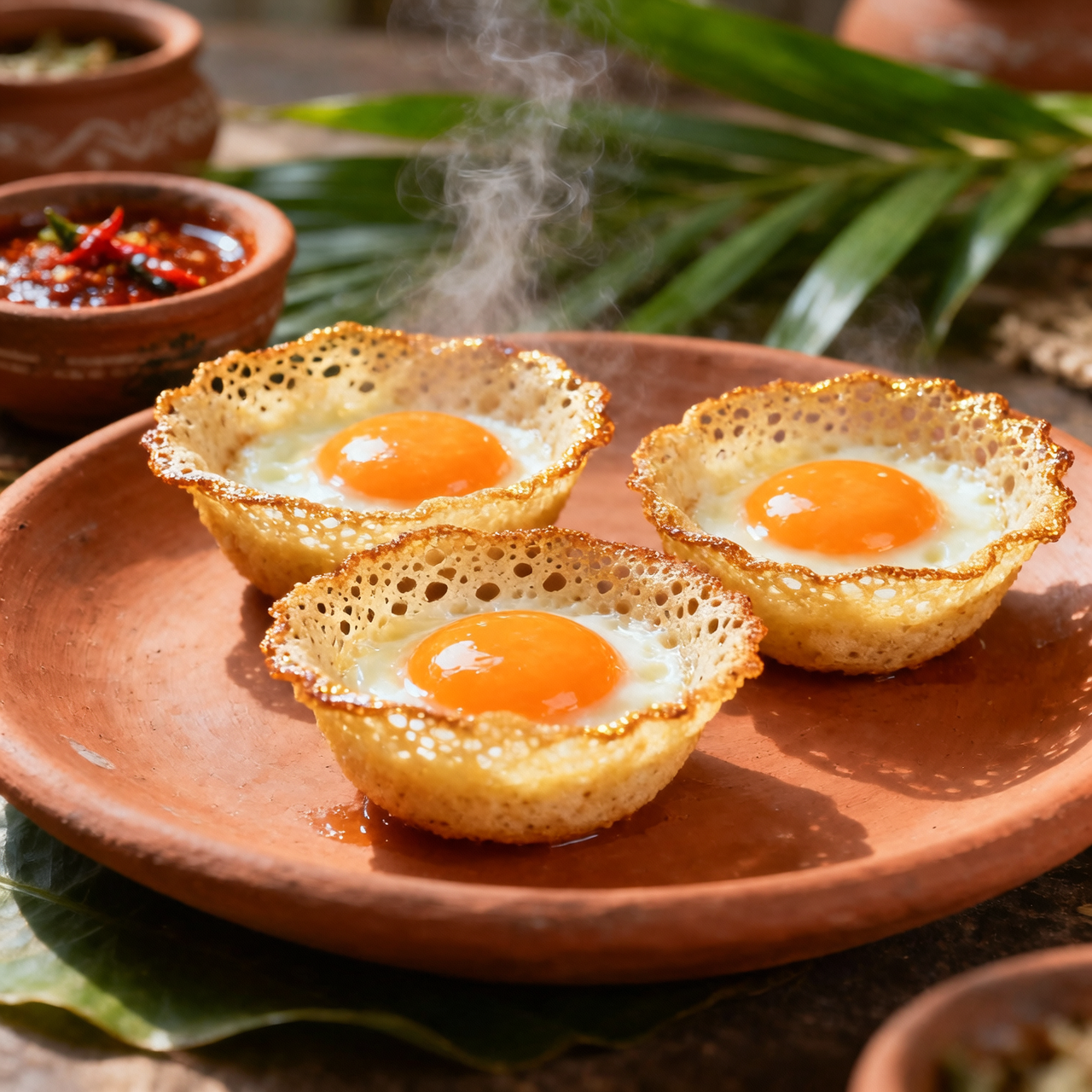
Egg Hoppers
I first understood the quiet magic of egg hoppers not in a bustling Colombo kitchen, but through the slow, deliberate rhythm of my grandmother’s wooden bowls. Born from the ancient South Indian appam tradition, Sri Lankans transformed this fermented rice crepe by embracing local coconut milk and a precise resting period that coaxes out a gentle, tangy effervescence. To me, this dish is more than a morning meal; it is a testament to patience and the art of balancing textures. The delicate, lace-like rim shatters at the touch, giving way to a pillowy, steamed center that cradles a softly set egg. What makes it so deeply meaningful is how it demands presence. You cannot rush fermentation, and you cannot force the batter. I have watched countless home cooks falter by using the wrong flour blend, skipping the overnight rest, or heating the pan too aggressively. The most frequent mistake, though, is impatience with the egg itself. Crack it too soon, and it pools into a rubbery sheet; crack it too late, and the batter sets before the white can settle into its signature crater. True mastery lies in listening to the pan’s quiet sizzle, swirling the batter with a practiced wrist, and trusting the slow steam. When done right, the hopper becomes a vessel of comfort, carrying generations of coastal mornings in every bite. It reminds me that the simplest ingredients, given time and respect, will always reward you.
Nutrition
| Per serving | Calories | Protein | Carbs | Fat | Sat fat | Fibre | Sugar | Sodium |
|---|---|---|---|---|---|---|---|---|
| beginner | 480kcal | 11g | 46g | 27g | 16g | 3g | 5g | 475mg |
| intermediate | 480kcal | 11g | 46g | 27g | 16g | 3g | 5g | 475mg |
| expert | 480kcal | 11g | 46g | 27g | 16g | 3g | 5g | 475mg |
Per serving · Ava-estimated — a guide, not a clinical figure.
- 200 grice flour— finely milled, not coarse
- 300 mlcoconut milk— full-fat, unsweetened
- 5 gactive dry yeast— fresh, not expired
- 15 gpalm sugar— grated or finely chopped
- 4 gfine sea salt— adjust to taste
- 4 largechicken egg— room temperature
- 30 mlneutral cooking oil— for greasing the pan
- 150 mllukewarm water— for activating yeast
This version strips away the intimidation factor by prioritizing reliable shortcuts and forgiving timing. Instead of committing to a multi-hour fermentation, we will use a rapid yeast activation method paired with a resting period that guarantees a light, spongy texture without the risk of over-proofing. The primary focus here is mastering the heat and the pour. You will learn to read the pan’s temperature by watching how the batter spreads and bubbles, rather than relying on a thermometer. Watch for the edges to turn translucent and crisp while the center remains soft enough to cradle the egg. Common beginner mistakes include pouring too much oil, which fries the batter instead of steaming it, and cracking the egg too early, which causes the white to spread unevenly. By using a consistent ladle measurement and keeping your wrist loose while swirling the pan, you will build muscle memory quickly. This approach guarantees a confident first attempt, delivering that signature crispy lace and tender center with minimal stress. Treat the first two hoppers as practice runs, adjust your flame accordingly, and you will be flipping them with ease by the fourth.
Equipment
- Hopper pan or small non-stick skillet— curved sides help form the bowl
- Measuring ladle— approx 60ml capacity
- Silicone spatula(optional)— for gentle release
Method
- 1
Activate the yeast by dissolving the palm sugar and fine sea salt in lukewarm water, then stirring in the active dry yeast until frothy.
Water should feel like bathwater, not hot.
proofing~ 5 min - 2
Whisk the activated yeast mixture into the rice flour and coconut milk until a smooth, thin batter forms, then cover and let it rest at room temperature.
Resting relaxes the starch for better spreading.
resting~ 15 min - 3
Heat the pan over medium-low heat and lightly coat the surface with a few drops of neutral oil using a paper towel.
The pan is ready when a drop of water sizzles immediately.
tempering~ 2 min - 4
Pour a full ladle of batter into the center of the hot pan and quickly swirl it to coat the bottom and lower sides.
Do not lift the pan off the heat.
swirling~ 1 minTricky bit - 5
Crack a chicken egg directly into the center of the setting batter and immediately cover the pan with a lid.
Covering traps steam to set the egg white.
steaming~ 3 min - 6
Slide the finished hopper onto a warm plate while the edges are still crisp, and repeat until the batter is gone.
Serve immediately for optimal texture.
plating~ 1 min