
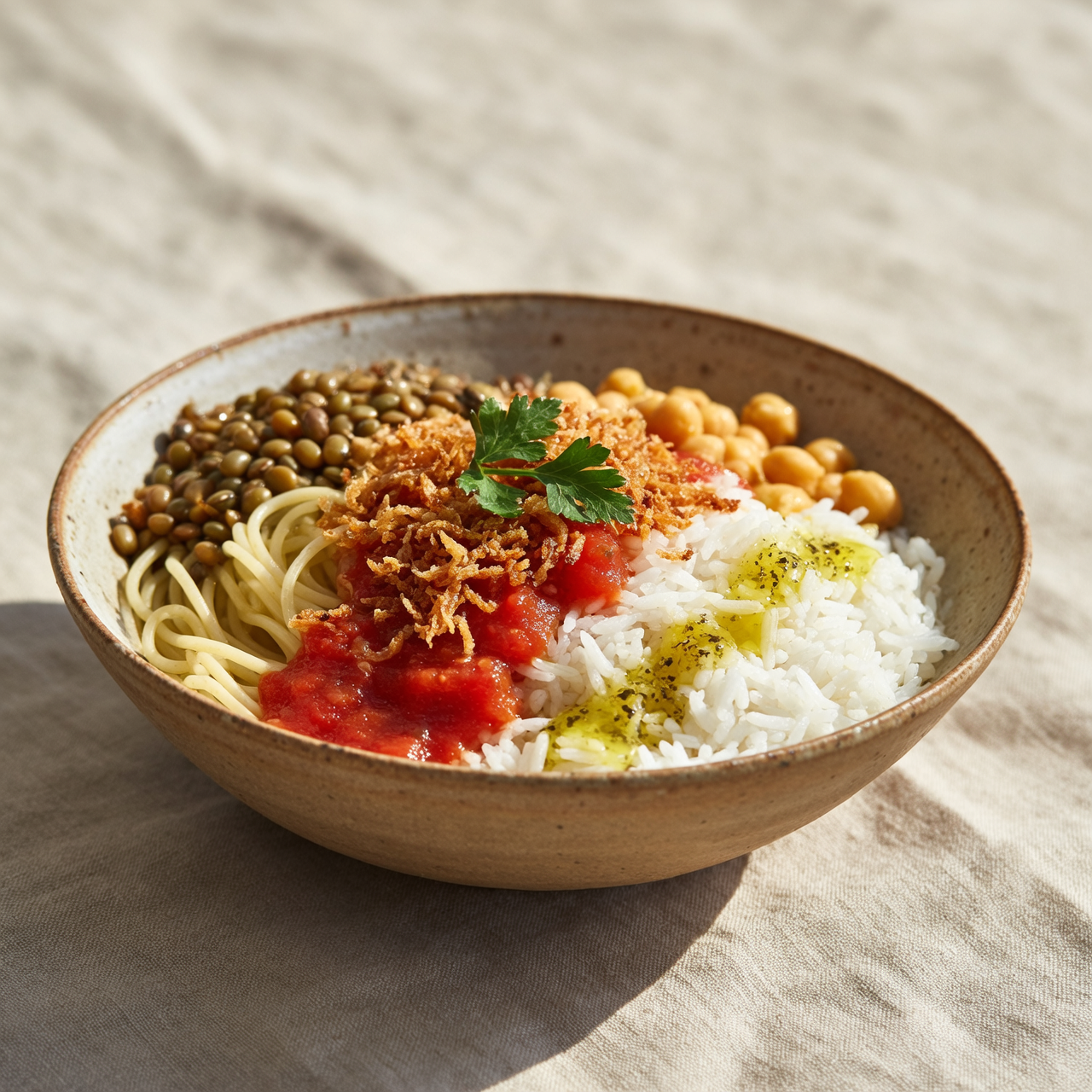
Koshari
I’ve always believed that the soul of a city lives in its street corners, and nowhere is that truer than in Cairo’s bustling koshari stalls. This humble Egyptian staple layers rice, lentils, and pasta beneath a tangy tomato-vinegar sauce and a blanket of crispy fried onions, creating a symphony of textures that somehow defies its humble origins. Historically tracing its roots through nineteenth-century trade routes that blended Indian khichdi, Italian pasta, and local spices, koshari has evolved into a national emblem of resourceful, plant-forward cooking. Yet, when I see supermarket shelves stocked with those three-pound fifty microwave koshari bowls, my heart sinks. Those pre-packaged versions rely on dehydrated flavour sachets and overly processed starches that turn mushy under high heat, completely stripping away the bright acidity and deep, caramelised onion sweetness that make the dish sing. Making it from scratch isn’t just about avoiding artificial thickeners and excessive sodium; it’s about reclaiming the slow, deliberate layering of flavours that transforms simple pantry staples into something deeply nourishing. The most common pitfall I see is rushing the sauce and onions. If you don’t simmer the tomato base long enough to concentrate its natural sugars, or if you crowd the pan when frying the shallots, you’ll lose that essential contrast between sweet crunch and sharp, tangy heat. Take your time. Let the rice absorb its broth properly, rinse the lentils until the water runs clear, and never skip the slow fry for the onions. When you finally scoop that first hot portion into a bowl, you’ll understand exactly why generations have lined up for this masterpiece.
Nutrition
| Per serving | Calories | Protein | Carbs | Fat | Sat fat | Fibre | Sugar | Sodium |
|---|---|---|---|---|---|---|---|---|
| beginner | 450kcal | 16g | 73g | 12g | 2g | 9g | 8g | 520mg |
| intermediate | 520kcal | 18g | 86g | 13g | 2g | 14g | 7g | 410mg |
| expert | 540kcal | 20g | 88g | 11g | 2g | 13g | 7g | 380mg |
Per serving · Ava-estimated — a guide, not a clinical figure.
- 200 gRice— Egyptian short-grain or jasmine preferred, rinsed
- 150 gBrown lentil— Sorted and rinsed
- 100 gMacaroni pasta— Small elbow or ditalini shape
- 200 gChickpea— Canned or pre-cooked, drained
- 300 gYellow onion— Thinly sliced for frying
- 4 cloveGarlic clove— Minced for sauce
- 60 gTomato paste
- 45 mlWhite vinegar
- 5 gGround cumin
- 3 gCayenne pepper(optional)— Adjust for heat preference
- 120 mlVegetable oil— Neutral oil for frying and sautéing
- 12 gSalt— Fine sea salt, divided across components
- 2 gBlack pepper— Freshly ground
Pre-mixed koshari kits or canned tomato-vinegar blends typically cost $8–$12 per serving and rely on hydrolyzed vegetable protein, excess citric acid, and stabilizers that flatten the authentic flavor profile. This beginner-friendly from-scratch version skips all processed shortcuts while simplifying timing through a single-pot absorption method for grains and a straightforward pan sauce. Crispy onions stay manageable with a gentle medium-heat fry and a light flour dusting. Watch the lentils closely to avoid mushiness, and taste the sauce before serving to balance the vinegar’s sharpness with the tomatoes’ natural sweetness. The assembly is highly forgiving—components can be prepped ahead and layered cold or warm without compromising texture. You will learn the foundational rhythm of Egyptian street cooking without juggling multiple burners or stressing over exact temperatures. Expect a hearty, deeply comforting bowl that outperforms any supermarket alternative in both nutritional integrity and cost. Rinse all dry ingredients thoroughly to remove excess starch, ensuring each component cooks evenly and stays distinct.
Equipment
- Medium saucepan— for boiling lentils and rice
- Large heavy skillet— prevents hot spots when frying onions
- Small pot— for simmering the daqqa sauce
- Fine-mesh strainer— drains pasta and rinses grains efficiently
Method
- 1
Rinse brown lentils under cold water until it runs clear, then simmer in fresh water until tender but intact.
Drain immediately to stop cooking and prevent mushiness.
simmering~ 15 min - 2
Toast rinsed long-grain rice in a dry saucepan until fragrant, then add measured water, cover, and cook on low heat.
Do not lift the lid during the absorption phase.
absorption~ 18 min - 3
Sauté minced garlic in oil until soft, stir in crushed tomatoes, cumin, coriander, chili flakes, and vinegar, then simmer until thickened.
Taste and adjust salt or vinegar before serving.
reducing~ 10 min - 4
Slice onions thinly, toss with a light dusting of flour, and fry in hot oil over medium heat until golden brown.
Crowding the pan will steam instead of crisp the onions.
pan-frying~ 8 minTricky bit - 5
Boil short pasta in generously salted water until al dente, then drain and toss with a splash of oil.
Reserve a spoonful of pasta water if the sauce needs thinning.
al dente~ 9 min - 6
Layer rice, lentils, and pasta in deep bowls, then ladle warm daqqa over the top and finish with crispy onions.
Serve immediately for the best temperature and texture contrast.
plating~ 2 min
Cooking from frozen
Thaw overnight in the fridge, then reheat gently in a covered skillet with a splash of water to restore moisture to the grains.
Storage times are a guide — always use your judgement and store food safely.