
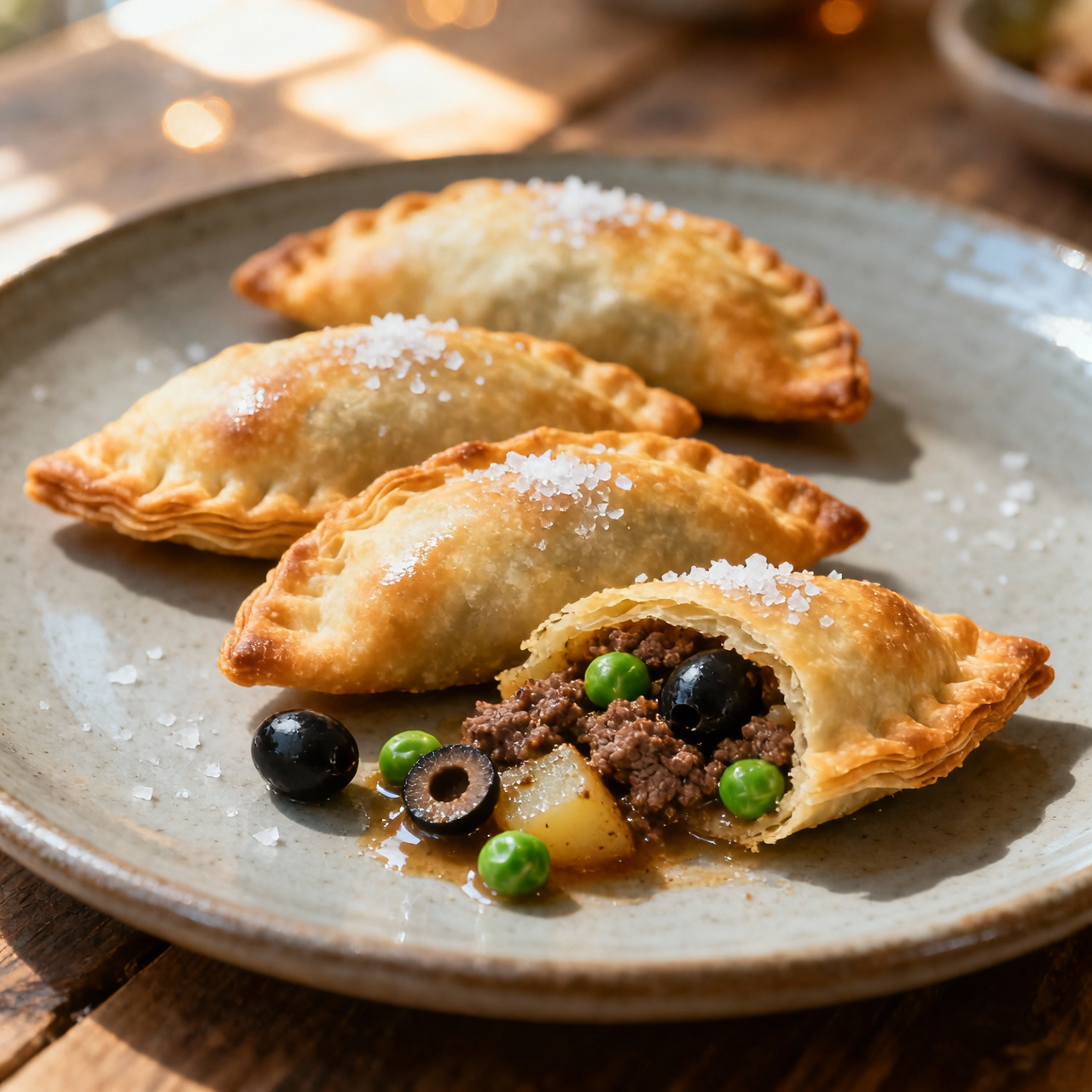
Empanadas Saltenas
I’ve always believed that a proper empanada salteña is less a snack and more an edible geography lesson. Born in the rugged northwest of Argentina, specifically around the city of Salta, these hand-pies carry the weight of colonial trade routes and indigenous cooking techniques, slowly evolving into a regional obsession that eventually crossed into Uruguay and beyond. What makes them so vital to my culinary memory isn’t just the flaky crust, but the precise, almost architectural balance inside: a rich, slow-simmered stew of beef, potatoes, olives, and hard-boiled eggs, bound together with a gelatin-rich broth that transforms into a savory jus when baked. That’s the secret, and it’s also where most home cooks stumble. People rush the filling, skipping the long reduction that builds depth, or they overwork the dough until it shatters instead of folds. Another common misstep? Failing to seal them with that signature repulgue—the braided crimp that isn’t just decorative, but functional, keeping the precious juices locked inside until the first bite. When done right, the pastry yields to a burst of warm, complex filling that tastes of cumin, smoked paprika, and patience. I make these not because they’re easy, but because they demand attention. They remind me that food at its best is a negotiation between tradition and technique, and that every imperfect fold still tells a story worth eating.
Nutrition
| Per serving | Calories | Protein | Carbs | Fat | Sat fat | Fibre | Sugar | Sodium |
|---|---|---|---|---|---|---|---|---|
| beginner | 541kcal | 20g | 58g | 27g | 8g | 4g | 3g | 810mg |
| intermediate | 541kcal | 20g | 58g | 27g | 8g | 4g | 3g | 810mg |
| expert | 541kcal | 20g | 58g | 27g | 8g | 4g | 3g | 810mg |
Per serving · Ava-estimated — a guide, not a clinical figure.
- 500 gall-purpose flour— sifted
- 240 mlcold water— divided
- 80 gbeef lard— rendered and cooled slightly
- 10 gfine sea salt— divided
- 300 gbeef chuck— trimmed of excess fat and diced small
- 150 gyellow onion— finely diced
- 100 gred bell pepper— seeded and minced
- 200 grusset potato— peeled and cut into half-inch cubes
- 100 ggreen peas— blanched
- 2 largehard-boiled egg— chopped
- 80 ggreen olive— pitted and sliced
- 250 mlchicken stock— low sodium
- 15 gunflavored gelatin powder— bloomed in cold water
- 8 gsmoked paprika
- 5 gground cumin
- 2 gground allspice
- 1 gcayenne pepper— adjust to heat preference
- 10 gfresh garlic— minced
- 30 mlneutral vegetable oil— for sautéing
- 1 largelarge egg— beaten for wash
This version removes the intimidation factor by leaning on reliable pantry staples and streamlined assembly. Instead of blooming individual spices in hot fat, you will use a prepared empanada seasoning paste that guarantees the classic Salta flavor profile without risking burnt aromatics. The dough relies on a straightforward hot-water method that stays forgiving even if overworked, eliminating the need for precise lamination. I have structured the filling steps to cook down quickly while preserving the necessary moisture for the signature juicy interior. Your main focus here should be temperature management: cool the filling completely before sealing, and use a simple fork-crimp if the traditional repulgue feels daunting. Watch the oven closely during the final minutes; beginner dough tends to brown faster due to higher sugar content in shortcut mixes. If you notice the edges darkening too quickly, tent loosely with foil. The goal is a confident first attempt that delivers the unmistakable savory heat and structural integrity expected of the dish. By mastering the seal and the bake timing here, you build the muscle memory needed to tackle more traditional methods later.
Equipment
- large mixing bowl— stainless steel preferred
- rolling pin— wooden or silicone
- rimmed baking sheet— line with parchment
- fork— standard dinner fork
Method
- 1
Combine flour, salt, and warm water in a large bowl until a smooth dough forms.
Do not overmix; stop as soon as it comes together.
kneading~ 2 min - 2
Heat oil in a skillet and brown the diced beef over medium heat.
Drain excess fat to prevent sogginess.
searing~ 3 min - 3
Stir in the prepared seasoning paste, diced vegetables, and broth until thickened.
Mixture should coat the back of a spoon.
reducing~ 5 min - 4
Remove from heat and fold in cooled gelatin, peas, and chopped hard-boiled eggs.
Gelatin must be cold to avoid melting prematurely.
tempering~ 2 min - 5
Roll dough into circles, fill centers, and seal edges firmly with a fork.
Press down hard to prevent bursting during baking.
crimping~ 3 minTricky bit - 6
Brush with beaten egg and bake until golden brown.
Internal temperature should reach 165°F.
baking~ 25 min