
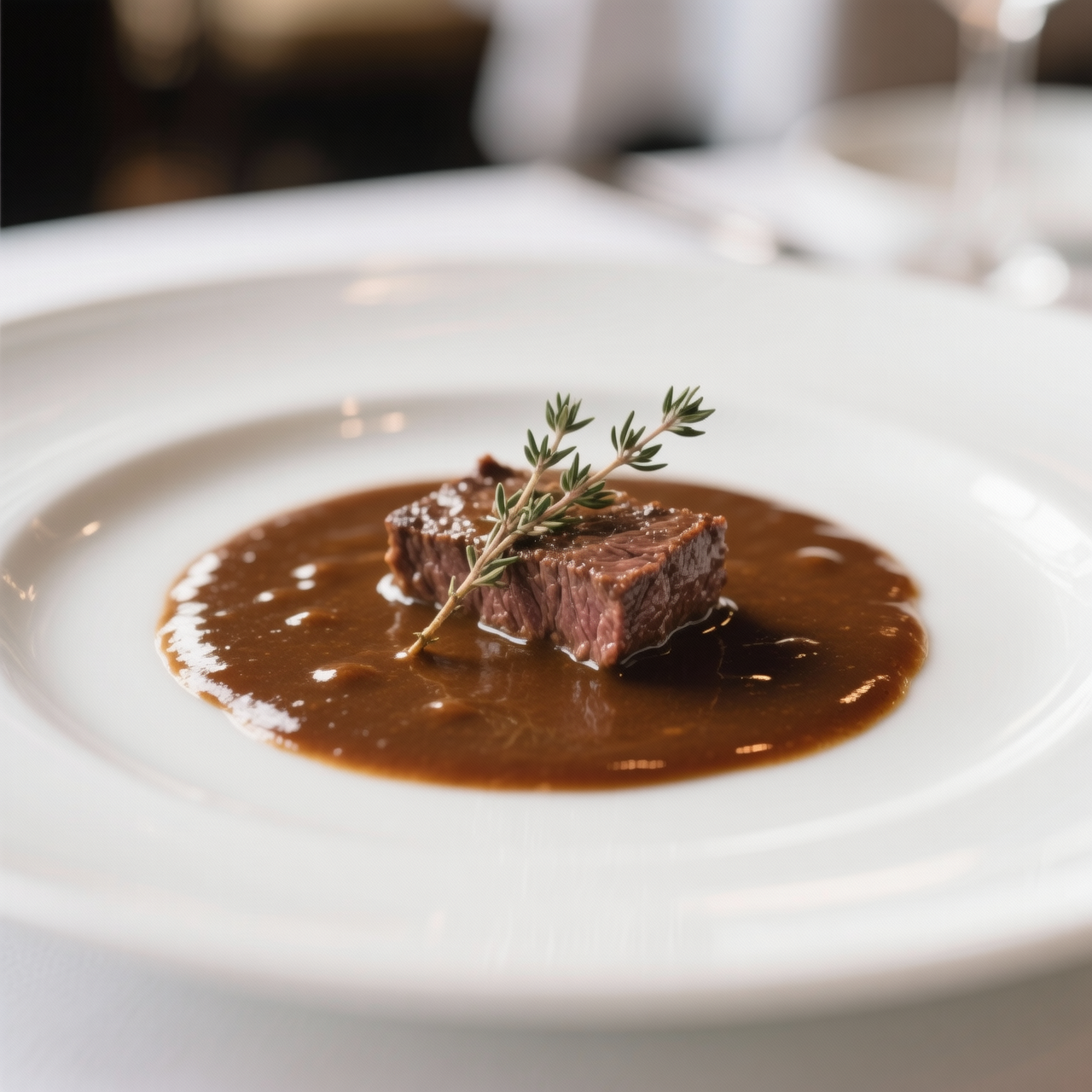
Espagnole sauce
When I first learned to coax a true Espagnole from the bottom of a heavy pot, I realized I was touching the very bedrock of classical French cuisine. Born in the kitchens of nineteenth-century Paris and codified by Auguste Escoffier, this brown mother sauce is less a standalone condiment than a culinary keystone. It carries the deep, resonant umami of slow-roasted veal or beef bones, caramelized mirepoix, and a rich tomato backbone, all thickened by a dark roux. I love it because it teaches patience; you cannot rush the Maillard reaction without sacrificing depth. Yet, so many home cooks stumble at the very first step. The most common pitfall is burning the roux, which introduces a bitter, acrid note that ruins the entire batch. Another frequent misstep is skimming too aggressively, leaving behind the fond that should be deglazed, or conversely, failing to skim enough fat and impurities during the long simmer, which leaves the sauce greasy and cloudy. I always remind myself that a proper Espagnole should taste profoundly savory but balanced, with a velvety texture that clings to the back of a spoon. It matters because from this single foundation springs demi-glace, bordelaise, and countless other derivatives that define professional French cooking. When I make it now, I treat it as a batch hero, knowing that a well-executed pot will reward me for months. I freeze it in measured portions, trusting that the slow cooling and proper reheating will preserve its complex architecture, ready to elevate a simple roast or transform into something entirely new with just a splash of wine and a handful of herbs.
Nutrition
| Per serving | Calories | Protein | Carbs | Fat | Sat fat | Fibre | Sugar | Sodium |
|---|---|---|---|---|---|---|---|---|
| beginner | 165kcal | 4g | 12g | 11g | 6g | 1g | 4g | 520mg |
| intermediate | 90kcal | 4g | 8g | 5g | 3g | 1g | 3g | 420mg |
| expert | 145kcal | 6g | 11g | 9g | 4g | 1g | 4g | 490mg |
Per serving · Ava-estimated — a guide, not a clinical figure.
- 1000 mlbeef stock— Homemade or high-quality low-sodium preferred
- 60 gbutter— Unsalted recommended for better seasoning control
- 60 gall-purpose flour
- 150 gonion— Finely diced
- 100 gcarrot— Finely diced
- 50 gcelery— Finely diced
- 30 gtomato paste
- 2 piecebay leaf
- 3 sprigfresh thyme— Keep whole for easy straining
- 5 gsalt— Adjust based on stock salinity
- 2 gblack pepper— Freshly cracked
This beginner-friendly approach strips away the intimidation factor of classic French mother sauces by embracing smart, time-saving shortcuts without sacrificing depth. Instead of roasting bones and simmering stock for hours, you will rely on high-quality store-bought beef broth and pre-chopped mirepoix or frozen onion-carrot-celery blends. The key technique here is the roux, which we will build slowly over medium-low heat to prevent scorching, using a simple visual cue: a light peanut butter color means you are ready. Jarred tomato paste is added early to caramelize quickly, locking in that essential savory backbone. Watch closely when incorporating the broth; whisk constantly in a steady stream to banish lumps before they form, then lower the heat to a bare simmer. You will notice the sauce gradually coat the back of a spoon as it reduces, signaling it is properly thickened. There is no need for constant vigilance or professional-grade equipment. A standard heavy pot, a flexible spatula, and about forty-five minutes of gentle cooking are all it takes. This method guarantees a rich, velvety base that freezes beautifully for future stews, gravies, or demi-glace reductions, building your confidence with every batch.
Equipment
- Heavy-bottomed saucepan— 2 to 3 quart capacity is ideal
- Silicone whisk— prevents scratching the pan surface
- Fine-mesh sieve(optional)— optional but recommended for a silky finish
Method
- 1
Melt the butter over medium-low heat and add the pre-chopped mirepoix.
Listen for a gentle sizzle rather than a loud crackle to avoid burning.
sweating~ 5 min - 2
Stir in the jarred tomato paste and cook until it darkens slightly.
This step unlocks deep umami flavors that raw paste lacks.
caramelizing~ 3 minTricky bit - 3
Sprinkle the flour over the vegetables and stir constantly until combined.
Aim for a pale tan roux that smells nutty, not burnt.
blooming~ 2 minTricky bit - 4
Slowly pour in the beef broth while whisking vigorously to prevent clumps.
Add the liquid in three separate stages for guaranteed smoothness.
tempering~ 4 minTricky bit - 5
Bring the mixture to a gentle bubble, then reduce heat to maintain a low simmer.
Leave the lid slightly ajar to allow excess moisture to escape.
simmering~ 20 min - 6
Strain the sauce through a fine mesh sieve into a clean bowl and season to taste.
Cool completely before transferring to freezer-safe containers.
straining~ 2 min
Cooking from frozen
Thaw overnight in the refrigerator and gently reheat in a saucepan over low heat, whisking occasionally to restore a smooth consistency.
Storage times are a guide — always use your judgement and store food safely.