
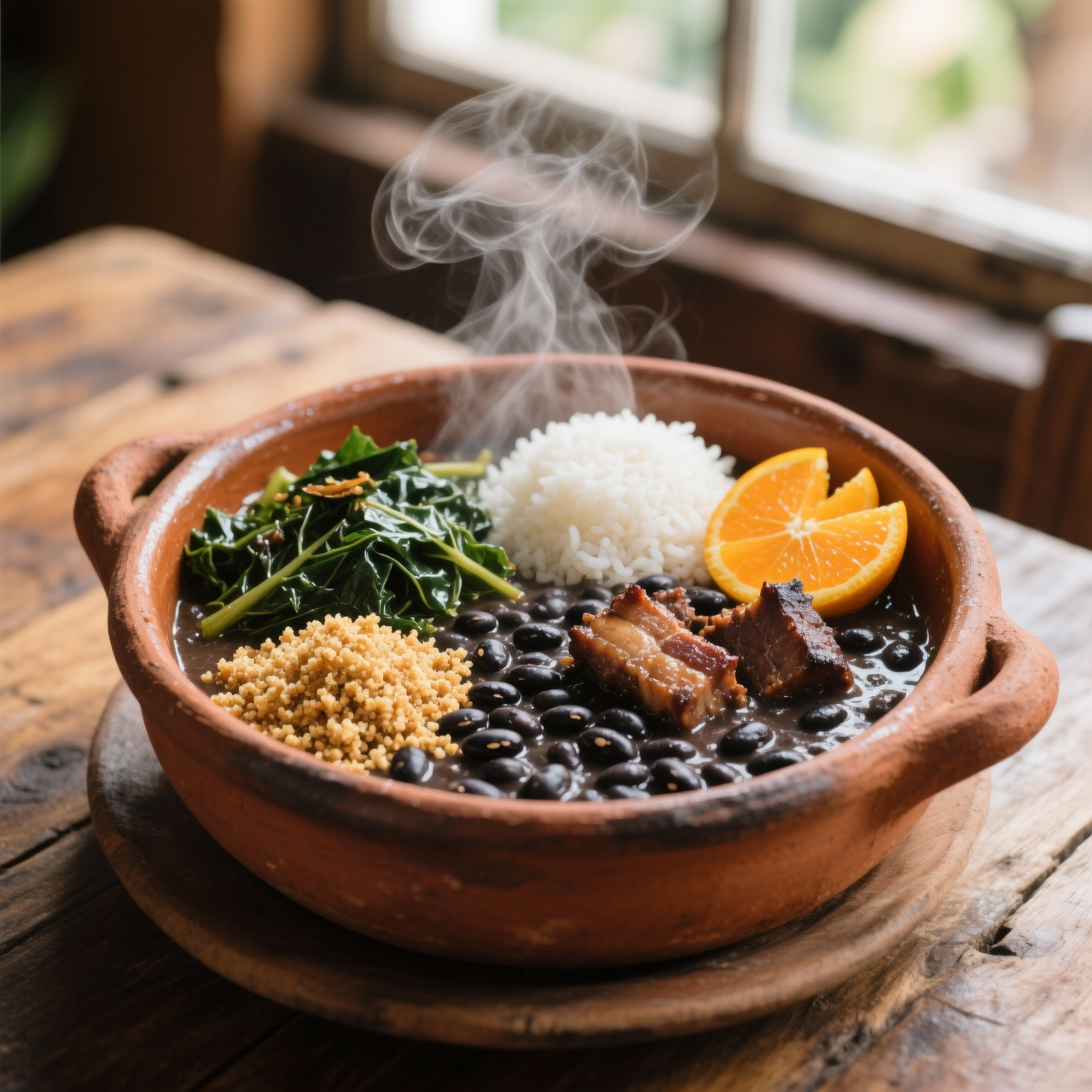
Feijoada
I have always believed that feijoada is less a recipe and more a living archive of Brazilian resilience. When I first stood over a heavy cast-iron pot, stirring a tangle of black beans and smoked meats, I wasn’t just cooking; I was participating in a centuries-old dialogue about survival and community. The dish’s origins are famously tangled in folklore, often romanticized as a humble creation of enslaved people making use of discarded pork cuts, though historians remind us it also carries echoes of European bean stews adapted to New World ingredients. What truly matters to me is how it functions as a culinary anchor. It demands patience, transforming tough, salty cuts into something profoundly tender through slow, deliberate simmering. Yet, that very patience is where most cooks stumble. I have seen too many rushed versions where the beans remain chalky or the broth turns muddy because the meats were added all at once, or worse, because the pot was stirred too vigorously and broke the beans into a pasty sludge. Another frequent misstep is underestimating the salt; cured pork parts release their brine gradually, so seasoning too early can ruin the balance. I always soak the beans overnight, parboil the tougher meats separately, and build the stew in stages, letting each layer surrender its flavor to the dark, glossy broth. When done right, feijoada doesn’t just feed a crowd—it gathers them, reminding us that time, attention, and respect for tradition yield something far greater than the sum of its parts.
Nutrition
| Per serving | Calories | Protein | Carbs | Fat | Sat fat | Fibre | Sugar | Sodium |
|---|---|---|---|---|---|---|---|---|
| beginner | 1180kcal | 50g | 126g | 54g | 17g | 20g | 8g | 1160mg |
| intermediate | 1180kcal | 50g | 126g | 54g | 17g | 20g | 8g | 1160mg |
| expert | 1180kcal | 50g | 126g | 54g | 17g | 20g | 8g | 1160mg |
Per serving · Ava-estimated — a guide, not a clinical figure.
- 400 gblack bean— dried, sorted and rinsed
- 300 gpork shoulder— boneless, trimmed
- 150 gsmoked sausage— cured, firm
- 150 gpork belly— thick-cut, skin removed
- 150 gonion— yellow, peeled
- 20 ggarlic— fresh cloves
- 3 wholebay leaf— dried
- 1 wholeorange— navel, ripe
- 30 mlolive oil— extra virgin
- 200 gwhite rice— long grain
- 200 gcollard green— stems removed
- 50 gcassava flour— toasted fine
- 10 gcoarse salt— sea salt
- 1500 mlwater— cold, filtered
This version is built for confidence, stripping away the intimidation of long soaks and complex meat prep while preserving the dish’s essential character. Instead of hand-chopping aromatics, you will use a quality jarred sofrito base, which delivers instant depth without demanding knife skills or patience. The meats are browned quickly in a single heavy pot to build fond, then combined with pre-rinsed beans and a measured pour of water. A steady, covered simmer replaces the traditional all-day braise, bringing the beans to tenderness in under an hour while keeping the broth cohesive. Watch for the moment the beans begin to split; that is your signal to stir gently and adjust the salt. The rice and collard greens are cooked simultaneously in separate pans, so timing everything to finish together is straightforward. Avoid the temptation to boil the stew aggressively, as high heat will break the beans into mush and cloud the broth. Keep the lid on, check the water level halfway through, and trust that the jarred aromatics will bloom beautifully in the rendered pork fat. Serve with sliced orange and store-bought farofa to complete the plate.
Equipment
- heavy-bottomed pot— 6-quart capacity
- cutting board— stable surface
- chef knife— 8-inch blade
- colander— stainless steel
Method
- 1
Rinse the black beans and transfer them to a heavy pot with water.
Cover by two inches.
rinsing~ 1 min - 2
Brown the pork shoulder, smoked sausage, and pork belly over medium-high heat.
Do not crowd the pan.
searing~ 8 min - 3
Stir in the jarred garlic and onion paste along with bay leaves.
Cook until fragrant and bubbling.
blooming~ 2 min - 4
Cover and simmer gently until the beans are completely tender.
Check water level halfway and top off as needed.
simmering~ 40 minTricky bit - 5
Boil the white rice and quickly sauté the collard greens in olive oil.
Keep the greens bright by cooking them fast.
wilting~ 10 min - 6
Slice the orange and arrange all components on a serving platter with cassava flour.
Serve immediately while hot.
plating~ 2 min