
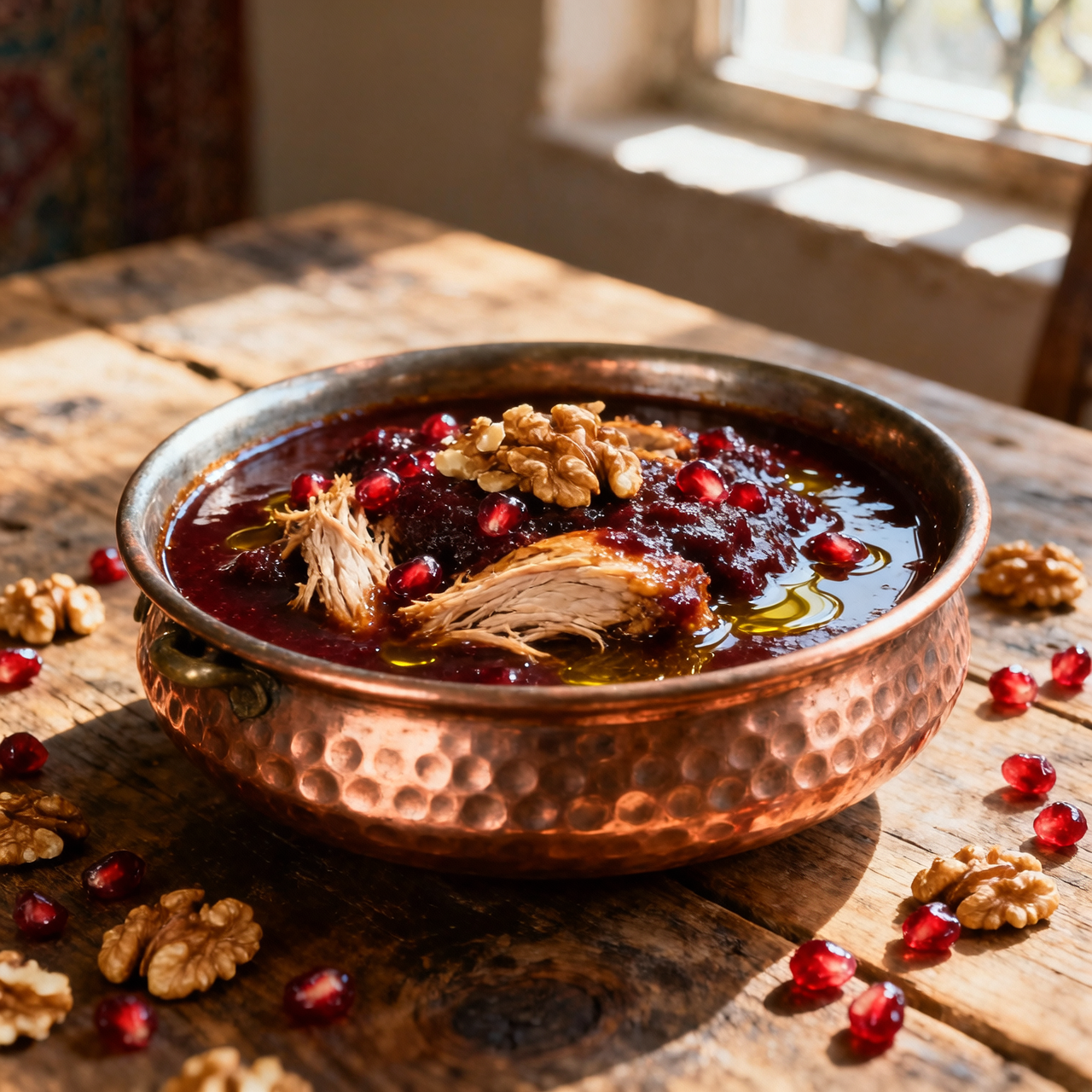
Fesenjan
Fesenjan is more than a stew to me; it is a quiet alchemy of patience and balance, born from the ancient orchards of northern Iran where pomegranate and walnut trees have intertwined for centuries. When I first learned to coax its dark, silken sauce to life, I realized this dish is a meditation on contrasts—sweet and sour, bitter and rich, all held together by slow, unwavering heat. It matters deeply in Persian kitchens not because it demands grand technique, but because it teaches restraint. Every grandmother I’ve watched stir a pot of fesenjan understands that rushing it yields a fractured, oily mess. The most common pitfall is impatience: toasting the walnuts too long scorches them into acrid dust, while undercooking the pomegranate molasses leaves a harsh, metallic tang. I’ve seen cooks drown the sauce in sugar to mask a bitter base, or skip the crucial step of skimming the oil as it rises, mistaking separation for failure rather than a sign of proper emulsification. True fesenjan reveals itself gradually, thickening over hours until the walnut oil weeps to the surface in a glossy, mahogany crown. It is a dish that refuses to be hurried, mirroring the Persian belief that time, when given respect, transforms simple ingredients into something profoundly comforting. When I finally taste that first spoonful, balanced perfectly between earth and fruit, I am reminded why this recipe has endured through generations, not as mere sustenance, but as a quiet testament to the beauty of waiting.
Nutrition
| Per serving | Calories | Protein | Carbs | Fat | Sat fat | Fibre | Sugar | Sodium |
|---|---|---|---|---|---|---|---|---|
| beginner | 745kcal | 39g | 43g | 48g | 8g | 4g | 31g | 1250mg |
| intermediate | 745kcal | 39g | 43g | 48g | 8g | 4g | 31g | 1250mg |
| expert | 745kcal | 39g | 43g | 48g | 8g | 4g | 31g | 1250mg |
Per serving · Ava-estimated — a guide, not a clinical figure.
- 200 gwalnut— raw halves or pieces, not pre-roasted
- 120 mlpomegranate molasses— check label for pure fruit concentrate
- 600 gchicken thigh— boneless and skinless
- 200 gyellow onion— one large bulb
- 0.5 gsaffron thread— premium grade
- 30 ggranulated sugar(optional)— adjust to balance tartness
- 10 gkosher salt
- 2 gblack peppercorn— freshly ground
- 480 mlchicken broth— low sodium
This version prioritizes confidence over tradition, giving you a reliable framework to experience Fesenjan signature sweet-and-sour profile without the intimidation of long simmering or manual grinding. You will use a standard food processor to quickly break down the walnuts, which guarantees an even texture and drastically reduces prep time. Instead of worrying about complex balancing, we rely on a trusted jarred pomegranate concentrate and measured sugar to hit the right flavor notes consistently. The key here is temperature control; keep your heat strictly at medium-low once the liquid hits the pan. Rushing will scorch the ground nuts and lock in a harsh bitterness. Watch for the moment the sauce transitions from a thin, grainy slurry to a smooth, cohesive glaze. You do not need to skim aggressively or manage oil separation manually. Simply let the pot do the heavy lifting while you focus on seasoning in stages. Taste every ten minutes, adjusting salt and sugar until the tartness softens and the meat becomes fork-tender. This approach strips away the guesswork, proving that a deeply satisfying Persian stew is entirely within reach on a busy weeknight.
Equipment
- food processor— standard blade attachment
- non-stick skillet— heavy bottom preferred
- measuring cups— for accurate liquid ratios
Method
- 1
Process the raw walnuts in a food processor until they form a coarse, uniform meal.
Stop immediately once the texture resembles damp sand to avoid releasing excess oil too early.
grinding~ 1 min - 2
Dice the yellow onion and sauté it in a neutral oil until completely translucent.
Do not allow the onions to brown or caramelize.
sweating~ 5 min - 3
Stir the processed walnuts into the softened onions and toast them gently.
The mixture should smell nutty but never bitter.
toasting~ 2 minTricky bit - 4
Pour in the pomegranate molasses, chicken broth, and granulated sugar, then bring the mixture to a bare simmer.
Keep the heat strictly at medium-low to prevent scorching.
simmering~ 3 min - 5
Add the chicken thighs, kosher salt, and black peppercorns, then cover the pot.
Check the liquid level halfway through to ensure the chicken stays submerged.
braising~ 20 min - 6
Bloom the saffron threads in two tablespoons of hot water and fold it into the stew.
Wait until the final five minutes to preserve the floral aroma.
blooming~ 2 min - 7
Remove the chicken, shred it roughly with two forks, and return it to the sauce.
Taste for balance and adjust salt or sugar if needed.
finishing~ 2 min