
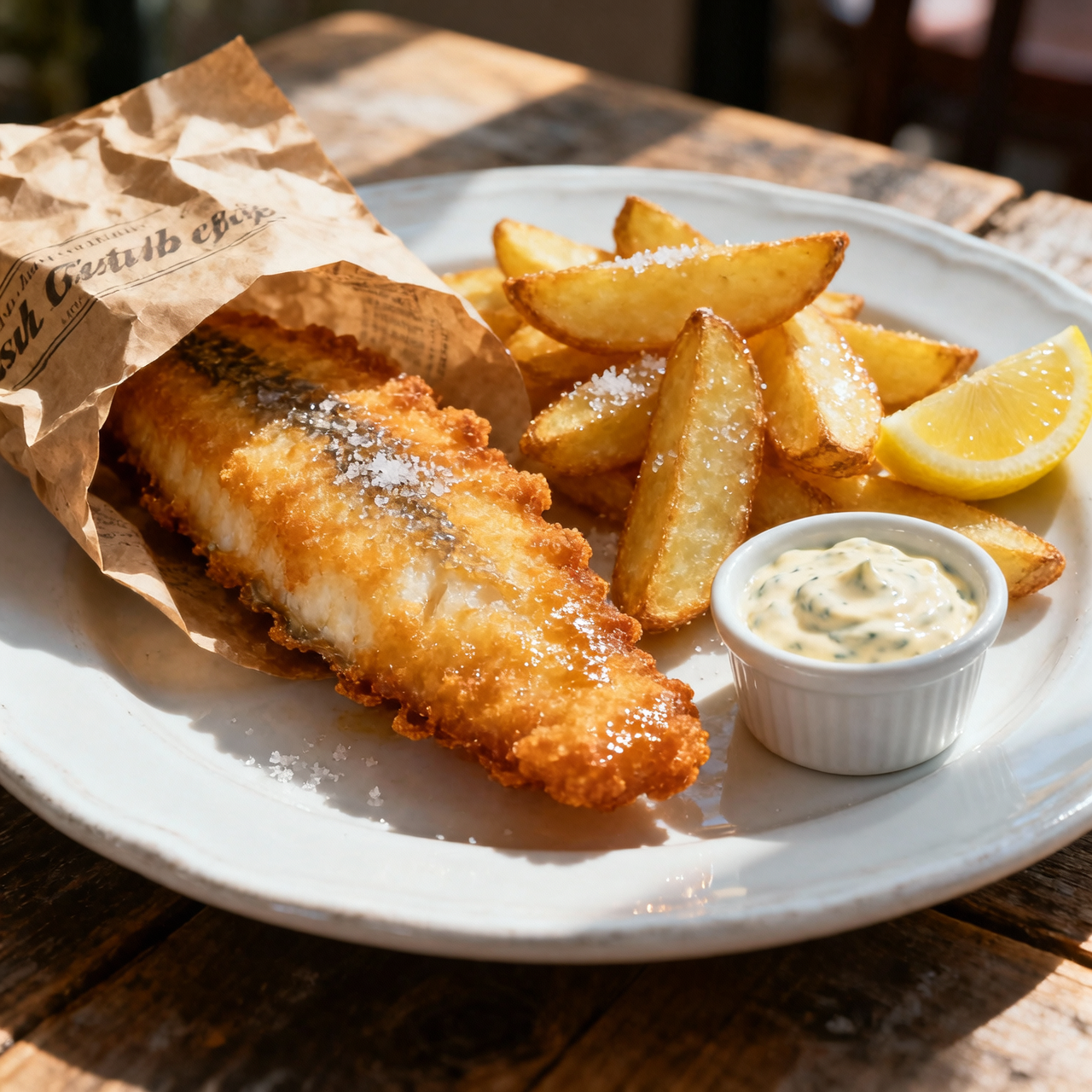
Fish and Chips
I have always viewed fish and chips not merely as a meal, but as a quiet testament to British maritime heritage. When I first learned to make it, I was struck by how this unassuming dish bridges centuries of coastal trade and working-class resilience. The concept of frying battered cod alongside potatoes arrived in the nineteenth century, born from Jewish immigrants frying fish and Lancashire vendors selling chips. Together, they formed a culinary marriage that fed factory workers and sailors alike, eventually wrapping itself in greaseproof paper and becoming a national ritual. To me, recreating it is an act of preservation, a way to honor the seaside towns where the scent of malt vinegar and hot oil hangs heavy in the sea air. Yet, the path to a perfect plate is notoriously treacherous. Many cooks rush the batter, using lukewarm beer or skipping the crucial resting period, which guarantees a heavy, soggy crust instead of the glass-like shatter we crave. Others overlook the potato variety, choosing waxy types that collapse into mush rather than yielding that coveted fluffy interior and crisp exterior. Temperature control remains the silent guardian of success; dropping the oil too low steams the fish, while letting it climb too high scorches the coating before the flesh cooks through. I have learned to respect the rhythm of double-frying, to listen for the specific sizzle that signals readiness, and to never crowd the pan. When done right, the result is more than comfort food. It is a golden, steaming slice of history that demands patience, precision, and a deep respect for the simple ingredients that built it.
Nutrition
| Per serving | Calories | Protein | Carbs | Fat | Sat fat | Fibre | Sugar | Sodium |
|---|---|---|---|---|---|---|---|---|
| beginner | 680kcal | 35g | 63g | 30g | 3g | 6g | 2g | 1180mg |
| intermediate | 680kcal | 35g | 63g | 30g | 3g | 6g | 2g | 1180mg |
| expert | 680kcal | 35g | 63g | 30g | 3g | 6g | 2g | 1180mg |
Per serving · Ava-estimated — a guide, not a clinical figure.
- 600 gcod fillet— thick-cut, sustainably sourced
- 800 gpotato— Maris Piper or Russet variety
- 150 gplain flour— sifted
- 5 gbaking powder— fresh and active
- 10 gfine sea salt— for seasoning batter and chips
- 250 mlsparkling water— ice cold
- 2000 mlneutral high-smoke-point oil— vegetable, sunflower, or peanut
- 30 mlmalt vinegar— traditional British style
- 1 wholelemon— halved for serving
This version is designed for a confident first attempt, prioritizing safety and simplicity over absolute precision. You will skip the traditional double-fry for the potatoes, opting instead for a single, straightforward cook that guarantees a tender interior without the stress of managing two temperature stages. The batter relies on a quick mix-and-dip method, which means you won’t need to worry about resting times or precise hydration ratios. Focus heavily on keeping your oil at a steady, moderate temperature; if you lack a thermometer, a wooden spoon handle test will suffice to confirm it is ready. Watch closely for overcrowding the pot, as dropping too much food at once will crash the temperature and lead to greasy results. Drain everything on paper towels or a wire rack immediately after removing it from the oil, and season generously while the surface is still hot. The goal here is not perfection, but a reliably crisp, deeply satisfying meal that proves you can handle the fundamentals without intimidation. Embrace minor inconsistencies as learning milestones.
Equipment
- Heavy-bottomed pot— deep enough for safe frying
- Deep-fry thermometer— essential for temperature safety
- Wire cooling rack— prevents sogginess better than paper towels
Method
- 1
Peel and cut potatoes into thick batons, then soak them in cold water.
Soaking removes surface starch for a crispier finish.
soaking~ 5 min - 2
Whisk flour, baking powder, salt, and ice-cold sparkling water in a bowl until just combined.
Do not overmix; small lumps are acceptable.
whisking~ 1 min - 3
Pour oil into a heavy pot and heat it to 160°C using a thermometer.
Maintain a steady heat throughout the cook.
heating~ 10 minTricky bit - 4
Add drained potatoes to the oil and cook until tender but pale.
Fry in a single batch to avoid temperature drops.
par-frying~ 8 min - 5
Dip cod in batter, gently lower into the oil, and fry until golden brown and opaque.
Turn once halfway through for even coloring.
battering~ 6 minTricky bit - 6
Drain fish and chips on a wire rack, season immediately, and serve with malt vinegar.
Seasoning while hot ensures proper adhesion.
draining~ 1 min