
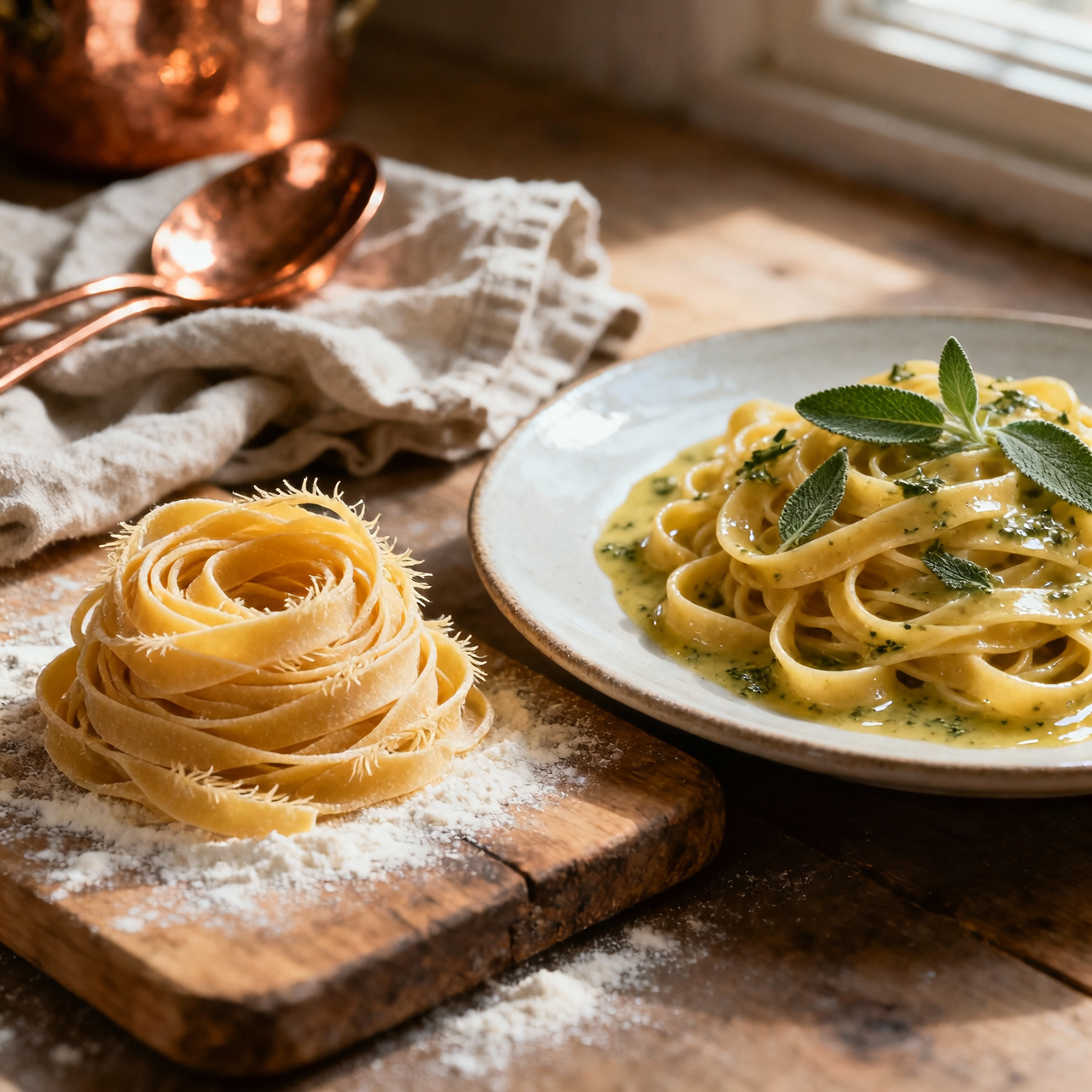
Fresh egg pasta (tagliatelle)
There is a quiet alchemy in transforming nothing but flour and eggs into silk. Fresh tagliatelle, born in the heart of Emilia-Romagna, represents the Italian kitchen’s reverence for restraint and rhythm. When you buy it packaged or dried, you are paying a premium for shelf-stability and a brittle, uniform bite that never quite absorbs sauce the way a properly rested, hand-cut ribbon will. Shop-bought fresh pasta often sits in modified atmospheres, losing its delicate moisture and becoming gummy when cooked. This recipe strips away the industrial padding, returning you to the essential ratio: one hundred grams of flour per large egg. The secret is not speed, but patience. A common pitfall is overworking the dough, which develops too much gluten and yields tough noodles instead of tender ones. Another is skipping the rest, which leaves the dough springy and impossible to roll thin. By letting hydration happen slowly and rolling with confident, even pressure, you unlock a texture that is supple, slightly porous, and impossibly light. This foundation replaces the dried aisle entirely, scaling effortlessly into pappardelle, fettuccine, or lasagne sheets. Once you feel the dough yield beneath your palms and watch it catch a simple emulsion of butter and cheese, you will understand why generations have refused to settle for the packaged alternative. The craft is forgiving, deeply tactile, and entirely yours to master.
Nutrition
| Per serving | Calories | Protein | Carbs | Fat | Sat fat | Fibre | Sugar | Sodium |
|---|---|---|---|---|---|---|---|---|
| beginner | 430kcal | 15g | 75g | 7g | 2g | 3g | 1g | 210mg |
| intermediate | 430kcal | 15g | 75g | 7g | 2g | 3g | 1g | 210mg |
| expert | 430kcal | 15g | 75g | 7g | 2g | 3g | 1g | 210mg |
Per serving · Ava-estimated — a guide, not a clinical figure.
- 400 g00 flour— High-protein type, not self-raising
- 4 unitslarge egg— Room temperature for even hydration
- 5 gfine sea salt— Dissolves evenly into dough
- 30 gsemolina flour— Coarse variety for dusting and preventing sticking
Focus on the bowl and fork method instead of the traditional well, which minimizes mess and prevents uneven hydration. A longer autolyse allows the flour to fully absorb egg moisture while you step away. Emphasize tactile cues over strict timers. Watch for dough that feels dry or cracks at the edges; add water sparingly, one teaspoon at a time. The goal is a cohesive, smooth ball without overworking it. Rolling uses a standard pin, aiming for consistent thickness rather than perfect uniformity. Cutting relies on a sharp chef knife and a straight edge. The extended rest deeply relaxes gluten, making it highly forgiving for first attempts. Monitor humidity changes in your kitchen and adjust with minimal water or flour. This process prioritizes confidence and consistency over speed. Avoid rushing the resting phase, as it is absolutely non-negotiable for easy rolling. Your first batch will cook evenly and hold its shape beautifully. Trust the dough’s feel, not the clock.
Equipment
- large mixing bowl— glass or ceramic preferred
- wooden spoon— for initial stirring
- rolling pin— standard French style works well
- chef knife— sharp blade for clean cuts
- clean kitchen towel— for covering dough
Method
- 1
Combine the flour and fine sea salt in a large mixing bowl.
Whisk briefly to distribute salt evenly.
dry mixing~ 1 min - 2
Make a deep well in the center and crack the eggs directly into it.
Break yolks gently with a fork to prevent shell fragments.
well formation~ 1 min - 3
Stir the eggs with a fork, gradually pulling flour from the walls until a shaggy mass forms.
Stop when no dry pockets remain.
hydration~ 5 minTricky bit - 4
Cover the dough tightly with the towel and let it rest at room temperature for thirty minutes.
Do not skip this step; it relaxes the gluten network.
autolyse~ 30 min - 5
Roll the dough thinly on a lightly semolina-dusted surface and slice into uniform ribbons with the knife.
Dust cut strands lightly with semolina before cooking.
sheeting~ 10 minTricky bit
Cooking from frozen
Defrost overnight in the fridge, then drop directly into boiling salted water for two minutes until al dente, or toss gently into a hot pan sauce.
Storage times are a guide — always use your judgement and store food safely.