
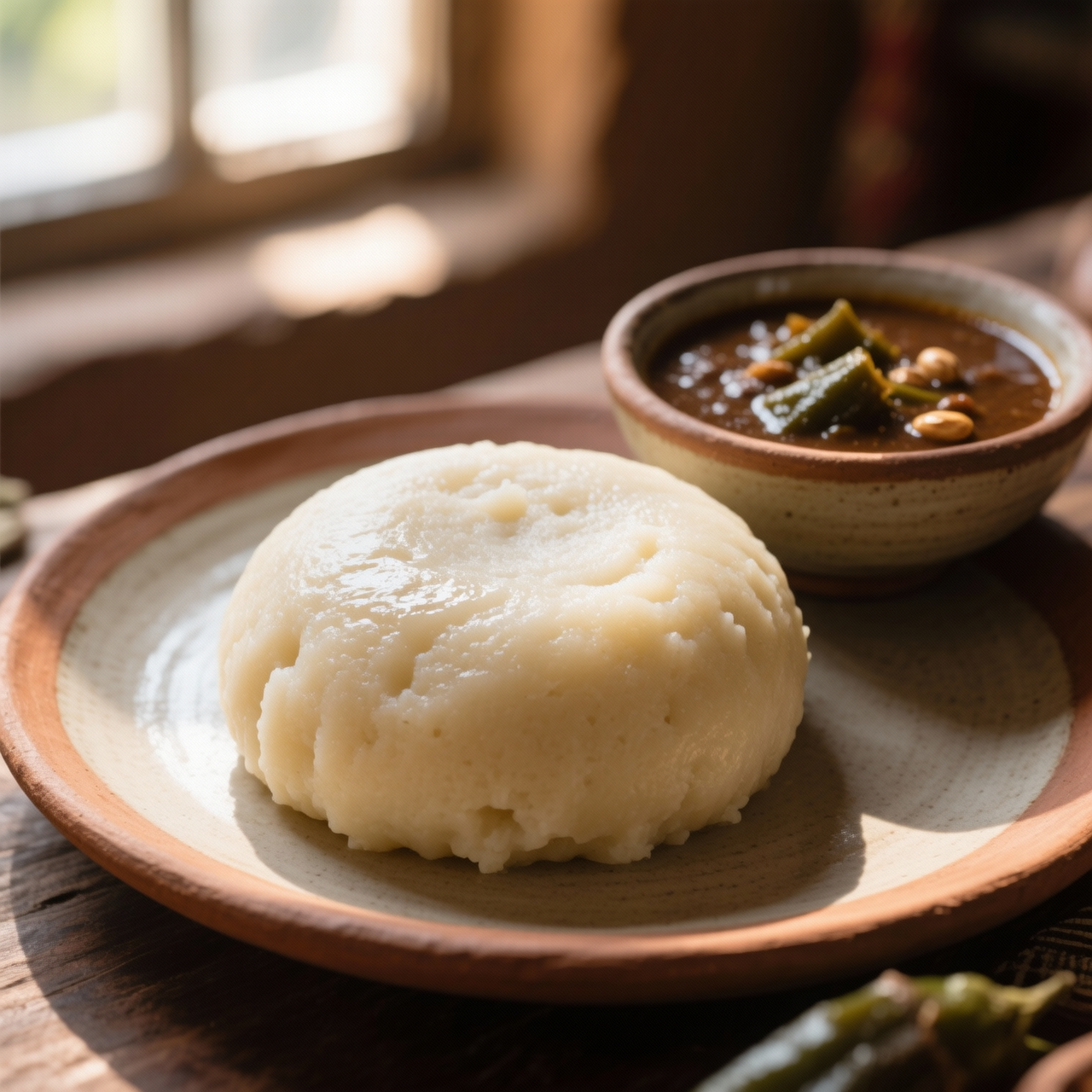
Fufu (pounded cassava)
I still remember the first time I watched my grandmother wrestle a wooden pestle into a heavy clay mortar, her forearms gleaming with effort as she coaxed raw cassava and green plantain into a smooth, resilient dough. That rhythm is the heartbeat of West African dining, where pounded fufu isn’t just a side dish but a cultural anchor, meant to be torn by hand and dipped into rich, simmering stews. Yet so many home cooks today reach for those pale, plastic-wrapped tubs of instant fufu powder from the supermarket aisle. You’ll usually pay around three to four pounds for a box that promises convenience, but what you actually get is a gummy, slightly sour compromise with a powdery mouthfeel that lacks the earthy sweetness and elastic chew of the real thing. Making it from scratch is a small rebellion against industrial shortcuts, and it requires nothing more than patience, a heavy-bottomed pot, and a willingness to work the starch until it surrenders. The most common mistake I see is rushing the hydration or skipping the vigorous folding stage. Cassava and plantain need sustained, rhythmic pounding and turning to develop that signature glossy stretch; if you stop halfway, you’ll end up with a lumpy, crumbly mess that falls apart on the plate. Another pitfall is using old or improperly dried cassava, which can turn bitter and fibrous instead of melting into a velvety swallow. When you take the time to properly cook, mash, and pound it yourself, the result is profoundly satisfying—a dense, pillowy dough that holds its shape, absorbs the heat of a pepper soup, and carries generations of technique in every handful.
Nutrition
| Per serving | Calories | Protein | Carbs | Fat | Sat fat | Fibre | Sugar | Sodium |
|---|---|---|---|---|---|---|---|---|
| beginner | 320kcal | 2g | 78g | 1g | 0g | 5g | 7g | 5mg |
| intermediate | 285kcal | 3g | 68g | 1g | 1g | 4g | 9g | 12mg |
| expert | 295kcal | 2g | 70g | 1g | 0g | 3g | 2g | 10mg |
Per serving · Ava-estimated — a guide, not a clinical figure.
- 1000 gcassava root— peeled, tough central core removed, and cut into uniform chunks
- 250 gplantain(optional)— peeled and sliced
Store-bought instant fufu powder costs around $4 a box and relies heavily on refined cassava starch, artificial stabilizers, and preservatives to mimic the traditional texture. The result is often a gummy, one-note paste that lacks the subtle earthy sweetness and authentic elastic chew of real pounded cassava. This beginner version skips the labor-intensive peeling and grating of raw tubers by starting with pre-peeled frozen cassava and ripe plantain, which you simply boil until tender before pounding. The goal here is a forgiving, foolproof technique that yields a smooth, stretchy dough in under an hour without requiring professional strength. Watch the moisture closely as you work the dough: add hot water one tablespoon at a time to avoid making it sticky, and stop pounding the moment it pulls away cleanly from the sides of the mortar. You will feel the resistance change from grainy to silky. Keep a bowl of warm water nearby to wet your pestle or hands, which prevents sticking and ensures a perfectly cohesive ball. Serve immediately with rich stews or soups, as the texture firms up as it cools.
Equipment
- Heavy-bottomed pot— ensures even boiling without scorching the starch
- Large wooden mortar and pestle— traditional pounding vessel; a heavy stand mixer with dough hook works as a modern substitute
- Colander— for draining hot water quickly
- Small bowl of warm water— for wetting hands and pestle to prevent sticking
Method
- 1
Chop the pre-peeled frozen cassava and plantain into uniform 2-inch chunks.
Use a sturdy chef knife on a stable cutting board.
chopping~ 2 min - 2
Place the chunks in the heavy pot and cover completely with cold water.
Water should sit about two inches above the produce.
submerging~ 1 min - 3
Bring the pot to a rolling boil over high heat, then reduce to a steady simmer.
Cover loosely with a lid to retain steam.
simmering~ 20 min - 4
Pierce a cassava piece with a fork to test for doneness.
The metal should slide through with zero resistance.
testing~ 1 min - 5
Drain the tubers completely and transfer them immediately to the wooden mortar.
Working quickly preserves the natural starch binding properties.
transferring~ 1 min - 6
Pound the hot cassava and plantain while gradually drizzling in hot water.
Add one tablespoon at a time to strictly control hydration.
pounding~ 10 minTricky bit - 7
Fold and turn the dough between strikes until it forms a smooth, glossy ball.
Dip the pestle in warm water frequently to prevent sticking.
kneading~ 5 min - 8
Shape the finished fufu into four equal portions using damp hands.
Serve warm alongside your chosen soup or stew.
portioning~ 2 min
Cooking from frozen
Thaw completely in the fridge, then steam or microwave with a splash of water while kneading vigorously to restore its smooth, elastic stretch.
Storage times are a guide — always use your judgement and store food safely.