
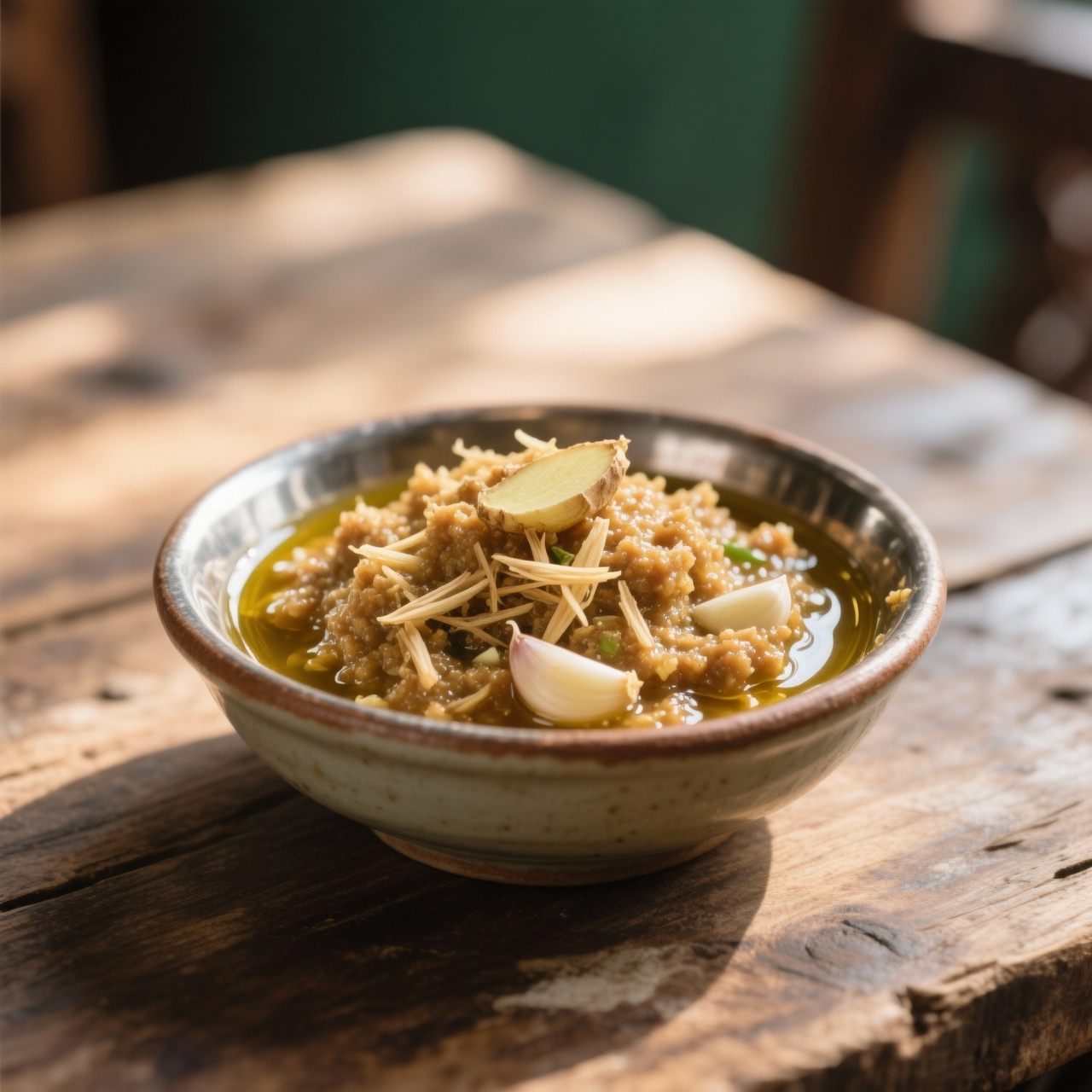
Ginger-Garlic Paste
Ginger-garlic paste is the absolute backbone of Pakistani home cooking, acting as the aromatic foundation that transforms raw ingredients into deeply comforting meals. Long before I started documenting recipes, I watched my grandmother and mother dedicate entire Sunday afternoons to peeling, washing, and stone-grinding these two humble roots. It was never just about convenience; it was a ritual of patience. What many newcomers overlook when trying to recreate this staple is the critical importance of moisture control. If you leave even a trace of water on the ginger or garlic before blending, the paste will ferment prematurely, turning sour and developing an unpleasant bitterness within days. I always pat everything bone-dry, then add a precise splash of neutral oil and a generous pinch of salt to naturally inhibit bacterial growth. Another frequent misstep is over-processing into a watery puree. I prefer a slightly coarse grind because that subtle texture releases its essential oils more gradually when sizzled in hot ghee. This paste bridges the gap between everyday dals and weekend feasts, carrying the unmistakable signature of Pakistani kitchens. When I prepare it in bulk, I portion the mixture directly into ice cube trays, knowing each frozen square holds the exact flavor needed for a dozen future dishes. It is a quiet testament to how a simple, intentional preparation can save countless hours while preserving the soul of the cuisine. Respecting the ingredients means treating this paste not as an afterthought, but as the essential first step that dictates the success of everything that follows.
Nutrition
| Per serving | Calories | Protein | Carbs | Fat | Sat fat | Fibre | Sugar | Sodium |
|---|---|---|---|---|---|---|---|---|
| beginner | 115kcal | 3g | 19g | 4g | 1g | 2g | 2g | 580mg |
| intermediate | 110kcal | 2g | 16g | 5g | 1g | 3g | 2g | 180mg |
| expert | 85kcal | 2g | 14g | 3g | 0g | 3g | 2g | 650mg |
Per serving · Ava-estimated — a guide, not a clinical figure.
- 100 gfresh ginger root— Peeled and roughly chopped
- 100 ggarlic clove— Peeled
- 15 mlneutral vegetable oil— Acts as a preservative for frozen storage
- 5 gsalt— Fine grain for even distribution
This beginner-friendly approach strips away the traditional mortar-and-pestle labor by relying on a standard food processor or high-speed blender. Since we are making a large batch for freezing, efficiency and consistency are your main goals. Instead of worrying about exact peeling techniques, simply use pre-peeled garlic cloves and ginger chunks, which you can find in most grocery stores. The key to success here is managing moisture; too much liquid will create a watery paste that separates in the freezer, while too little will strain your motor. I will walk you through the precise water-to-oil ratio that acts as a lubricant, ensuring a silky-smooth emulsion without burning out your appliance. Watch closely for the telltale visual shift from a chunky mixture to a uniform, vibrant cream. Once processed, you will immediately portion the paste into a standard ice cube tray. This method guarantees you always have a perfectly measured, ready-to-use flavor base on hand, completely eliminating last-minute prep stress for your everyday Pakistani cooking. Just pop out a cube, drop it into your hot pan, and let the aroma do the work.
Equipment
- Food processor or blender— A standard 7-cup model works best
- Silicone ice cube tray— Flexible trays pop out frozen cubes easily
- Rubber spatula— Use to scrape down the processor walls
Method
- 1
Place pre-peeled ginger chunks and garlic cloves into the processor bowl.
Leave enough headspace for the lid to sit flush without pressure.
loading~ 1 min - 2
Pour in neutral oil, a pinch of salt, and exactly two tablespoons of cold water.
The water prevents friction heat from prematurely cooking the raw aromatics.
emulsifying~ 1 min - 3
Pulse the machine in five-second bursts until the mixture transforms into a completely smooth cream.
Stop halfway to scrape down the sides and catch any stubborn chunks.
pulsing~ 2 minTricky bit - 4
Scoop the finished paste into a silicone ice cube tray and smooth the tops with your spatula.
Tap the tray firmly on the counter twice to release trapped air pockets before freezing.
portioning~ 3 min
Cooking from frozen
Pop cubes straight into hot oil; skip thawing to preserve sharp aromatics.
Storage times are a guide — always use your judgement and store food safely.