
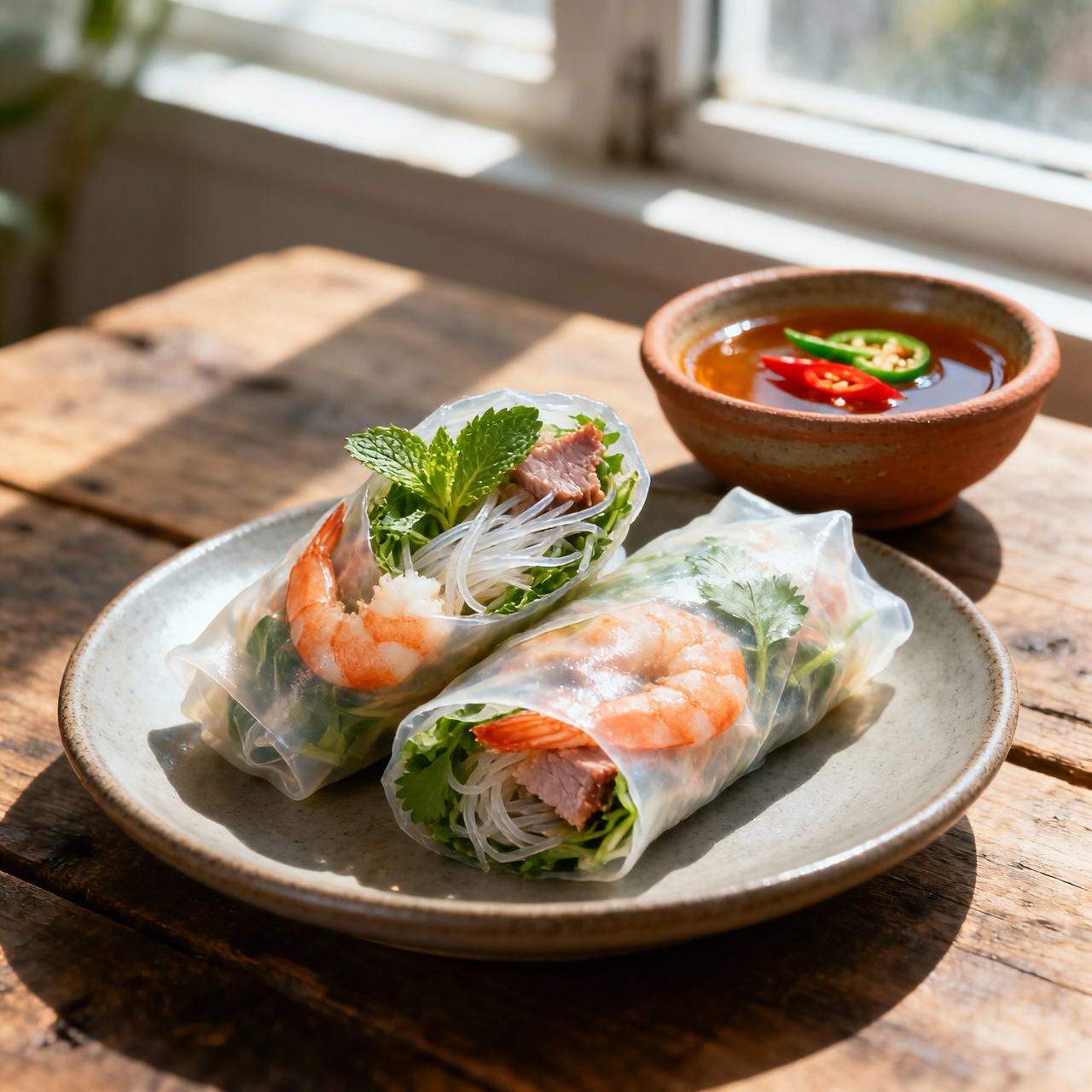
Goi Cuon
I still remember the first time I watched my grandmother’s hands move with that quiet, practiced grace, coaxing translucent rice paper into perfect cylinders. Goi Cuon, often called summer rolls or fresh spring rolls, is not just a snack in Vietnam; it is a quiet celebration of balance. Born in the humid south where heavy meals feel burdensome, these rolls emerged as a lighter alternative to their fried cousins, embracing raw herbs, cool vermicelli, and the clean snap of fresh shrimp or tofu. What makes them matter to me is their honesty. There is nowhere for poor ingredients to hide. Every layer must be intentional. Yet, for all their simplicity, they trip up so many cooks. The most frequent mistake I see is overstuffing the wrapper, which guarantees a tear or a clumsy bite. Another is skipping the damp towel step, leaving the rice paper brittle or, worse, so soggy it collapses. I have learned that patience is not optional here. You must hydrate the paper just enough, lay your fillings neatly in the center, fold the sides with deliberate tension, and roll without rushing. When done right, the roll holds together like a promise. Dip it into a bright nuoc cham or a rich peanut sauce, and you taste the rhythm of Vietnamese home cooking: fresh, precise, and deeply comforting. It is a dish that rewards mindfulness, and once you master it, you will never look at a summer roll the same way again.
Nutrition
| Per serving | Calories | Protein | Carbs | Fat | Sat fat | Fibre | Sugar | Sodium |
|---|---|---|---|---|---|---|---|---|
| beginner | 460kcal | 18g | 68g | 5g | 2g | 3g | 9g | 1125mg |
| intermediate | 460kcal | 18g | 68g | 5g | 2g | 3g | 9g | 1125mg |
| expert | 460kcal | 18g | 68g | 5g | 2g | 3g | 9g | 1125mg |
Per serving · Ava-estimated — a guide, not a clinical figure.
- 12 sheetsRice paper wrapper— 22cm round, traditional grade
- 150 gDried rice vermicelli noodle— thin variety, not glass noodles
- 200 gBoneless pork belly— skinless, evenly thick
- 200 gRaw medium shrimp— peeled and deveined
- 8 piecesButter lettuce leaf— washed and completely dried
- 20 gFresh mint leaf— tender stems removed
- 20 gFresh cilantro sprig— washed thoroughly
- 20 gThai basil leaf— no woody stems
- 1 mediumEnglish cucumber— julienned into matchsticks
- 60 mlFish sauce— traditional grade, first press preferred
- 2 mediumLime— juiced and strained
- 30 gGranulated sugar— white cane sugar
- 4 wholeGarlic clove— peeled
- 2 wholeBird's eye chili— stems trimmed
- 120 mlFiltered water— warm, not hot
At this stage, your priority is mastering the physical architecture of the roll without getting bogged down in complex prep. I recommend leaning on trusted pantry shortcuts for the dipping sauce—a high-quality bottled nuoc cham will give you the right sweet-sour-salty baseline while you focus on handling the wrappers. The real challenge here is moisture management. Rice paper behaves differently depending on your tap water temperature and how aggressively you soak it. You will learn to treat it like a delicate membrane: a quick two-second dip, then a resting period on a damp towel to soften evenly before assembly. Watch for overfilling. Beginners often pack rolls too tightly, which guarantees tearing and gummy textures. Instead, aim for a loose, organized layout. Place your proteins in a neat line, layer herbs flat, and practice the foundational fold-and-tuck motion. Your first few attempts will be imperfect, but consistency builds quickly once you respect the hydration window and keep your work surface dry. Confidence comes from repetition, not perfection. By the time you finish, you will understand the rhythm of assembly and know exactly how to adjust your rolling tension for clean, intact results.
Equipment
- Shallow dipping dish— wide enough to lay a full wrapper flat
- Damp kitchen towel— clean and lint-free
- Sharp chef's knife— for slicing protein
- Small saucepan— for boiling water
Method
- 1
Bring a medium pot of lightly salted water to a gentle simmer.
Water should bubble softly, not violently.
boiling~ 5 min - 2
Poach the pork belly until opaque and firm, then transfer to an ice bath.
Prevents rubbery texture.
poaching~ 10 minTricky bit - 3
Add the rice vermicelli to boiling water, cook until tender, drain, and rinse under cold water.
Stops residual cooking immediately.
blanching~ 3 min - 4
Dip one rice paper wrapper into warm water for exactly three seconds, then lay it flat on a damp towel.
Do not rush this step.
hydrating~ 1 minTricky bit - 5
Layer lettuce, noodles, herbs, cucumber, pork, and shrimp onto the lower third of the wrapper in a single horizontal line.
Keep fillings centered.
assembling~ 2 min - 6
Fold the bottom edge over the filling, tuck the sides inward, and roll upward firmly to seal.
Apply even pressure to avoid gaps.
tucking~ 1 minTricky bit