
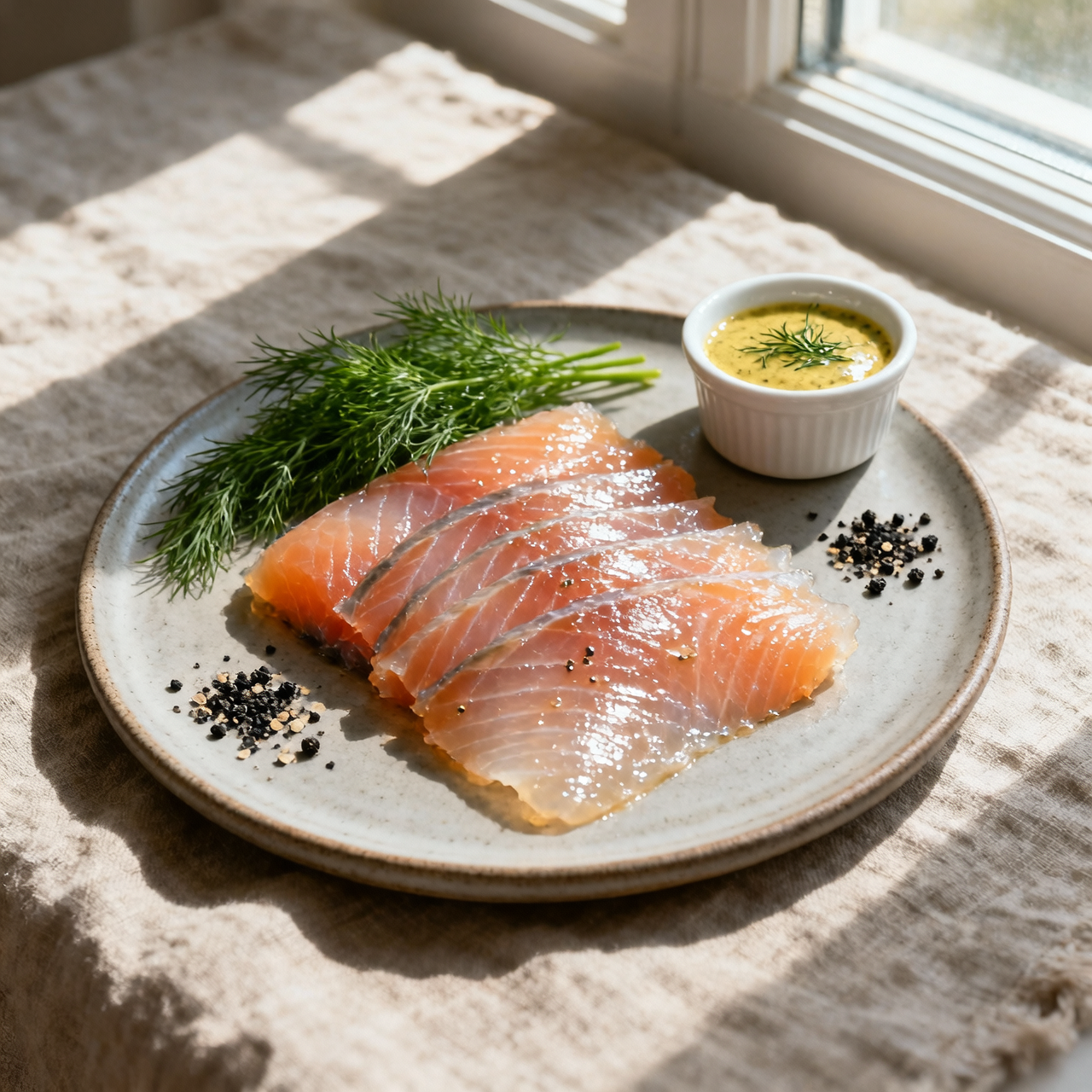
Gravlax
When I first learned to make gravlax, I was struck by how beautifully it captures the Scandinavian instinct for patience. The name itself is a quiet echo of medieval survival: grav for grave, lax for salmon. Long before refrigeration, fishermen would bury salted salmon in the damp sand above the high-tide line, letting natural fermentation preserve it through harsh Nordic winters. Today, we have traded the beach for the refrigerator and swapped fermentation for a precise balance of salt and sugar, but the soul of the dish remains entirely unchanged. It matters deeply to me because it teaches culinary restraint. Gravlax does not mask the fish; it elevates it, coaxing out a delicate sweetness and a firm, translucent texture that only time and careful curing can achieve. Yet, it is remarkably easy to misstep. The most common pitfall is rushing the cure or miscalculating the salt-to-sugar ratio, which leaves the flesh either harshly brined or unpleasantly soft. I have also watched too many cooks skip the essential weight, forgetting that steady pressure draws out moisture evenly and guarantees that silky finish. Freshness is absolutely non-negotiable, and I always seek out the finest fillets with the skin intact. Finally, slicing thinly against the grain at a sharp angle is where the true magic reveals itself. When done right, gravlax is not just a starter; it is a quiet, enduring lesson in trusting the process.
Nutrition
| Per serving | Calories | Protein | Carbs | Fat | Sat fat | Fibre | Sugar | Sodium |
|---|---|---|---|---|---|---|---|---|
| beginner | 403kcal | 35g | 11g | 23g | 4g | 2g | 7g | 1217mg |
| intermediate | 403kcal | 35g | 11g | 23g | 4g | 2g | 7g | 1217mg |
| expert | 303kcal | 26g | 8g | 17g | 3g | 1g | 5g | 913mg |
Per serving · Ava-estimated — a guide, not a clinical figure.
- 1000 gsalmon fillet— skin-on, center-cut, pin bones removed
- 100 gcoarse sea salt— non-iodized preferred
- 100 ggranulated sugar— white, standard
- 15 gwhite peppercorns— whole
- 80 gfresh dill— washed and thoroughly dried
- 30 mlaquavit(optional)— or unflavored vodka
- 45 gwhole grain mustard— traditional coarse grind
- 30 gDijon mustard— smooth consistency
- 25 mlhoney— mild, floral variety
- 1 wholelemon— for zest and juice
This version prioritizes confidence and consistency over tradition. You will use a straightforward dry-cure method that removes guesswork, relying on a simple salt-to-sugar ratio to safely draw moisture from the fish. The biggest advantage here is flexibility; you are encouraged to use a high-quality pre-mixed mustard sauce if you prefer to skip the emulsion step entirely. Watch closely for proper weight distribution during the cure, as an uneven press can leave pockets of raw flesh near the edges. Keep the salmon fully submerged in its own brine, flipping it regularly to guarantee uniform texture. Do not rush the resting phase or rinse the fish under warm water, which can cook the delicate proteins. The goal is a forgiving process that yields silky, translucent slices every time, even if your knife skills are still developing. Trust the clock, maintain steady refrigeration, and let the cure do the heavy lifting.
Equipment
- shallow glass baking dish— non-reactive surface prevents metallic taste
- heavy-duty plastic wrap— food-grade, airtight seal required
- flat dinner plate— acts as a pressing surface
- chef's knife— 8-inch standard blade
Method
- 1
Stir the coarse sea salt, granulated sugar, and cracked white peppercorns together in a medium bowl until fully combined.
A uniform blend prevents uneven curing.
mixing~ 1 min - 2
Pat the salmon fillet completely dry with paper towels and place it skin-side down on a double layer of plastic wrap.
Any surface moisture will dilute the cure.
drying~ 2 min - 3
Brush the aquavit evenly across the exposed flesh of the salmon.
Alcohol acts as a flavor carrier and mild sanitizer.
deglazing~ 1 min - 4
Press the salt-sugar mixture firmly and evenly over the entire flesh side of the fish.
Ensure no bare spots remain to prevent spoilage.
seasoning~ 3 minTricky bit - 5
Cover the seasoned surface completely with the fresh dill sprigs.
Overlap the fronds like roof tiles for full coverage.
layering~ 2 min - 6
Wrap the salmon tightly in the plastic, place it in the baking dish, and set a plate on top with heavy cans for weight.
Pressure expels moisture and firms the texture.
weighting~ 2 min - 7
Refrigerate the weighted salmon for forty-eight hours, turning the package over every twelve hours.
Rotate gently to redistribute the accumulated brine.
resting~ 4320 min - 8
Remove the plastic, rinse the salmon briefly under cold water, and pat it thoroughly dry.
Rinsing removes excess salt for a balanced finish.
rinsing~ 2 min - 9
Combine the whole grain mustard, Dijon mustard, honey, and lemon zest in a bowl, or whisk in a high-quality pre-mixed mustard-dill sauce for a faster alternative.
Taste and adjust sweetness if using a commercial base.
blending~ 2 min - 10
Slice the gravlax thinly on a sharp diagonal, leaving the skin behind, and arrange the slices on a chilled platter.
Use gentle sawing motions to avoid tearing.
slicing~ 3 minTricky bit