
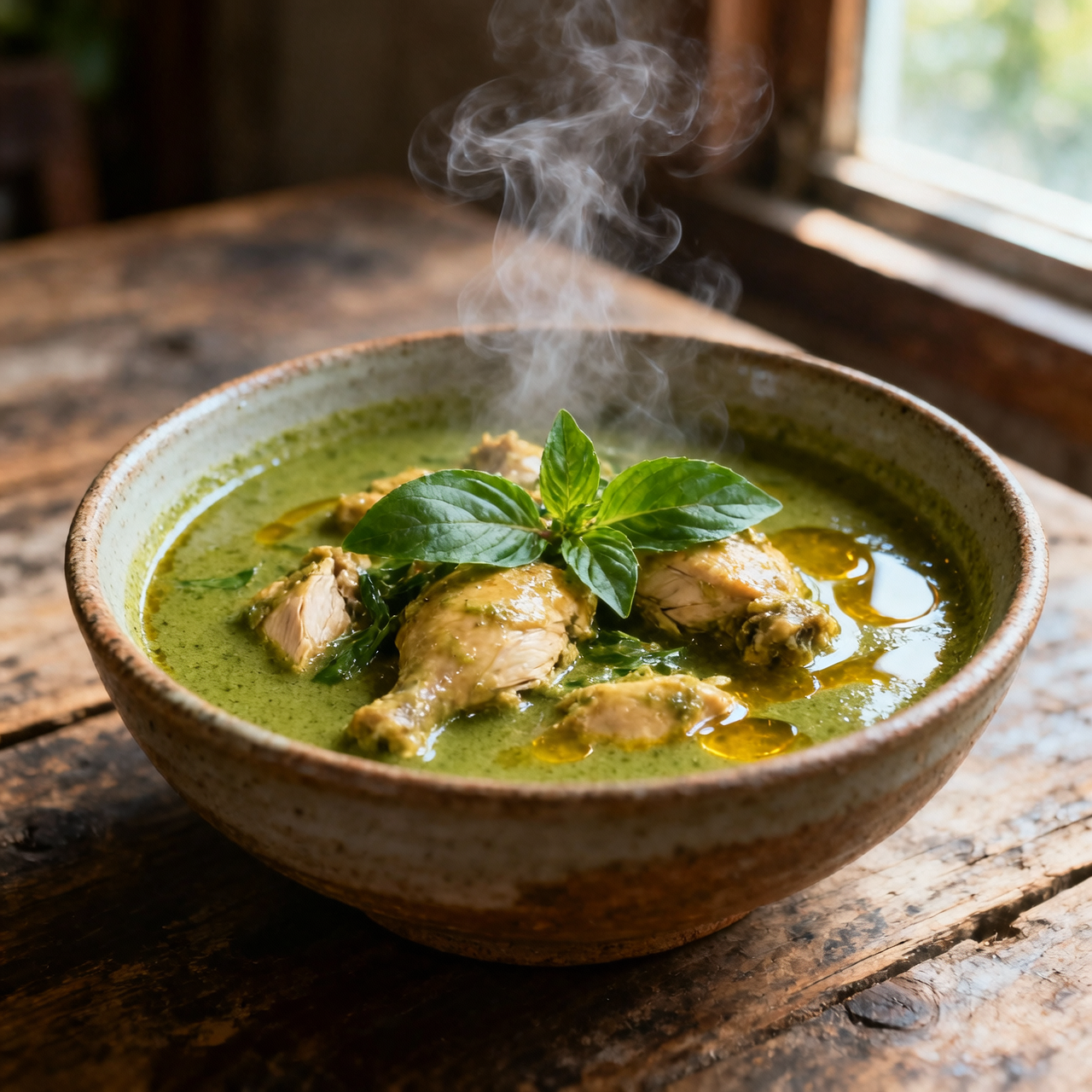
Green Curry
When I first learned to pound the vibrant green curry paste by hand, I realized how deeply Thai cuisine relies on harmony rather than heat. This dish traces its roots to the central plains of Thailand, where early cooks adapted Chinese stir-fry techniques to local ingredients, eventually crafting a curry defined by its fresh, herbal brightness rather than heavy spice. To me, green curry isn’t just a bowl of comfort; it’s a living lesson in balance. The interplay of sweet coconut milk, salty fish sauce, sharp lime leaves, and the subtle bite of green chilies teaches patience and precision. I’ve watched too many home cooks rush the foundation, tossing commercial paste straight into boiling liquid and wondering why the result tastes flat and one-dimensional. The real secret lies in toasting the paste in the thick cream of coconut milk first, coaxing out the essential oils until the kitchen fills with a fragrant, almost floral aroma. Another common misstep is drowning the curry in too much broth or adding vegetables all at once, which turns the sauce watery and mutes those delicate herbal notes. I always simmer the aromatics gently, letting the curry thicken naturally before folding in tender proteins and quick-cooking greens. When done right, each spoonful carries the lush humidity of a Thai morning, a reminder that great food doesn’t shout—it whispers, waits, and rewards those who listen closely.
Nutrition
| Per serving | Calories | Protein | Carbs | Fat | Sat fat | Fibre | Sugar | Sodium |
|---|---|---|---|---|---|---|---|---|
| beginner | 610kcal | 31g | 18g | 46g | 9g | 2g | 7g | 1080mg |
| intermediate | 610kcal | 31g | 18g | 46g | 9g | 2g | 7g | 1080mg |
| expert | 610kcal | 31g | 18g | 46g | 9g | 2g | 7g | 1080mg |
Per serving · Ava-estimated — a guide, not a clinical figure.
- 600 gchicken thigh— boneless, skinless, cut into bite-sized pieces
- 400 mlcoconut milk— full-fat, unsweetened
- 10 pcsgreen chili— fresh Thai bird's eye or serrano, adjust to taste
- 60 gshallot— peeled and roughly chopped
- 30 ggarlic— peeled
- 20 ggalangal— fresh, peeled and sliced
- 2 stalkslemongrass— tender inner core only, thinly sliced
- 15 gcoriander root— washed thoroughly
- 15 gshrimp paste— fermented, toasted if raw
- 6 pcskaffir lime leaf— fresh or frozen, torn to release oils
- 30 gthai basil— stems removed
- 45 mlfish sauce— high-quality, clear amber
- 20 gpalm sugar— grated or finely chopped
- 150 gbamboo shoot— pre-cooked, rinsed and drained
- 30 mlvegetable oil— neutral, for frying paste
This version prioritizes clarity and confidence over complexity. You will follow a straightforward, linear process designed to eliminate guesswork while still delivering authentic flavor. The key difference here is the streamlined paste preparation and forgiving timing windows. Instead of chasing exact oil separation, you will rely on visual and aromatic cues that are easy to recognize. Watch the heat closely when adding coconut milk; gentle simmering prevents curdling and ensures a silky texture. If you feel overwhelmed by the raw aromatics, a quick pulse in a food processor replaces the traditional mortar and pestle without sacrificing the essential flavor base. The most common mistake at this stage is rushing the protein. Give the chicken time to sear briefly before the liquid is introduced, which locks in moisture and prevents a boiled texture. Keep your ingredients prepped and measured before lighting the stove. Taste the broth halfway through cooking and adjust the salt-to-sugar balance gradually. Remember that green curry should taste bright and layered, not overwhelmingly spicy. Trust the simmer, stir occasionally, and finish with fresh herbs off the heat. You will have a deeply satisfying, restaurant-quality bowl with minimal stress.
Equipment
- Heavy-bottomed pan— non-stick is fine here
- Food processor(optional)— or high-quality jarred paste
- Wooden spatula— for gentle stirring
Method
- 1
Blend the shallots, garlic, galangal, lemongrass, coriander root, green chilies, and shrimp paste into a smooth paste, or substitute with a high-quality jarred green curry paste.
Pulse in short bursts to avoid overheating.
blending~ 1 min - 2
Heat the vegetable oil in a heavy-bottomed pan over medium heat and add the prepared paste.
Stir constantly until fragrant and slightly darkened.
blooming~ 2 min - 3
Pour in half of the coconut milk and stir continuously until the mixture thickens.
Look for oil pooling at the edges as a visual cue.
splitting~ 3 minTricky bit - 4
Add the chicken pieces and toss thoroughly to coat.
Cook until the exterior turns opaque.
searing~ 3 min - 5
Pour in the remaining coconut milk and bring the liquid to a gentle simmer.
Add the bamboo shoots and torn kaffir lime leaves now.
simmering~ 5 min - 6
Season with fish sauce and palm sugar.
Stir until dissolved and taste for balance.
seasoning~ 1 min - 7
Remove from heat immediately and fold in the Thai basil leaves.
Let rest for two minutes before serving.
wilting~ 2 min