
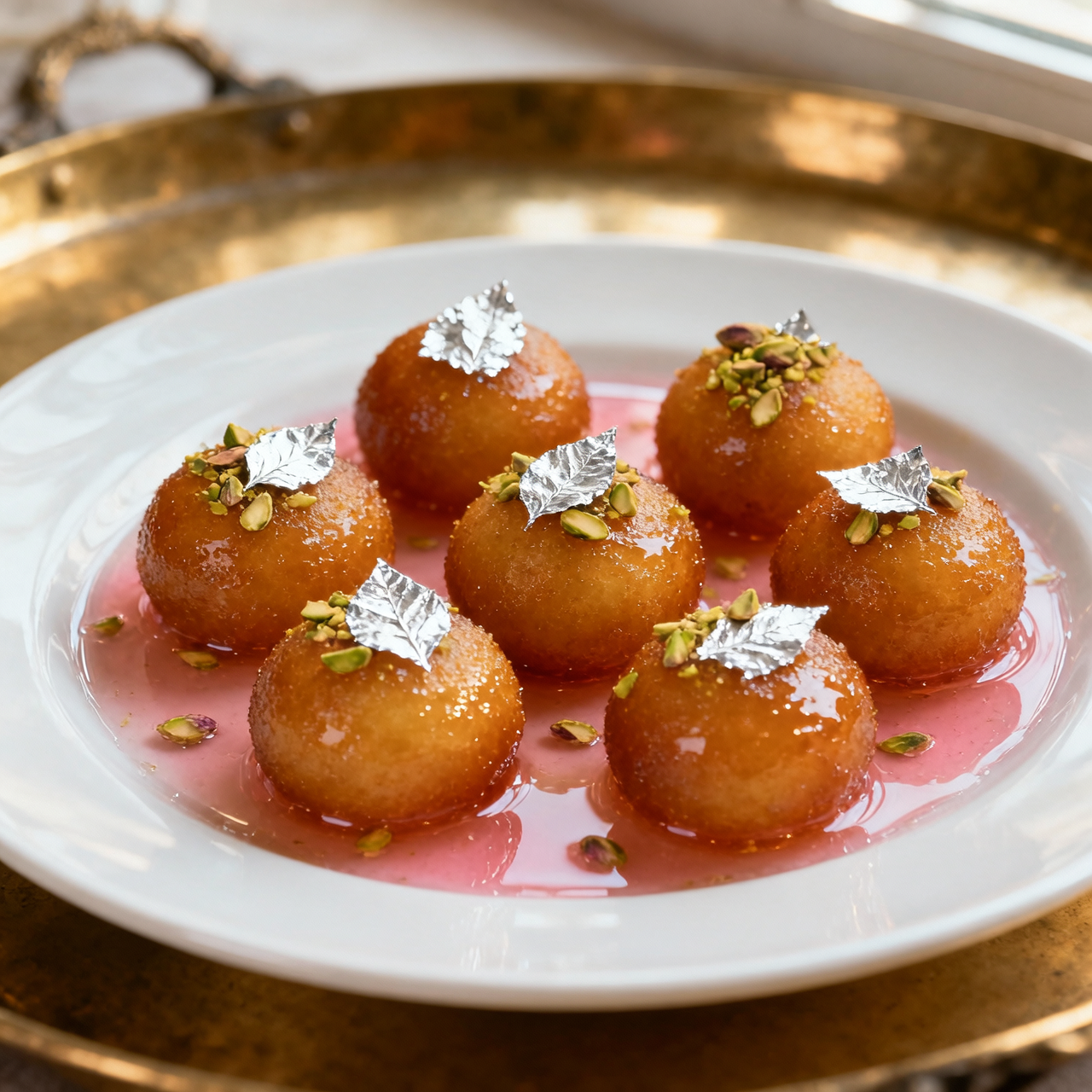
Gulab Jamun
When I first learned to craft gulab jamun, I was chasing a memory rather than simply following a recipe. The name itself carries a poetic lineage, whispering of ancient Persian roots where gulab denotes fragrant rose water and jamun references the dark, sweet berry the finished sweet so elegantly mimics. Carried across historic trade routes and lovingly reimagined by Indian kitchens that traded wheat for slow-simmered milk solids, it has firmly anchored itself as the golden crown of our celebratory tables. To me, this dessert matters profoundly because it operates as a tactile bridge between generations, proving that true comfort can be kneaded by hand, carefully fried, and steeped in quiet patience. Yet, its apparent simplicity remains a beautiful deception, one that routinely ensnares eager home cooks in a cycle of disappointment. The most frequent mistake I witness is forcing the dough, kneading it with heavy hands until the proteins bind too tightly, yielding dense, rubbery spheres instead of cloud-soft pillows. Oil temperature is equally merciless; if the heat climbs too quickly, the exterior hardens before the center can bloom, while lukewarm fat turns them into heavy, greasy sponges. The syrup demands the exact same delicate attention. Boiled past the thread stage, it refuses to penetrate the fried exterior; left too thin, it dilutes the delicate milk flavor into a watery mess. I always remind myself to treat the dough like a fragile secret, maintain a gentle, steady simmer for frying, and allow room-temperature syrup to work its slow, osmotic magic. Success here never comes from rigid timers or exact measurements, but from cultivating a quiet intuition for texture and heat until the perfect balance finally reveals itself on your tongue.
Nutrition
| Per serving | Calories | Protein | Carbs | Fat | Sat fat | Fibre | Sugar | Sodium |
|---|---|---|---|---|---|---|---|---|
| beginner | 765kcal | 15g | 104g | 32g | 15g | 1g | 95g | 325mg |
| intermediate | 765kcal | 15g | 104g | 32g | 15g | 1g | 95g | 325mg |
| expert | 765kcal | 15g | 104g | 32g | 15g | 1g | 95g | 325mg |
Per serving · Ava-estimated — a guide, not a clinical figure.
- 200 gMilk powder— full-fat preferred, sifted
- 50 gAll-purpose flour— sifted
- 2 gBaking soda— freshly opened
- 30 mlGhee— melted and slightly cooled
- 120 mlWhole milk— room temperature
- 300 gGranulated sugar— refined white
- 300 mlWater— filtered
- 4 pcsGreen cardamom pod— lightly crushed
- 10 mlRose water— food grade
- 500 mlVegetable oil— neutral high smoke point
At the beginner level, we prioritize consistency over improvisation. You will work with the exact same ingredients as the traditional recipe, but the technique is engineered for forgiveness. The dough is mixed just until combined to prevent toughness, and we rely on a thermometer to remove guesswork from frying temperatures. The syrup is brought to a precise boil and cooled slightly before soaking, guaranteeing even absorption without splitting. I have built in clear visual checkpoints so you never wonder if the dough is ready or the oil is too hot. This version embraces measured pacing: gentle kneading, careful rolling, and controlled frying. Watch for the golden-brown blush that signals perfect caramelization. If your batch feels dense, do not worry; resting and soaking will soften them. The goal is to build muscle memory and confidence without overwhelming you with dough variables. Follow the steps exactly, respect the timing cues, and you will achieve restaurant-quality results on your first attempt.
Equipment
- Heavy-bottomed pan— non-stick is fine here
- Digital candy thermometer— clip-on preferred
- Slotted spoon— stainless steel
Method
- 1
Whisk the milk powder, all-purpose flour, and baking soda together in a large mixing bowl.
Ensure no lumps remain before adding liquids.
whisking~ 1 min - 2
Drizzle in the melted ghee and room temperature milk, then knead gently until a soft, pliable dough forms.
Stop immediately when cracks disappear; overworking makes them tough.
kneading~ 3 min - 3
Cover the dough with a damp cloth and let it rest on the counter.
Do not refrigerate at this stage.
resting~ 10 min - 4
Combine the sugar, water, and crushed cardamom pods in a heavy-bottomed pan and bring to a boil.
Target exactly 104 degrees Celsius, then remove from heat.
simmering~ 7 min - 5
Heat the vegetable oil in a separate deep pan to exactly 145 degrees Celsius.
Use the thermometer; lower heat prevents cracking.
temperature control~ 5 minTricky bit - 6
Roll the dough into smooth, crack-free balls and slide them gently into the hot oil.
Keep the flame low and stir constantly to ensure even coloring.
deep-frying~ 8 minTricky bit - 7
Transfer the fried balls directly into the warm syrup and let them soak.
Turn occasionally for uniform absorption.
soaking~ 15 min