
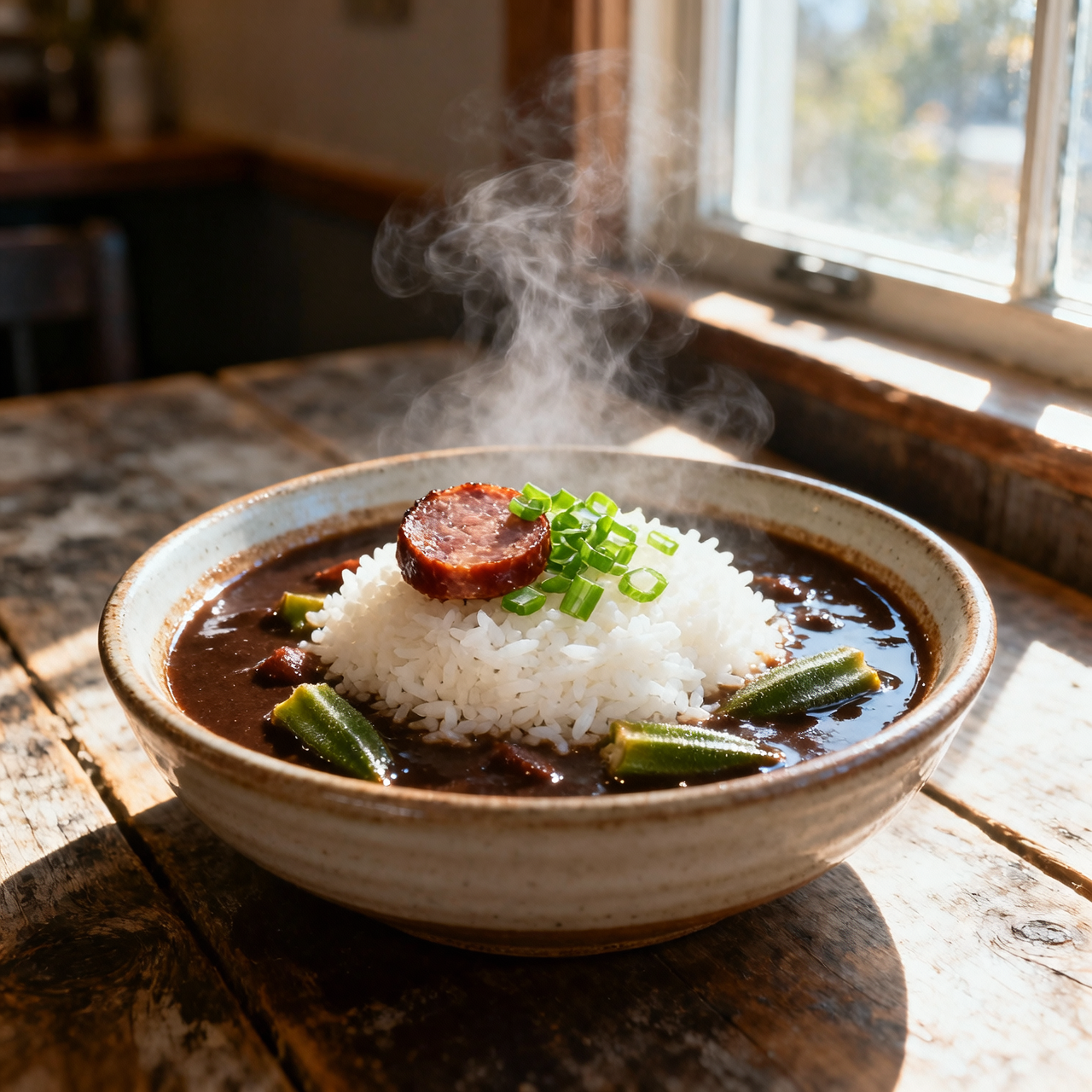
Gumbo
I’ve always believed that gumbo isn’t just a dish; it’s a living archive of the Gulf South. Born in the marshlands where West African, French, Spanish, and Indigenous foodways collided, it’s a culinary negotiation written in roux and okra. When I first stood over a heavy Dutch oven as a young cook, I quickly learned that gumbo demands patience and respect. It matters because it refuses to be rushed or rigidly standardized—every parish, every family, every kitchen has its own rhythm, yet the soul remains the same: deep, layered, and deeply communal. But that freedom is also where most cooks stumble. The most frequent mistake I see is treating the roux as an afterthought. A proper dark roux isn’t about speed; it’s about controlled, unwavering attention. You stir constantly, watching the flour and fat shift from peanut butter to polished mahogany, knowing that a single moment of distraction can turn hours of labor into bitter ruin. Another common pitfall is overcrowding the pot with too many competing proteins or skipping the holy trinity’s slow sweat. Gumbo isn’t a catch-all; it’s a carefully balanced conversation between earth, sea, and smoke. You have to let the flavors build in stages, giving each ingredient time to surrender its essence to the broth. When you finally taste it, properly rested and ladled over a mound of white rice, you’re not just eating a stew—you’re tasting generations of resilience, adaptation, and love. And that’s worth every minute of vigilance.
Nutrition
| Per serving | Calories | Protein | Carbs | Fat | Sat fat | Fibre | Sugar | Sodium |
|---|---|---|---|---|---|---|---|---|
| beginner | 750kcal | 34g | 83g | 31g | 7g | 5g | 5g | 1580mg |
| intermediate | 750kcal | 34g | 83g | 31g | 7g | 5g | 5g | 1580mg |
| expert | 750kcal | 34g | 83g | 31g | 7g | 5g | 5g | 1580mg |
Per serving · Ava-estimated — a guide, not a clinical figure.
- 220 gandouille sausage— smoked, fully cooked
- 340 gshrimp— peeled and deveined, tails on
- 180 gyellow onion— finely diced
- 120 gcelery— finely diced
- 140 ggreen bell pepper— finely diced
- 60 gall-purpose flour— for roux base
- 60 mlneutral oil— vegetable or canola
- 1000 mlchicken stock— unsalted, low-sodium preferred
- 200 gokra— fresh, sliced into 1cm rounds
- 10 gfilé powder— ground sassafras leaves
- 8 gkosher salt— adjust to taste
- 3 gcayenne pepper— ground
- 15 gfresh parsley(optional)— chopped, for garnish
- 300 gwhite rice— long-grain, cooked for serving
This version strips away the intimidation of traditional gumbo by leaning on reliable pantry shortcuts without sacrificing soul. You will use a pre-made dark roux base to bypass the notoriously finicky flour-and-oil browning process, ensuring a rich, nutty foundation every time. I have structured the steps to walk you through layering flavors safely, starting with the holy trinity and moving steadily to the simmer. Watch the pot closely when adding the stock; it will seize and bubble violently before smoothing out into a velvety stew. The goal here is confidence, not perfection. Keep your heat at a steady medium to prevent scorching the bottom, and taste as you go to adjust seasoning. By the time the shrimp turn pink and the okra loses its raw bite, you will have a deeply satisfying bowl that proves you belong in the kitchen. Trust the timing cues provided, and do not rush the final simmer.
Equipment
- Heavy-bottomed Dutch oven— non-stick coating is acceptable
- Silicone whisk— for smooth roux integration
- Measuring spoons— standard set
Method
- 1
Heat a large Dutch oven over medium heat until warm.
Surface should feel hot but not smoking.
preheating~ 1 min - 2
Add the neutral oil and jarred roux base, stirring until completely melted.
Whisk constantly to prevent sticking.
melting~ 2 min - 3
Stir in the diced onion, celery, and bell pepper.
Cook until translucent and fragrant.
sweating~ 5 min - 4
Pour in half of the chicken stock while whisking vigorously.
The mixture will thicken immediately before loosening.
deglazing~ 1 minTricky bit - 5
Add the remaining stock, sliced sausage, and okra.
Bring to a gentle bubble, not a rolling boil.
simmering~ 15 min - 6
Nestle the shrimp into the broth and cook until opaque.
Do not overcook or they will become rubbery.
poaching~ 3 min - 7
Remove from heat and whisk in the filé powder and cayenne.
Stir until fully dissolved.
seasoning~ 1 min - 8
Ladle the gumbo over cooked white rice and garnish with parsley.
Serve immediately while hot.
plating~ 1 min