
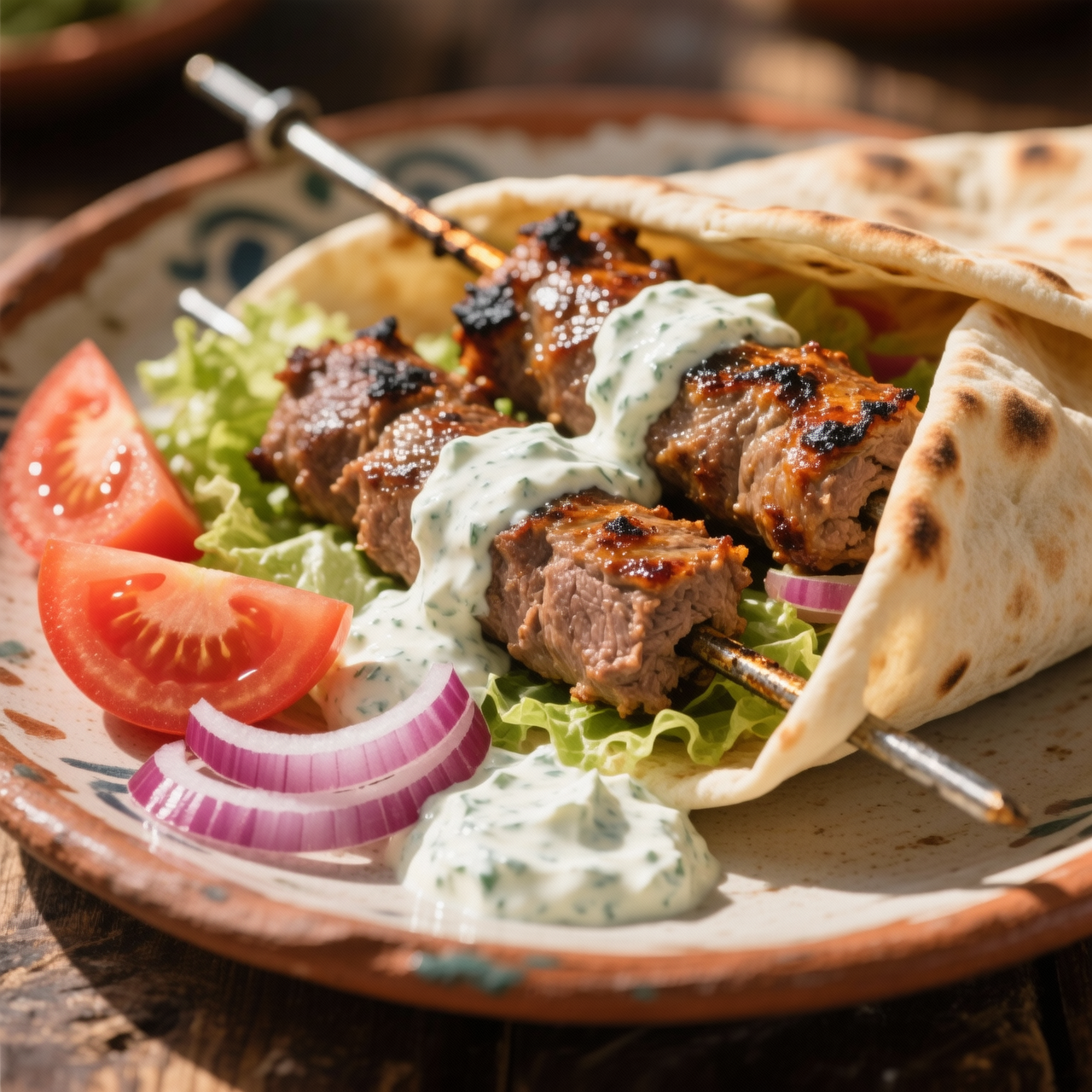
Gyros (spit-style meat)
When I first encountered proper gyros in Athens, it was never about the thin, grey deli slices that crowd supermarket freezers back home. Those mass-produced rolls cost barely two pounds, but they’re packed with binders, excessive sodium, and artificial smoke that masks the complete absence of real meat flavour. True gyros began as a street-food adaptation of Ottoman döner, brought to Greece by refugees and perfected with local pork, oregano, and slow vertical roasting. Recreating that at home matters because it reclaims control over your protein, swapping chemical stabilisers for honest, recognisable ingredients. The biggest mistake people make is treating it like a quick marinade job. You cannot rush the stack. I always see beginners skipping the crucial resting phase, slicing too thick, or drowning the meat in cheap spice packets that burn bitter in the oven. The real magic lies in layering thin, hand-pounded pork cutlets with a dry rub of garlic, smoked paprika, oregano, and a touch of olive oil, then compressing them tightly so they roast into a unified, sliceable log. Without a commercial vertical rotisserie, a standard home oven does the job beautifully if you respect the low-and-slow approach and finish with a brief high-heat blast for crisp edges. It takes patience, but the payoff is a deeply savoury, herbaceous stack that actually tastes like the Mediterranean coast rather than a factory floor. You will never look back at those rubbery pre-sliced rolls once you experience how a proper, from-scratch loaf shaves cleanly off the knife, delivering a texture and depth that processed versions simply cannot replicate.
Nutrition
| Per serving | Calories | Protein | Carbs | Fat | Sat fat | Fibre | Sugar | Sodium |
|---|---|---|---|---|---|---|---|---|
| beginner | 385kcal | 32g | 3g | 26g | 7g | 1g | 1g | 460mg |
| intermediate | 380kcal | 28g | 4g | 28g | 9g | 1g | 2g | 720mg |
| expert | 560kcal | 38g | 2g | 42g | 15g | 1g | 1g | 750mg |
Per serving · Ava-estimated — a guide, not a clinical figure.
- 1000 gpork shoulder— trimmed of excess fat and cut into uniform chunks
- 60 mlolive oil
- 45 mllemon juice— freshly squeezed
- 15 ggarlic— finely minced
- 10 gdried oregano— preferably Greek variety
- 18 gkosher salt
- 5 gblack pepper— freshly ground
- 5 gsweet paprika(optional)
- 150 gyellow onion— finely grated, excess moisture removed
- 3 gdried thyme(optional)
This beginner-friendly version strips away the intimidating rotisserie setup and replaces it with a foolproof oven-stacked loaf method. Store-bought deli gyros meat typically costs eight to ten dollars per pack and relies heavily on phosphates, fillers, and excessive sodium to retain moisture, leaving you with a mushy texture and one-dimensional flavor. Here, you will build a clean, aromatic spice paste from scratch using whole garlic, dried oregano, and pantry staples. The technique focuses on two crucial habits: packing the seasoned pork tightly into a loaf pan to mimic traditional spit density, and slicing thin only after a full rest period. Watch the internal temperature closely, as overcooking will dry out lean shoulder cuts. The covered bake ensures gentle, even cooking while the brief final broil creates those signature caramelized edges without demanding constant rotation or specialized gear. You will end up with tender, deeply seasoned meat that shaves cleanly, proving that authentic street-food results only require patience and proper layering, not expensive equipment.
Equipment
- Food processor or blender— Standard countertop size works best for paste
- 9x5-inch loaf pan— Light-colored metal prevents over-browning
- Instant-read thermometer— Essential for checking safe internal temperature
- Sharp chef’s knife— Keep it honed for clean, thin slices
Method
- 1
Pulse garlic cloves, red onion, olive oil, red wine vinegar, dried oregano, sweet paprika, ground cumin, salt, and black pepper in a food processor until a smooth paste forms.
Scrape down the sides twice to avoid uneven chunks.
emulsifying~ 1 min - 2
Toss two pounds of cubed pork shoulder with the spice paste until every piece is thoroughly coated.
Wear gloves if you prefer to keep hands clean.
marinating~ 2 min - 3
Pack the seasoned meat firmly into a parchment-lined loaf pan, pressing down hard to eliminate air gaps.
A flat-bottomed glass works perfectly for compacting.
compacting~ 3 minTricky bit - 4
Cover the pan tightly with foil and bake until a thermometer inserted into the center reads one hundred fifty-five degrees Fahrenheit.
Do not skip the thermometer check for food safety.
slow roasting~ 45 min - 5
Transfer the baked loaf to a cutting board and let it rest for twenty minutes before carefully lifting out the parchment.
Resting allows the proteins to relax and retain juices.
resting~ 20 min - 6
Shave the meat into thin strips using a sharp chef’s knife or a sturdy carving fork.
Angle the blade at forty-five degrees for wider, tender slices.
shaving~ 5 minTricky bit - 7
Spread the slices on a baking sheet and broil on high for three to four minutes until the edges crisp and brown.
Watch closely to prevent burning from the rendered fat.
broiling~ 4 minTricky bit
Cooking from frozen
Thaw overnight in the fridge, then slice thinly and warm gently in a covered dish at 160°C for 15 minutes.
Storage times are a guide — always use your judgement and store food safely.