
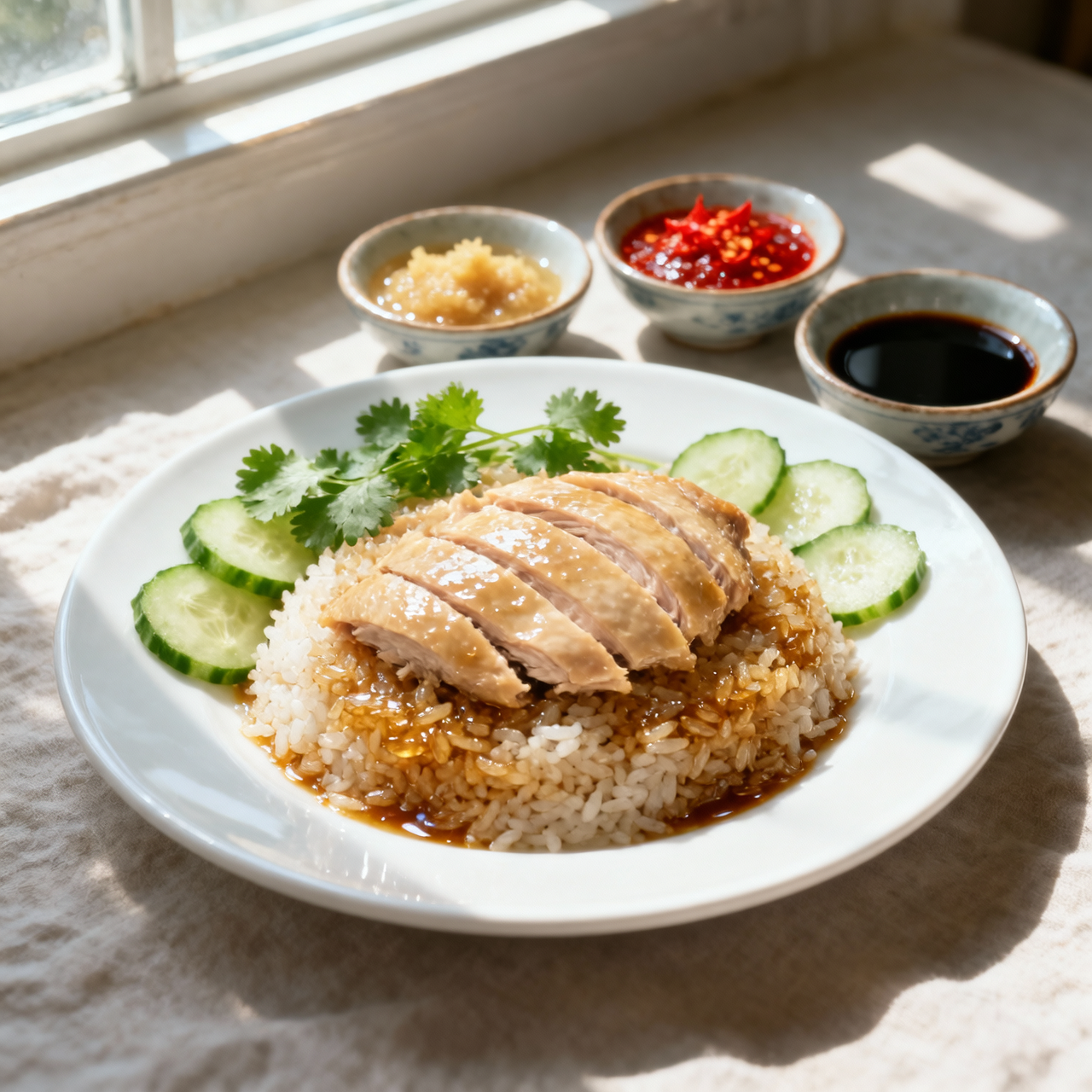
Hainanese Chicken Rice
I first encountered Hainanese chicken rice in the bustling hawker centres of Singapore, where its unassuming appearance belies a profound culinary legacy. Born from the resourcefulness of early Hainanese immigrants who adapted their homeland’s poached chicken to local ingredients and tastes, this dish evolved into a national emblem of Singaporean identity. What makes it truly remarkable is its deceptive simplicity; it demands reverence for technique rather than a pantry of exotic spices. The chicken must be gently poached at a precise simmer to yield impossibly tender meat with a glossy, gelatinous skin, while the rice absorbs the rich, ginger-infused broth and toasted aromatics until every grain carries a fragrant, buttery depth. Yet, this very simplicity is where most cooks falter. I’ve seen countless attempts ruined by boiling the chicken too vigorously, which toughens the flesh and strips away that signature silkiness, or by under-toasting the garlic and ginger before cooking the rice, leaving the dish tasting flat and one-dimensional. Another frequent misstep is neglecting the dipping trio—chili, ginger, and dark soy—each calibrated to complement, not overpower, the delicate balance of the main components. To master this dish is to embrace patience, precision, and a deep respect for restraint. It’s not merely about feeding the body; it’s about honoring generations of culinary adaptation, where every careful simmer and measured grain whispers a story of migration, resilience, and quiet perfection. When done right, it feels like tasting history itself, warm and comforting on the plate.
Nutrition
| Per serving | Calories | Protein | Carbs | Fat | Sat fat | Fibre | Sugar | Sodium |
|---|---|---|---|---|---|---|---|---|
| beginner | 920kcal | 46g | 82g | 42g | 12g | 2g | 2g | 1050mg |
| intermediate | 920kcal | 46g | 82g | 42g | 12g | 2g | 2g | 1050mg |
| expert | 920kcal | 46g | 82g | 42g | 12g | 2g | 2g | 1050mg |
Per serving · Ava-estimated — a guide, not a clinical figure.
- 1500 gwhole chicken— preferably free-range
- 400 gjasmine rice— rinsed and thoroughly drained
- 60 gfresh ginger— unpeeled for poaching, peeled for sauces
- 30 ggarlic cloves— divided between broth and condiments
- 50 gscallions— white and green parts separated
- 4 leavespandan leaves— fresh or frozen
- 15 mlsesame oil— toasted
- 45 mlchicken fat— rendered or substitute with neutral oil
- 15 gkosher salt
- 3 gwhite pepper— finely ground
- 30 mllight soy sauce— regular or tamari
- 15 mlrice vinegar
- 40 gred chilies— fresh
- 10 gcilantro
- 200 gcucumber— thinly sliced for garnish
- 5 mldark soy sauce(optional)— for rice coloring
This pathway is designed for your first confident attempt, prioritizing accessibility without sacrificing the dish’s soul. You will lean on a trusted jarred chili-ginger paste and pre-toasted rice seasoning to bypass the most time-intensive prep, allowing you to focus entirely on mastering the gentle poach. The critical lesson here is temperature control: keep your liquid at a bare simmer, never a rolling boil, to prevent the chicken from turning stringy. Watch for the subtle pull-back of the leg joint to gauge doneness, and trust the ice bath completely. It is your insurance policy for that signature gelatinous skin. When toasting the rice, stir constantly until the grains turn translucent around the edges to prevent mushiness later. I have streamlined the dipping sauce into a quick blend, but I urge you to taste and adjust the vinegar until the heat sings rather than burns. The rice cooker will handle the hydration, leaving you free to slice, plate, and appreciate how a few reliable shortcuts can still yield a deeply comforting, restaurant-adjacent result. Focus on the rhythm of simmer, chill, and rest, and you will quickly graduate to building every element from scratch.
Equipment
- Large stockpot— must fit whole chicken
- Rice cooker— standard or fuzzy logic
- Ice bath bowl— large enough to submerge bird
- Chef's knife— sharp for clean slicing
Method
- 1
Fill a large stockpot with water, add half the ginger and scallion whites, then bring to a boil before lowering to a gentle simmer.
Keep bubbles barely breaking the surface.
poaching~ 5 min - 2
Submerge the whole chicken carefully, skin-side up, and maintain the low simmer until juices run clear.
Do not cover tightly.
submerging~ 30 minTricky bit - 3
Transfer the cooked bird directly into a prepared bowl of ice water until completely chilled.
Let it rest for ten minutes minimum.
shocking~ 10 min - 4
Rinse the rice thoroughly, then stir in the pre-mixed rice seasoning and rendered fat until evenly coated.
Drain well to prevent soggy rice.
coating~ 2 min - 5
Add the seasoned rice to a rice cooker with water, close the lid, and cook until the cycle completes.
Use the standard white rice setting.
steaming~ 25 min - 6
Combine the jarred chili paste, soy sauce, rice vinegar, and sesame oil in a small bowl and whisk until smooth.
Adjust sweetness to taste.
emulsifying~ 1 min - 7
Carve the chilled chicken into bite-sized pieces, arrange over the fluffed rice with cucumber slices, and serve immediately.
Wipe knife between cuts for clean edges.
plating~ 3 min