
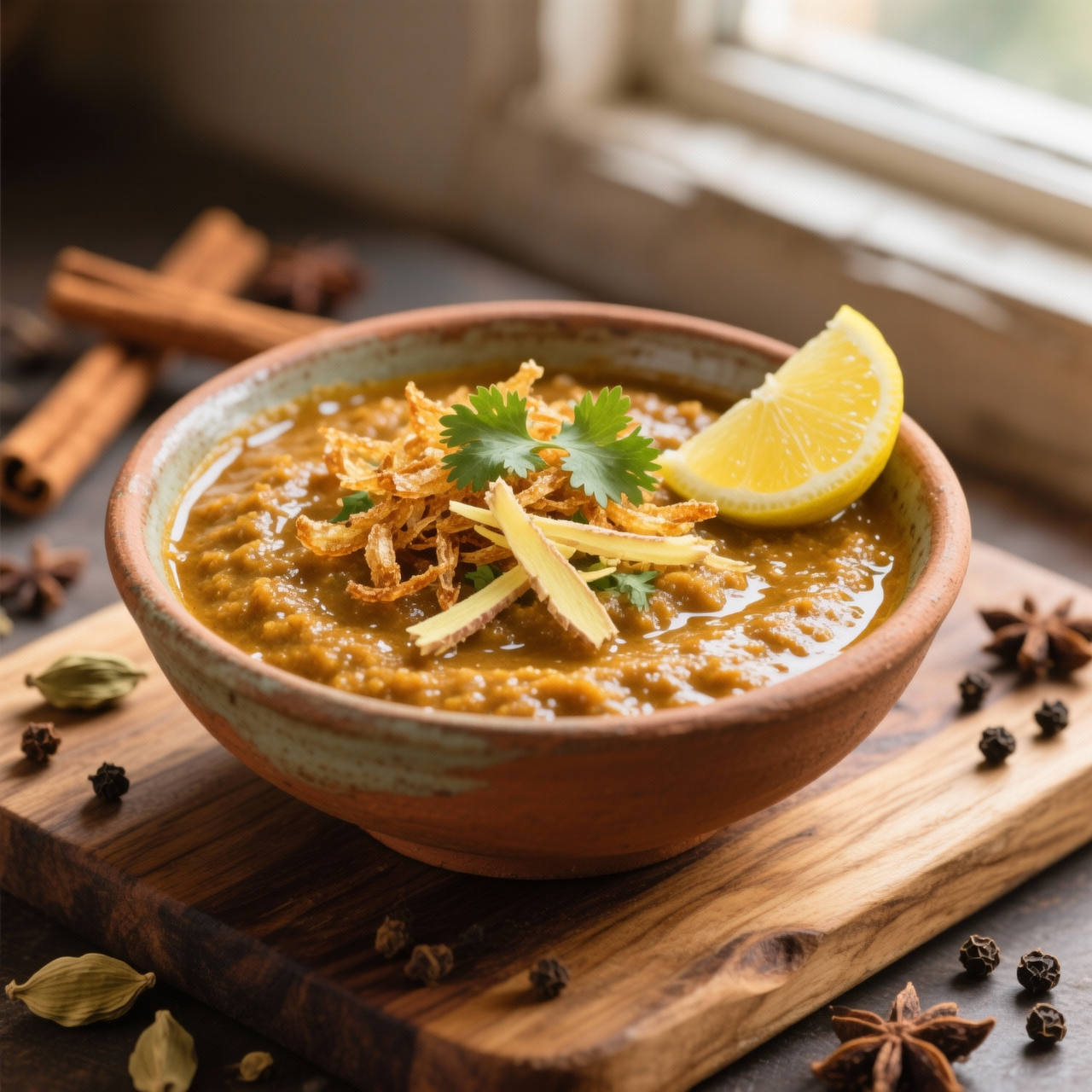
Haleem
I’ve always believed that Haleem is less a recipe and more a testament to patience, a slow-simmered conversation between wheat, barley, lentils, and meat that unfolds over hours. Its roots stretch back to the Arab harissa, but as it traveled through Persian courts and settled into the subcontinent, it transformed into something distinctly ours. In Pakistan, it’s not just a dish; it’s a communal ritual, a monsoon companion, and a Ramadan staple that binds families around steaming pots and shared spoons. I remember my grandmother’s kitchen, where the rhythmic stirring of the heavy degchi was almost meditative, a practice passed down through generations of women who understood that true flavor cannot be rushed. Yet, for all its beauty, Haleem is notoriously unforgiving to the impatient cook. The most common mistake I see is rushing the pounding process, leaving the meat and grains in distinct, unblended pockets rather than coaxing them into that signature velvety, homogenous texture. Another frequent misstep is under-toasting the spices or adding the oil too early, which dulls the complex layers of garam masala, ginger, and fried onions that should sing through every bite. Some try to shortcut the overnight soaking or rely on pressure cookers without adjusting the liquid ratios, ending up with a watery, separated mess instead of the rich, cohesive stew it’s meant to be. When you approach it with reverence, allowing the grains to break down naturally and the collagen to melt into the broth, you’re rewarded with something profoundly comforting—a dish that tastes like heritage itself.
Nutrition
| Per serving | Calories | Protein | Carbs | Fat | Sat fat | Fibre | Sugar | Sodium |
|---|---|---|---|---|---|---|---|---|
| beginner | 880kcal | 38g | 75g | 47g | 17g | 18g | 4g | 1450mg |
| intermediate | 880kcal | 38g | 75g | 47g | 17g | 18g | 4g | 1450mg |
| expert | 880kcal | 38g | 75g | 47g | 17g | 18g | 4g | 1450mg |
Per serving · Ava-estimated — a guide, not a clinical figure.
- 500 gBeef chuck— cut into large chunks
- 150 gWheat berry— rinsed and drained
- 50 gHulled barley— rinsed and drained
- 50 gSplit chickpea— rinsed and drained
- 50 gRed lentil— rinsed and drained
- 50 gYellow split pea— rinsed and drained
- 300 gYellow onion— peeled and roughly chopped
- 40 gFresh ginger root— peeled
- 30 gGarlic clove— peeled
- 60 gUnsalted butter— or clarified ghee
- 40 mlNeutral oil— for frying
- 2000 mlWater— plus more as needed
- 10 gCumin seed— whole
- 10 gCoriander seed— whole
- 5 gBlack peppercorn— whole
- 5 gGround turmeric— powdered
- 10 gKashmiri chili powder— finely ground
- 15 gFine sea salt— to taste
- 2 pieceLemon— quartered
- 30 gFresh cilantro— roughly chopped
- 20 gFresh mint leaf— roughly chopped
This version strips away the intimidation factor by leaning on reliable shortcuts without sacrificing the soul of the dish. We replace the lengthy spice-toasting process with a high-quality, jarred haleem masala paste, which guarantees balanced flavor from the very first stir. The technique focuses on visual and tactile cues rather than strict timers, guiding you through the exact moment the grains surrender and the meat shreds effortlessly. You will use an immersion blender for the final breakdown, which safely replicates the traditional hand-beaten texture in a fraction of the time. Watch closely during the simmering phase; a gentle bubble is your friend, but a rolling boil will cause the starches to scorch and separate. The goal here is consistency and confidence. By following these structured checkpoints, you will achieve a rich, cohesive stew that feels deeply comforting and entirely your own. Master this foundation, and you will quickly develop the intuition needed to refine the process on your own terms.
Equipment
- Large heavy pot— at least six quart capacity
- Immersion blender— stick attachment
- Kitchen tongs— heat-resistant
Method
- 1
Rinse all grains and lentils until the water runs clear, then combine them with the beef chunks and water in a large heavy pot.
Do not skip rinsing; excess surface starch causes scorching.
soaking~ 5 min - 2
Add the jarred haleem paste, turmeric, chili powder, and salt to the pot and stir until evenly distributed.
Paste should coat the back of a spoon.
blooming~ 2 min - 3
Cover and bring to a gentle simmer, then reduce heat to low and cook uncovered for sixty minutes.
Maintain a lazy bubble, not a rolling boil.
simmering~ 60 minTricky bit - 4
Remove the pot from the heat and use tongs to shred any remaining large pieces of meat against the side of the pot.
Meat should yield to gentle pressure.
shredding~ 5 min - 5
Submerge an immersion blender and pulse the mixture in short bursts until smooth and cohesive.
Stop immediately once a porridge-like texture forms.
emulsifying~ 3 minTricky bit - 6
Stir in the chopped ginger, cilantro, and mint, then ladle into bowls with lemon wedges on the side.
Garnishes should be added off-heat to preserve brightness.
finishing~ 2 min