
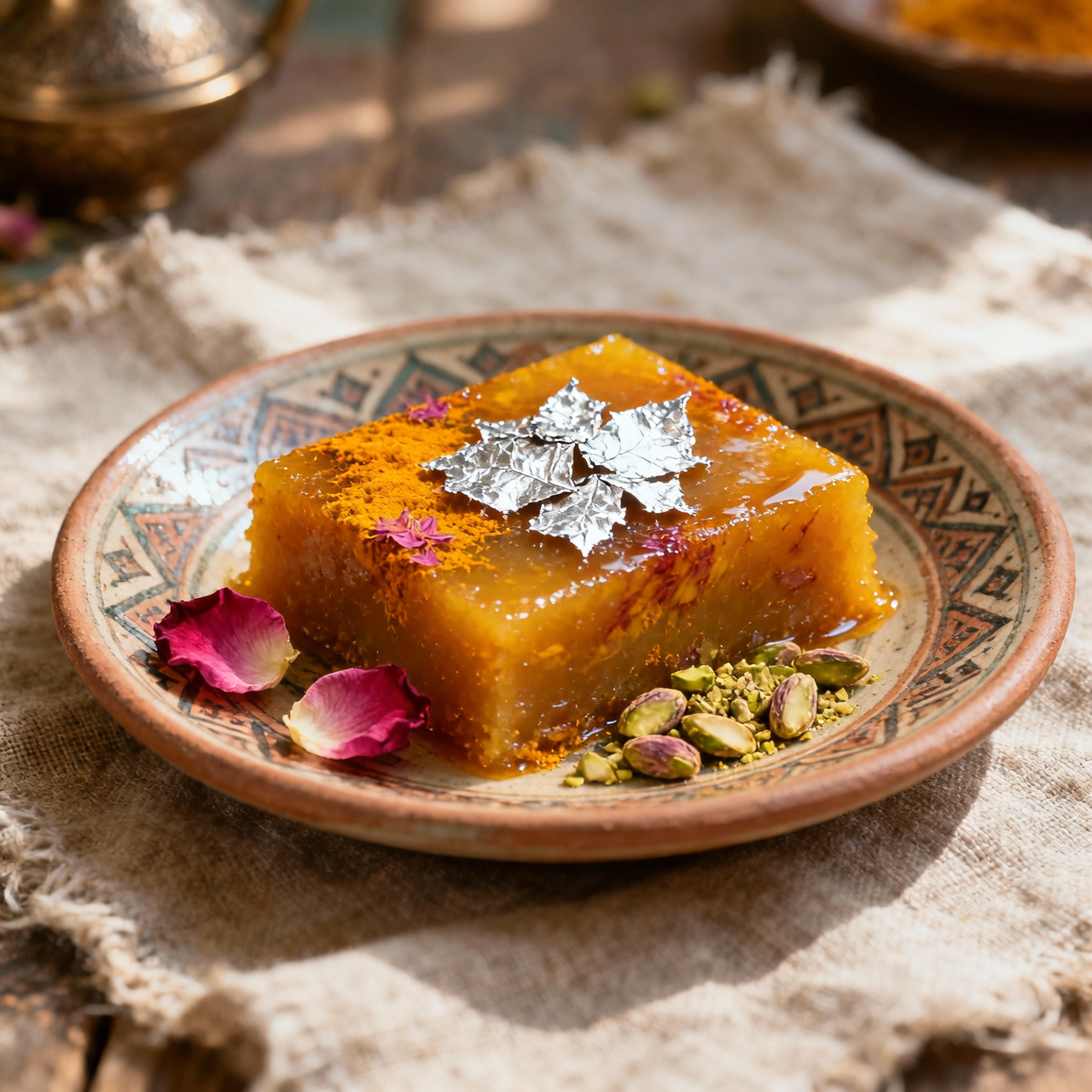
Halva (saffron-rosewater)
I still remember the exact moment I realized the halva sitting on supermarket shelves was a pale imitation of what a proper Persian kitchen produces. Those cardboard boxes, usually priced around six dollars, promise convenience but deliver a dense, waxy block propped up by hydrogenated oils, artificial rose essence, and enough refined sugar to mask a complete absence of toasted depth. True halva is an exercise in patience, born in Iranian teahouses where wheat flour, butter, sugar, and fragrant saffron-rosewater syrup are carefully coaxed into a single, melt-in-your-mouth confection. I share this recipe because eating a from-scratch version fundamentally changes your understanding of this sweet. The process looks simple, which is precisely why so many cooks fail. The most common pitfall is rushing the flour toast, which either leaves a raw, doughy taste or pushes the wheat past golden into a bitter, scorched territory. Equally treacherous is the syrup stage. If your saffron-rosewater liquid is not hot enough when it hits the buttered flour, the mixture will split and turn greasy. If it boils violently, it will seize into a hard, unworkable mass. Constant stirring and temperature control are your only real tools here. I refuse to allow packet mixes, jarred pastes, or industrial shortcuts at any skill level. By dry-toasting your own flour, blooming real saffron threads, and simmering simple syrup with genuine rosewater, you reclaim a centuries-old tradition that actually delivers on its promises. It is a quiet victory over mass-produced sweets, and once you taste that warm, floral silk, you will never buy a box again.
Nutrition
| Per serving | Calories | Protein | Carbs | Fat | Sat fat | Fibre | Sugar | Sodium |
|---|---|---|---|---|---|---|---|---|
| beginner | 490kcal | 4g | 68g | 22g | 14g | 2g | 50g | 40mg |
| intermediate | 545kcal | 6g | 59g | 31g | 19g | 2g | 37g | 95mg |
| expert | 490kcal | 5g | 64g | 22g | 13g | 2g | 54g | 140mg |
Per serving · Ava-estimated — a guide, not a clinical figure.
- 200 gWheat flour— Sifted to ensure even toasting and prevent clumping
- 150 gUnsalted butter— Can be substituted with ghee for a richer flavor
- 250 gGranulated sugar— Fine grain dissolves more readily in the syrup
- 300 mlWater— Room temperature is ideal for syrup preparation
- 0.5 gSaffron— Bloom in 2 tablespoons of hot water for 10 minutes before use
- 60 mlRosewater— Use culinary-grade to avoid artificial aftertastes
- 2 gGround cardamom— Freshly ground provides the best aromatic profile
- 30 gSlivered pistachio(optional)— Reserved for garnish after the halva sets
This beginner-friendly version strips away the intimidation of traditional Persian halva while strictly honoring the from-scratch standard. Store-bought halva typically costs four to six dollars per small box, relying on hydrogenated vegetable oils, artificial flavorings, and a dense, chalky texture that masks the true floral notes of rosewater and saffron. By making it at home with just flour, butter, sugar, and real aromatics, you achieve a luxuriously silky, melt-in-your-mouth crumb for a fraction of the price. The key difference here is a lower-heat, whisk-heavy method that eliminates the risk of burning or sudden clumping when adding the hot syrup. Watch your flour closely during the toasting phase; it should smell deeply nutty and turn a pale golden color, not brown. When combining the syrup and flour base, maintain steady, rhythmic whisking to encourage a smooth emulsion before the mixture rapidly thickens. Pour the finished halva into a lined dish and let it rest undisturbed. As it cools, the structure will firm into clean, elegant slices ready to serve with afternoon tea.
Equipment
- Heavy-bottomed pan— non-stick is fine here
- Small saucepan— for syrup preparation
- Silicone whisk— essential for smooth emulsification
- 8x8 inch baking dish— lined with parchment paper
Method
- 1
Steep a pinch of saffron threads in two tablespoons of hot water for ten minutes.
Crush the threads lightly between your fingers before adding water to maximize color release.
steeping~ 10 min - 2
Combine granulated sugar, water, rosewater, and the steeped saffron in a small saucepan over medium heat.
Do not let it boil vigorously, as this will drive off the delicate floral aroma.
reducing~ 4 min - 3
Simmer gently until the sugar fully dissolves, then remove from heat and keep the syrup warm.
Warm syrup incorporates into flour much more smoothly than cold syrup.
blooming~ 3 min - 4
Melt butter in a heavy-bottomed pan over medium-low heat, then add flour and whisk constantly.
A wide pan exposes more surface area to prevent hot spots and scorching.
rouxing~ 5 minTricky bit - 5
Cook the flour mixture until it turns pale golden and releases a rich, toasted wheat scent.
Lower the heat immediately if you see any darkening edges.
toasting~ 5 min - 6
Carefully pour the warm syrup into the flour base while whisking vigorously to prevent lumps.
The mixture will seize and bubble; keep whisking until it smooths out.
tempering~ 1 minTricky bit - 7
Continue cooking and stirring for two minutes until the halva pulls away from the pan sides, then transfer to a lined dish to cool completely before slicing.
Press the surface flat with a spatula before it sets for clean, professional edges.
setting~ 2 min
Cooking from frozen
Thaw overnight in the refrigerator, then bring to room temperature and stir gently to restore its silky texture.
Storage times are a guide — always use your judgement and store food safely.